A Spacing Rehearsal Should Teach the Cast What the Theater Changes
By Broadwaytrax Content Studio · August 21, 2026
The short answer: a musical-theater spacing rehearsal should teach the company what changes when the show leaves the rehearsal room and enters the actual theater.
Distances become longer. Entrances take more time. Singers may hear less of the accompaniment. The playback operator may lose sight of a cue. A scene change that fit inside a taped floor plan may now arrive late against a fixed track.
The goal is not to polish the whole production. It is to identify which differences belong to the room, which belong to the staging, and which require a real change to the playback plan.
What is a spacing rehearsal in musical theater?
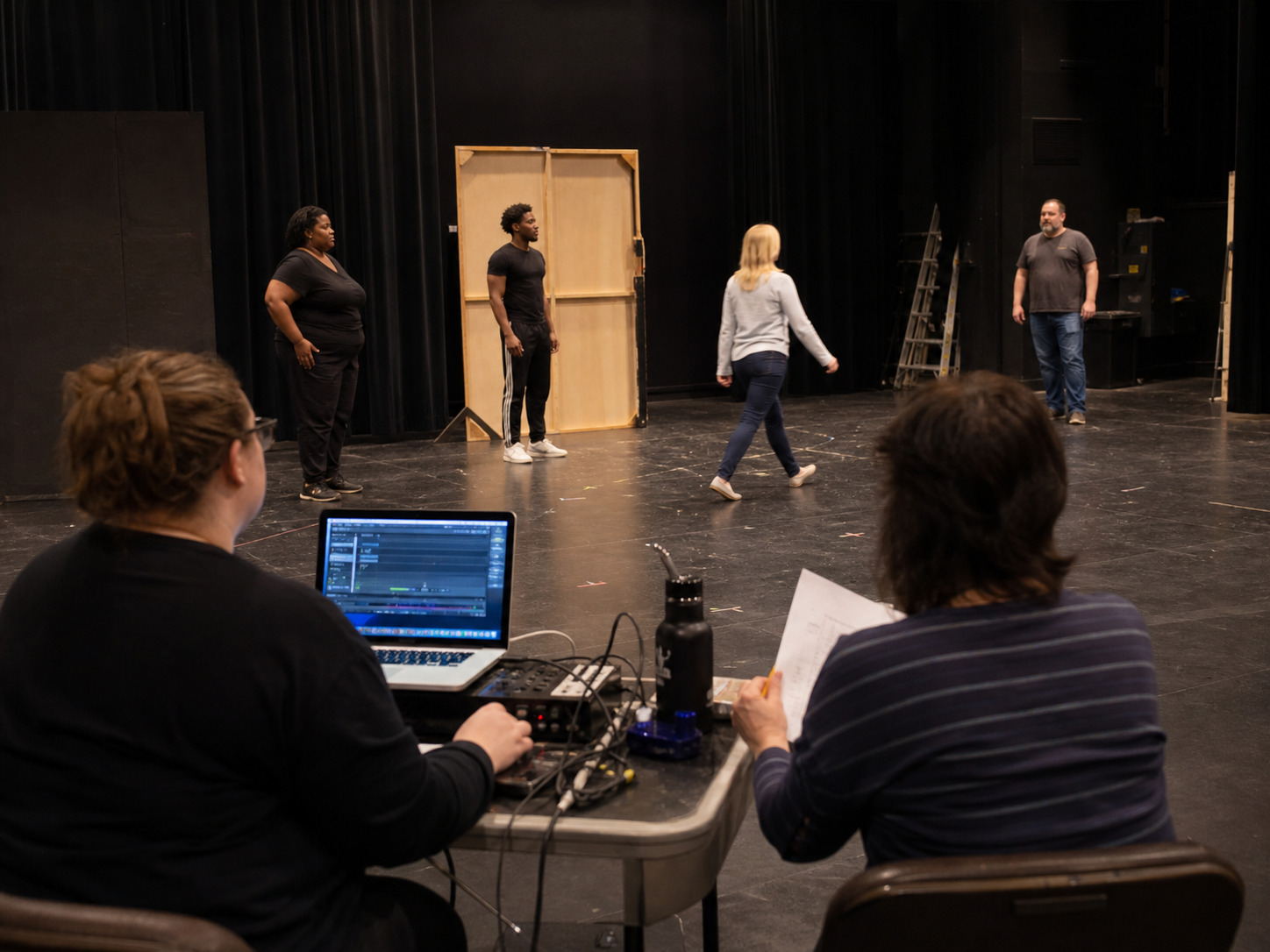
A spacing rehearsal is an early session in the performance venue that gives performers and production staff time to adjust blocking, traffic, sightlines, entrances, exits, and technical handoffs to the real stage.
The company may mark vocals or choreography instead of performing at full effort. Scenery, microphones, monitors, costumes, and lighting may still be incomplete. That is normal. The rehearsal is useful when it exposes how the physical room changes the show before a full technical run makes every department wait.
For a musical using backing tracks, spacing also needs an audio question: can each performer travel through the real space and still find the cue, introduction, first entrance, internal landmark, and ending?
Bring one approved playback package into the theater
Do not use the venue move as a reason to rebuild the file list from memory.
Bring the same approved rehearsal package the cast already knows:
- cue number and song title;
- exact performance filename;
- key, cut, tempo, and ending;
- spoken or visual trigger;
- count-in, lead-in, vamp, or pickup information;
- safe restart point;
- next line, movement, or technical event;
- and primary and backup playback locations.
Keep guide-vocal files separate from accompaniment-only files. Old keys, old cuts, test exports, and personal practice copies should not sit beside the show files.
The Broadwaytrax (backing-track cue-sheet guide) gives the wider document structure. The spacing rehearsal should test whether that document still makes sense from the positions people will actually use.
Walk the room before running a number
Begin without playback.
Ask the cast and crew to walk the longest musical paths at a practical marking pace:
- the entrance before a song;
- the travel during an introduction;
- any cross that leads into a first lyric;
- the distance to a dance-break position;
- the route during a scene change or vamp;
- the exit after the final chord;
- and the path into the next line or cue.
Time the actual route. Check doors, stairs, wings, crossover space, furniture, orchestra rails, masking, and backstage traffic. A taped rehearsal floor may have been accurate in scale but still could not reproduce a narrow wing, a longer crossover, or a sightline blocked by scenery.
Do not request a longer intro merely because the cast is seeing the stage for the first time. First confirm that the path, pace, and cue are settled enough to judge.
Test what performers can hear from where they stand
A track that sounded clear in the rehearsal room can feel completely different in an auditorium.
Test exposed entrances from the places where performers actually sing:
- far upstage;
- behind scenery or masking;
- in a wing before an entrance;
- on a staircase or upper level;
- near a loudspeaker;
- far from a monitor;
- and in an ensemble formation where other voices change what each singer hears.
Listen for the first useful landmark, not just overall volume. A singer may hear the track but miss the soft pickup that tells them when to breathe. A dancer may hear bass in the room but not the rhythmic detail needed for the first count.
Adjusting the sound system and changing the track are different actions. Use the (musical-theater sound-check checklist) to investigate level, speaker coverage, monitors, balance, and playback equipment before deciding that the audio file itself is wrong.
Run every musical cue from its real approach
Starting at the first downbeat hides the question spacing is meant to answer.
For each important number:
- Start one spoken line, entrance, or movement before the cue.
- Let the real cue owner release playback.
- Use the operator position planned for the show.
- Continue through the first vocal or movement entrance.
- Jump to any travel-heavy internal section, dance break, vamp, or transition.
- Run the ending and the event that follows it.
The company does not need to perform every verse. It does need to prove the edges where physical distance and fixed music meet.
This is different from a (cue-to-cue rehearsal). Spacing establishes where people and cues can function in the venue. Cue-to-cue later tests the full technical sequence across departments.
Separate room problems from track problems
The first day in a theater creates strong opinions. Give each problem a short diagnosis before approving a revision.
| What happened | Check before editing the track | Useful next proof |
|---|---|---|
| Singer missed the opening | Could they hear the actual pickup from their position? | Repeat after monitor or position adjustment |
| Actor reached the mark after the intro | Is the route settled and free of traffic? | Time the same approved path twice |
| Dance entrance felt late | Did everyone receive the same count and landmark? | Mark the lead-in from the real cue |
| Operator started too early | Could the operator see or hear the cue owner? | Choose one visible or called release signal |
| Scene change outlasted the music | Is the change plan complete and repeatable? | Time the approved transition before requesting a vamp |
| Ending covered dialogue | Did the room balance or dialogue pace change? | Test level and pickup before requesting a new ending |
| Cast lost the restart | Is there a named file position and stage reset? | Rehearse one internal recovery point |
Record observations with measurements when possible. “Intro feels short” is vague. “The upstage-left entrance takes 11 seconds at the approved pace; the first vocal pickup arrives after 8 seconds” gives the team a problem it can solve.
Give cue ownership a sightline check
A cue can be perfectly written and still fail when the people involved cannot see or hear one another.
Stand at the conductor, stage-management, wing, and playback positions. Confirm:
- who owns the start;
- whether the release is called, visual, musical, or a combination;
- whether the operator can receive it without turning away from playback;
- whether the performer hears a reliable landmark;
- who releases a vamp or hold;
- and what happens if the cue is late or missed.
Avoid building a cue that depends on several people making the same judgment at once. The operator needs one unambiguous instruction.
If the stage manager calls the show, use stage-management cue numbers on the playback map. If the conductor releases a musical entrance, document what the operator follows. Keep the language consistent between the calling script, track sheet, and rehearsal notes.
Use partial effort without collecting false evidence
Spacing rehearsals often protect voices and bodies by marking.
That choice should be explicit. A marked run can prove distance, traffic, cue visibility, and file order. It may not prove vocal balance, choreography stamina, microphone behavior, or the timing of movement performed at full scale.
Label each observation:
- proved in the room;
- conditional because the section was marked;
- untested because equipment or scenery was missing;
- or ready for the next technical rehearsal.
This prevents a production from treating an incomplete test as final evidence—or from repeating work the spacing rehearsal already settled.
Approve a custom edit only after the need repeats
The venue may reveal a legitimate need for a different lead-in, cut, tempo, vamp, cue point, or ending. Confirm that the need remains after the staging, route, cue owner, and sound coverage are stable.
A useful custom request identifies:
- the approved source file;
- the exact cue or musical section;
- what happens onstage;
- the observed timing or entrance problem;
- the requested musical behavior;
- and how the new version will be tested.
Broadwaytrax (custom tracks) can support practical production needs including keys, cuts, tempos, lead-ins, cues, vamps, endings, orchestration adjustments, and full-show packages.
Keep performance permission separate from audio production. A track edit does not grant permission to alter protected show material. Confirm changes to the script, score, lyrics, orchestration, or other licensed material with the appropriate publisher, licensing house, or rights holder. The Broadwaytrax (theater-use and grand-rights guide) explains that distinction.
A practical 60-minute spacing plan
First 10 minutes: room and package check
Confirm the approved files, operator, cue sheet, playback and backup devices, stage-management position, conductor position, and the physical routes the session must test.
Next 15 minutes: entrances and first landmarks
Walk and then mark the approaches to the most exposed musical entrances. Test whether performers can hear and reach each first note from the real stage position.
Next 15 minutes: internal travel and transitions
Jump to dance breaks, vamps, scene changes, crossovers, stairs, and other sections where distance changes the timing.
Next 10 minutes: endings and next events
Run buttons, fades, cutoffs, exits, dialogue pickups, blackouts, and the first cue after each track.
Final 10 minutes: diagnosis and ownership
Classify each open item as staging, room sound, cueing, playback, performance, or track. Name one owner and one next test. Keep the current file approved until a reviewed replacement exists.
Spacing-rehearsal checklist for backing tracks
Before the company leaves the theater, confirm that:
- one approved playback package was used;
- rehearsal and performance files were clearly separated;
- long entrances and exits were timed on the real paths;
- exposed vocal and movement pickups were tested from actual positions;
- performers could hear useful musical landmarks;
- the operator could receive every cue owner’s signal;
- scene changes and vamps were tested against settled routes;
- sound-system problems were separated from file problems;
- marked sections were labeled as conditional rather than proved;
- safe restart points were named;
- every unresolved issue has one owner and one next proof;
- and no new track version will enter the show folder without review and testing.
FAQ: spacing rehearsals with backing tracks
Is a spacing rehearsal the same as a technical rehearsal?
No. A spacing rehearsal focuses on adapting people, traffic, sightlines, and key handoffs to the real venue. A technical rehearsal coordinates the wider sequence of lighting, sound, scenery, projections, costumes, stage management, performers, and playback.
Should the cast sing and dance at full effort?
Follow the rehearsal plan and qualified production leadership. Marking can be appropriate, but record what the reduced effort could not prove. Do not treat a marked vocal or movement pass as final balance or stamina evidence.
When should the track be changed?
Change the track when repeated evidence shows that a stable, approved production need cannot be solved through staging, cue ownership, sound coverage, or performer preparation. Describe the exact musical behavior required and test the replacement in the venue.
What if a performer cannot hear the introduction?
First test speaker coverage, monitor position, balance, stage position, and the clarity of the first musical landmark. A louder or edited file may not solve a coverage problem.
What should the final rehearsal note say?
Name the cue, observed gap, likely layer, owner, and next proof. Keep it operational: “Cue A18: upstage crossover takes three seconds longer than the current intro; director retimes settled path tomorrow before audio revision is requested.”
The useful test
If the first rehearsal in the theater exposes a repeatable timing, cue, key, cut, or transition need, Broadwaytrax can shape the files around the approved production plan.
Fit the Tracks to the RoomAt the end of spacing, ask: Does the company now know what the theater changed—and which of those changes actually belongs in the track plan?
If the answer is yes, the rehearsal has done its job. The room is no longer an unknown, and the next technical session can build on evidence instead of guesses.