The Audience Will Change the Timing. Your Track Plan Should Expect It
By Broadwaytrax Content Studio · August 17, 2026
Updated August 17, 2026
The short answer: a musical using backing tracks should rehearse audience reaction as part of the cue plan, because applause and laughter will change what performers can hear and how quickly the next line can land.
A fixed track will not notice that the audience is still clapping. It will not wait for a laugh, give an actor another breath, or protect a line that has become inaudible. The production has to decide in advance which moments keep moving, which moments can hold, and who owns the cue that starts the music again.
That work is not about predicting every audience. It is about giving the show enough structure to respond without losing the score.
Mark the moments most likely to earn a reaction
Start with the script, score, and current staging. Identify places where a live audience may change the timing:
- a character entrance that may receive applause,
- a comic line immediately before a musical pickup,
- a dance break that ends on a large visual moment,
- a sustained note or final chord that may trigger applause before the number is over,
- a reveal, transformation, or scenic effect,
- a blackout followed quickly by transition music,
- a reprise that begins while the audience is still responding,
- and the first bow or curtain-call entrance.
Do not label every exciting moment as a guaranteed hold. Instead, mark it as a reaction risk. The team can then choose whether the score should continue, whether the actor should wait, or whether the playback plan needs a flexible boundary.
A useful note is specific: “Possible laugh after the second line; next track begins on stage manager cue.” A note such as “wait for audience” leaves too many unanswered questions.
Decide what must keep moving
Many musical moments should not stop for applause.
A dance phrase built to a fixed count, underscoring beneath action, an ensemble section with overlapping entrances, or a tightly orchestrated scene change may lose energy if performers pause. In those moments, teach the company to stay inside the recorded pulse even when the room becomes loud.
Confirm three things:
- Performers can hear enough of the track to continue.
- The conductor or music director can reinforce the pulse without showing a competing tempo.
- Important text is not placed where a predictable reaction will cover it.
If a line repeatedly disappears beneath applause during invited rehearsals or previews, the answer may be a staging or cue adjustment—not simply asking the actor to speak louder.
Build flexibility at the boundary, not in the middle
A normal audio file is fixed once it starts. The cleanest flexible moment is often the space between files or sections.
Useful options include:
- A called start: The next file begins only after the stage manager or conductor gives the cue.
- A vamp: Repeatable music continues until a rehearsed exit cue.
- A separate button or sting: A short ending lands on a visual event without forcing the next scene to start.
- A split track: One file ends before the audience-sensitive moment, and the next begins when the room is ready.
- A counted hold: The production uses a fixed number of beats when the timing can be standardized.
- A live bridge: A pianist or small pit carries the flexible transition before recorded playback resumes.
The Broadwaytrax guide to (vamps, buttons, and stings) explains the different jobs those edits solve. Choose the smallest tool that makes the transition dependable.
Give every hold one owner
An applause hold fails when the cast, conductor, stage manager, and playback operator are all waiting for someone else.
Assign one person to release each flexible moment.
| Moment | Cue owner | Release signal |
|---|---|---|
| Entrance applause before dialogue | Actor or stage manager | Actor visibly resets and begins |
| Laugh before a song pickup | Conductor | Prepared breath and downbeat |
| Applause after a dance break | Stage manager | Called playback cue |
| Vamp beneath a scene shift | Stage manager or conductor | Named visual cue |
| Final chord into bows | Stage manager | Curtain-call cue after applause shape is clear |
The cue owner may vary by production. What matters is that the person running playback receives one unambiguous instruction.
The (conductor-with-tracks guide) provides a fuller way to separate fixed and flexible time across the show.
Rehearse the actor's part of the hold
Actors need more than permission to wait. They need a playable action during the wait.
An entrance-applause hold can become awkward when a performer freezes, breaks focus, or rushes the next line because the reaction feels unfamiliar. Rehearse where the actor looks, what physical action continues, and how the scene restarts.
For laughter:
- finish the thought before waiting;
- do not step on the first wave of the reaction;
- keep the scene alive instead of signaling for more laughter;
- pick up the next line as the sound falls, not after the room becomes completely silent;
- and protect the musical cue that follows.
For applause inside a number, decide whether the singer sustains, releases, moves, or simply continues. If the recording keeps going, the actor cannot extend a note indefinitely unless the track was built for it.
Test the sound system for a loud room
Audience reaction is also a monitor problem.
A cast that heard every detail in an empty theater may lose the intro, pulse, or first pickup when the house is full. Test the track from performer positions and from the conductor's location. Make sure the first audible landmark after a hold is clear enough to survive applause.
Check:
- stage monitors or other approved performer reference,
- the conductor's ability to hear the next entrance,
- speech clarity over transition music,
- whether the playback operator can hear the stage-manager call,
- and whether the house mix lets the audience understand the next line without the track becoming painfully loud.
Use the exact performance files during this test. The (musical-theater sound-check checklist) covers the signal path, monitor balance, playback level, and backup proof that should be completed before the house opens.
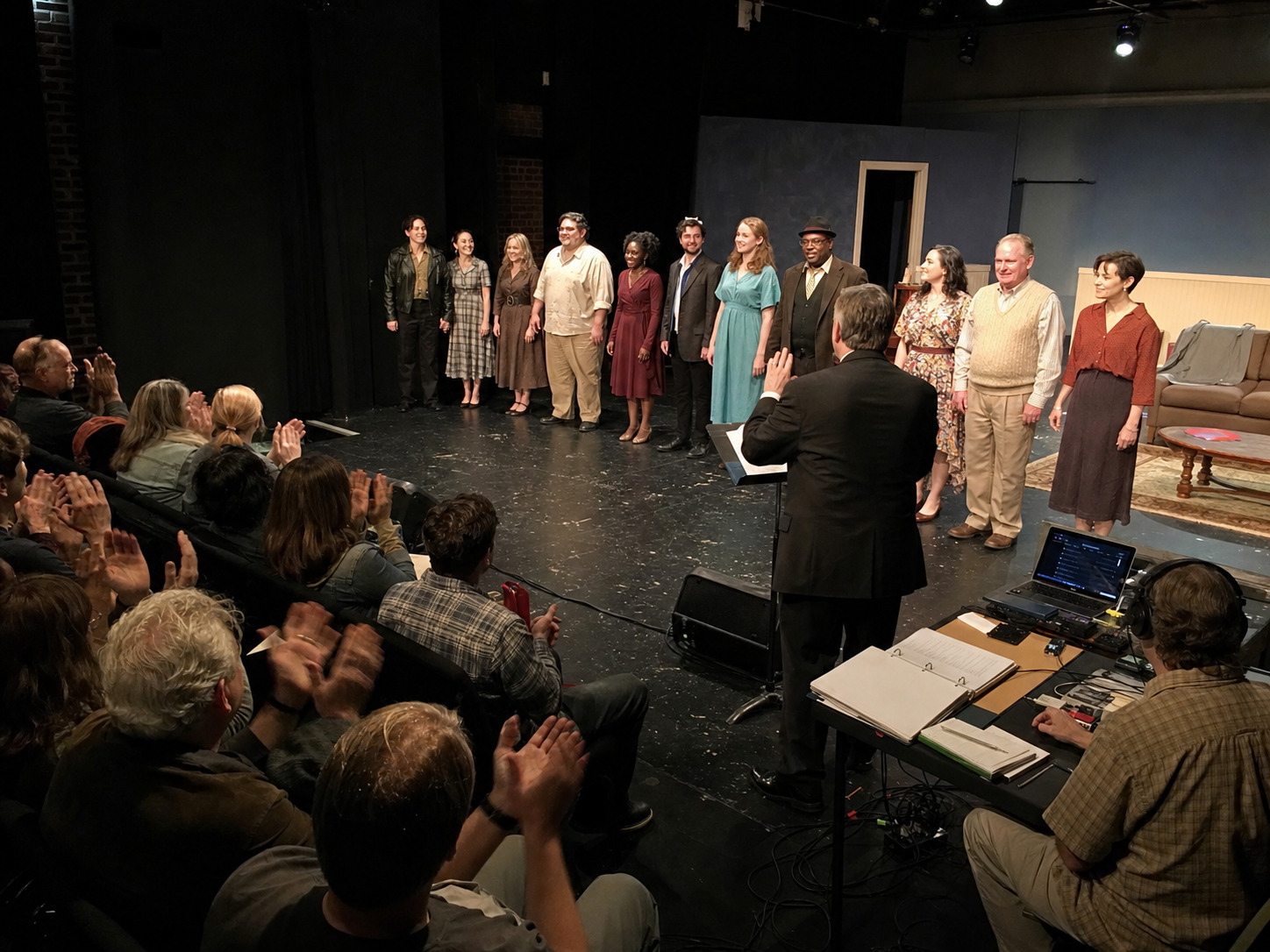
Put reaction notes on the real cue sheet
Do not keep applause planning only in the director's notebook.
Add it to the document the stage manager and playback operator will actually use. For each reaction-sensitive cue, include:
- the approved filename,
- the line or visual event before the cue,
- whether playback waits or continues,
- the cue owner,
- the exact release signal,
- the first audible landmark after the release,
- and the recovery plan if the cue is missed.
The (backing-track cue-sheet guide) shows the broader information that belongs in the final playback document.
Keep the language operational. “Wait for applause” is not enough. “QLX 24: GO when actor reaches the platform and stage manager calls; file begins with two-bar brass lead-in” is something the operator can run.
Use an invited audience before opening night
A run without listeners cannot reveal every reaction point.
If the production has an invited dress, preview, or small test audience, treat it as timing evidence. Ask the stage manager to note:
- where applause or laughter occurred,
- which lines were covered,
- where performers rushed,
- where a hold felt too long,
- which track entrances were hard to hear,
- and whether the cue owner was obvious.
Do not rebuild the entire show after one small audience. Look for repeated or structurally predictable problems. A well-staged reveal may receive a different reaction every night, but it can still have a stable cue boundary.
Plan the recovery before it is needed
Sometimes the audience responds longer than expected. Sometimes it does not respond at all.
Rehearse both outcomes.
If applause continues:
- the cue owner waits only when playback is designed to wait;
- actors sustain the scene without asking for more reaction;
- the operator follows the written release cue;
- and the conductor gives a visible preparation before the next entrance.
If the expected response does not happen:
- do not hold an empty pause indefinitely;
- use the same release signal;
- keep the scene's intention intact;
- and let the score move forward.
The system should support the audience that is actually present, not the audience imagined in rehearsal.
A production checklist
Before the first public performance, confirm that:
- likely applause and laughter points are marked;
- the team knows which sections continue and which can wait;
- every flexible boundary has one cue owner;
- vamps, split tracks, buttons, or live bridges are approved and rehearsed;
- actors know what they do during each hold;
- the conductor and cast can hear the restart landmark;
- reaction notes appear on the final cue sheet;
- at least one audience-bearing run has been observed when possible;
- and long, short, and absent reactions have all been considered.
The goal is not to control the audience. It is to keep the production responsive without asking a fixed file to make a live decision.
FAQ: applause, laughter, and backing tracks
Should actors wait for applause before the next line?
Only when the production has planned the hold and the next musical or dialogue cue can wait. If playback continues, the actor may need to stay with the track while protecting important text through staging, balance, or a different cue design.
Can a standard MP3 wait for laughter?
No. A normal MP3 continues at its recorded speed. The flexible moment must sit before playback begins, inside a designed vamp, between split files, or in another system specifically built for live control.
Who should restart the music after applause?
Assign one cue owner—commonly the stage manager or conductor—and document the signal the playback operator follows. Avoid a cue that depends on several people making the same judgment at once.
Do curtain calls need separate tracks?
Often, yes. Separate bows, exit music, or short entrance cues can make curtain-call timing easier to adjust around applause than one long fixed file.
When is a custom edit useful?
When the show needs a vamp, split cue, counted lead-in, extended transition, tailored ending, button, or other edit that matches a predictable audience-sensitive moment.
The useful test
Build vamps, split cues, counted lead-ins, buttons, endings, and transitions around the audience-sensitive moments your cast and operator need to run confidently.
Build Audience-Ready CuesAt every likely reaction point, ask: If the room is still laughing or clapping, what keeps moving, what can wait, and who makes that decision?
If those answers are written into the cue plan, the cast can stay present, the operator can act confidently, and the audience gets to respond without knocking the production off its musical path.