The Conductor Should Lead the Room, Not Chase the Track
By Broadwaytrax Content Studio · August 14, 2026
Updated August 14, 2026
The short answer: a conductor can lead a musical with backing tracks, but only when the company knows which musical choices are live and which are fixed inside the file.
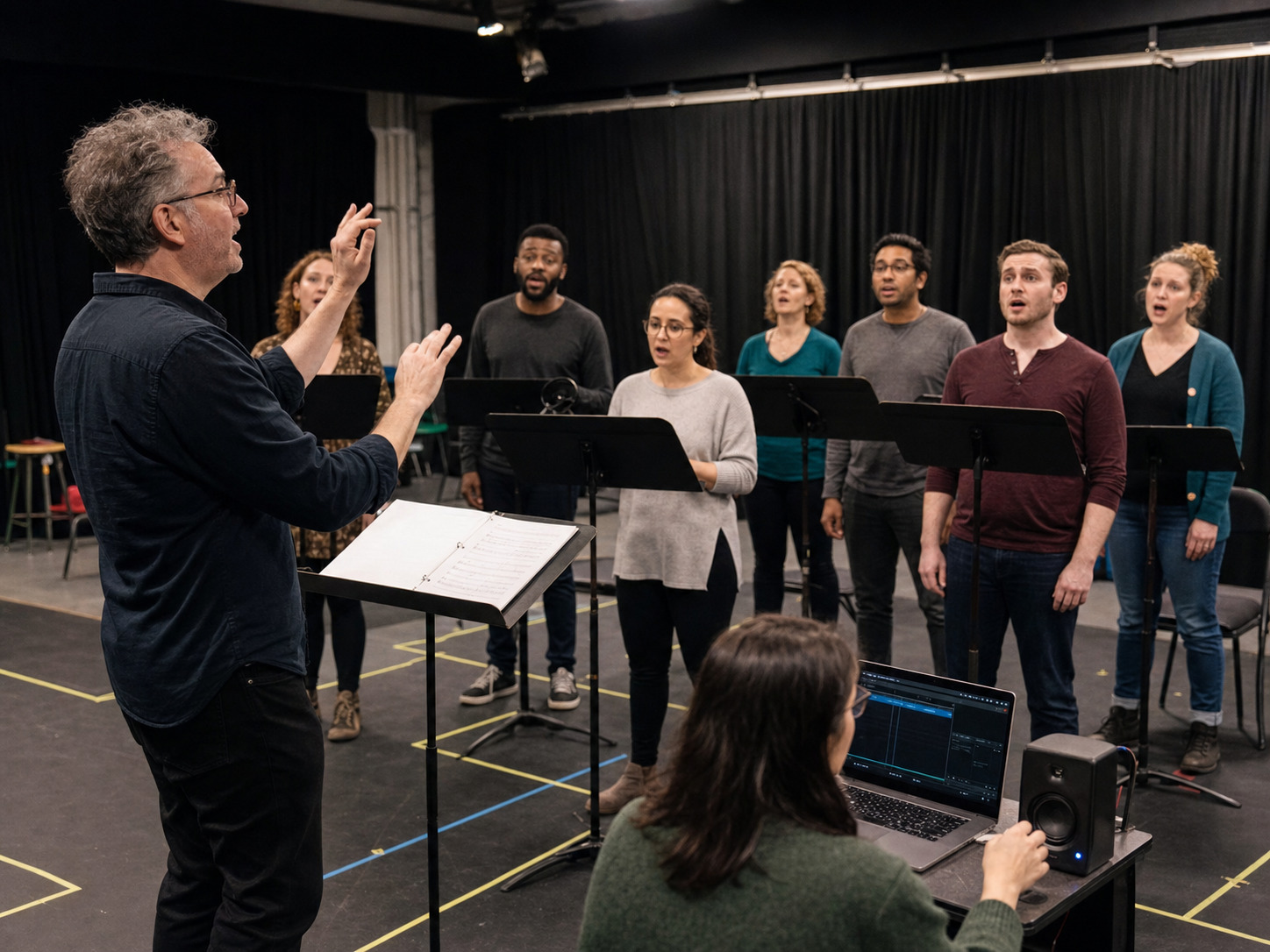
The conductor still shapes breath, intention, entrances, cutoffs, balance, and the actors' shared sense of time. What the conductor cannot do is silently ask a fixed recording to wait at a fermata, stretch a transition, or recover from a missed entrance. Those moments need to be designed into the track plan before the room depends on them.
That distinction turns conducting with tracks from a guessing game into a repeatable production system.
Separate fixed time from flexible time
Start by marking every section of the score as either fixed or flexible.
Fixed time keeps moving once playback starts. Most dance sections, underscoring, ensemble passages, and accompaniment built to a stable tempo belong here. The conductor leads the people through the recorded pulse; the file does not follow the baton.
Flexible time needs a live decision. That may include:
- a spoken scene that lands before the song begins,
- a breath before a difficult entrance,
- a fermata whose length changes with the actor,
- a vamp that waits for choreography or scenery,
- a rubato phrase that should move with the singer,
- or a button that must land on a visual event.
Do not leave those moments as vague notes such as “watch conductor.” Write down what the playback system will actually do. The track might begin on a called cue, hold in a repeated vamp, use a counted lead-in, or contain a custom tempo map shaped around the performer.
If no playback behavior is documented, the moment is not flexible. It is merely uncertain.
Give each musical moment one cue owner
The cast should never have to decide whether to follow the conductor, the speaker, the stage manager, or the actor who usually starts the phrase.
Assign one cue owner to each transition:
| Moment | Cue owner | What everyone follows |
|---|---|---|
| Track start after dialogue | Stage manager or conductor | One named visual or spoken cue |
| Counted musical entrance | Conductor | Prepared beat pattern and breath |
| Fixed dance passage | Recording | Audible pulse, reinforced by conductor |
| Vamp exit | Conductor or stage manager | One rehearsed exit cue |
| Fermata release | Conductor | Visible cutoff followed by the designed continuation |
| Final button | Recording and conductor together | Predetermined count and visual landing |
The precise assignment can vary by production. Consistency matters more than tradition. A school show with one music director running playback may organize cues differently from a professional production with a stage manager, audio operator, conductor, and separate musicians.
The rule is simple: one person owns the decision, and the rest of the room knows how that decision reaches the file.
Build a conductor's cue map, not just a playlist
A folder of correctly named audio files is necessary. It is not enough for conducting.
Create a cue map that connects the score to the playback plan. For each number, record:
- the approved filename and version,
- the dialogue or action before playback,
- who calls or triggers the start,
- the number of lead-in counts,
- the first audible landmark,
- any vamp, rubato, fermata, cut, or tempo change,
- the actor or ensemble entrance that needs a visual cue,
- the stop, fade, button, or transition at the end,
- and the safest restart point if the rehearsal stops.
This is more useful than telling the cast to “listen for the intro.” A conductor needs to know whether the intro contains four full bars, two pickup beats, an exposed sound effect, or a soft orchestral texture that will disappear in the room.
The same cue map should be available to the stage manager and playback operator. That keeps the (cue-to-cue rehearsal) focused on the same landmarks the conductor uses in music rehearsal.
Conduct the people through the pulse
During fixed-tempo sections, the conductor's job is not to imitate the recording. It is to make the recorded time usable by human performers.
That means showing the cast:
- a clear preparation before entrances,
- subdivisions before difficult pickups,
- larger phrase direction so the beat does not become mechanical,
- visible cutoffs even when the file already contains the release,
- and recovery gestures when an actor enters late but the track continues.
Give preparations early enough to matter. If the accompaniment enters on beat one, the cast may need the conductor's breath or gesture a full bar earlier. If the next phrase arrives after an unfamiliar orchestral fill, teach the fill as a landmark instead of expecting everyone to count silence under pressure.
For dance music, decide whether performers are primarily reading the conductor or hearing the pulse. The conductor can reinforce timing, but should not create a competing visual tempo. If the gestures drift from the track, the room receives two incompatible clocks.
Design rubato, fermatas, and vamps before tech
Expressive flexibility is where a standard accompaniment file most often collides with live performance.
A singer may naturally broaden the end of a phrase. A director may want a pause for a laugh. A scene shift may need four more measures. Those are valid production choices, but a fixed recording cannot infer them.
Choose the appropriate solution:
- Counted space: Build an exact number of beats or measures into the file.
- Recorded rubato: Shape the tempo around the singer and rehearse it consistently.
- Vamp: Repeat music until a named exit cue.
- Button or sting: Land a short musical ending on a rehearsed action.
- Separate cue: Split the material into two files so the next section starts only when called.
- Live instrument bridge: Let a pianist or small pit carry the flexible moment before the recording resumes.
If the current track's tempo does not support the scene, fix the file rather than teaching the cast to fight it. The Broadwaytrax guide to (planning a tempo change) explains how to describe the musical problem in production terms.
Make monitors support the baton
Conducting becomes harder when the cast hears the track late, unevenly, or too loudly.
During the real sound check, test from the performers' positions—not only from the house. The cast needs enough rhythmic and harmonic information to stay together without having the accompaniment mask consonants, dialogue, or live instruments.
The conductor also needs a dependable reference. That may be a floor monitor, a discreet personal monitor, or a nearby speaker aimed so the pulse reaches the podium clearly. Excessive delay between the main speakers and the conductor can make accurate gestures look late to the cast.
Use the exact approved files during this test. The (musical-theater sound-check checklist) covers the signal path, lyric clarity, monitors, endings, and backup playback that should be proven before the audience arrives.
Rehearse the visual language without playback
Before running full numbers, spend a few minutes teaching the company's shared signals.
Practice:
- the preparation for a track start,
- the gesture for a vocal pickup,
- the sign that a vamp will continue,
- the cue that releases the vamp,
- the cutoff for a fermata,
- the recovery gesture after a late entrance,
- and the physical indication that rehearsal has stopped even if playback is still fading.
Then add the track and test the same sequence. This exposes visual cues that are too small, too late, or blocked by staging.
Actors should know where to look when the choreography turns them away from the conductor. A section that cannot see the podium may need an assistant, a stage-side monitor, an audible landmark, or a staging adjustment.
A rehearsal checklist for the music director
Before declaring a number ready, confirm that:
- the score and audio file describe the same cut,
- the key and tempo match the approved production version,
- every start has one cue owner,
- every lead-in is counted and taught,
- every fermata, rubato section, and vamp has a real playback behavior,
- the cast knows whether the conductor or recorded pulse has priority,
- the conductor can hear the track without excessive delay,
- the stage manager and operator use the same cue language,
- and at least one restart point has been rehearsed.
The goal is not to make live performance rigid. It is to remove uncertainty from the mechanics so the conductor and actors can spend their attention on the scene.
FAQ: conducting a musical with tracks
Can a conductor slow down a backing track during performance?
Not safely unless the playback system and file were specifically built for live tempo control. A normal audio file continues at its recorded speed. Plan expressive tempo changes in advance or use a separate live-controlled section.
Should actors follow the conductor or listen to the track?
They should do both, but the production must define priority. In fixed passages, the conductor translates the recorded pulse into useful preparations and phrase direction. In flexible moments, actors follow the assigned live cue only when the file has been designed to wait or respond.
Do you need a click track?
Not always. A clearly audible accompaniment and a strong cue plan may be enough. Click can help a conductor or live musicians stay aligned with complex playback, but it requires appropriate routing and rehearsal so it does not reach the audience or distract performers.
When is a custom track worth considering?
When the production needs specific keys, cuts, rubato, vamps, lead-ins, cue points, tempo changes, or endings that a standard file does not provide. The best time to make those decisions is while the conductor can still rehearse them—not during final dress.
The useful test
Build the exact keys, cuts, tempos, rubato, lead-ins, vamps, cue points, and endings your conductor and cast can rehearse as one approved production version.
Build a Conductor-Ready TrackAsk one question at every musical transition: If the conductor changes something here, how does the track know?
If the answer is “it does not,” either keep that moment fixed or redesign the playback plan. Once the room understands that boundary, the conductor can lead confidently, the cast can breathe together, and the track becomes part of the production instead of an invisible authority everyone is chasing.