Do You Need a Count-In? Test the First Eight Seconds
By Broadwaytrax Content Studio · September 16, 2026
The first eight seconds of a backing track can decide whether an entrance feels prepared or improvised. A count-in may help, but it is not the automatic answer.
Use a count-in when performers need a shared pulse before music begins. Use a musical lead-in when the arrangement already provides the cue they need. Use a cue tone or spoken call only when the rehearsal or playback system has a clear reason for it. In performance, remove any aid that distracts the audience or duplicates a cue the company can already execute.
Start with the entrance the room has to make
Do not request “four clicks at the top” until the production has tested what happens immediately before the song.
The useful question is: what must the singer, dancer, conductor, stage manager, or playback operator know before the first downbeat?
An entrance may begin after:
- a spoken line;
- applause or laughter;
- a scene change;
- a blackout or light shift;
- a breath in silence;
- a conductor's visible preparation;
- or another piece of music that already establishes tempo.
Each situation calls for a different solution. A cast entering from dialogue may need a stable musical pickup. Dancers starting in silence may need audible pulse. A soloist may need enough introduction to breathe and find the first pitch. A conductor may need the orchestra inside the track to state the tempo rather than an exposed click the audience will hear.
Describe that event before describing the edit. “The ensemble starts after the set clears and needs four beats of pulse” is more useful than “add a count-in.”
Know the four common entrance tools
The terms are easy to mix up. Give each one a specific job.
Count-in
A count-in provides pulse before the musical material begins. It may be clicks, spoken numbers, percussion, or another short rhythmic sound.
It is useful when performers need to feel tempo before an exposed entrance, especially in rehearsal, dance calls, and practice files. It is less useful when the audience will hear an awkward production sound that does not belong to the performance.
Musical lead-in
A lead-in is part of the accompaniment. It may be an introduction, pickup, vamp, chord, or short phrase that gives the performer tempo, key, and character before singing or moving.
For many performance tracks, this is the cleanest option because the cue sounds like music rather than an instruction layered on top of it.
Cue tone
A cue tone is a brief signal placed before or inside a playback sequence. It can help an operator or performer locate a start, but it must be unmistakable and must not be confused with something the audience is meant to hear.
If the tone belongs only to rehearsal, label that version clearly and keep it outside the performance folder.
Spoken or visual cue
Sometimes the track does not need another sound. The stage manager can call the cue from a line or action. A conductor can prepare the company visibly. An operator can start playback from a rehearsed visual signal.
When the room already has a dependable cue owner and the arrangement supplies a clear first landmark, adding a count-in may create one cue too many.
Test the first eight seconds, not only the whole song
Full runs can hide entrance problems because everyone remembers what is coming. Isolate the sequence the way it will happen in the show.
- Begin one spoken line, stage action, or transition before the playback cue.
- Let the real cue owner release the operator.
- Use the actual track version and playback position.
- Continue through the first complete sung or danced phrase.
- Reset and repeat without coaching between attempts.
Watch for the exact failure.
If performers enter at different times, they may need clearer pulse. If everyone enters together but on the wrong pitch, a count-in will not solve the problem; the musical lead-in may need a stronger harmonic landmark. If the operator starts inconsistently, the stage cue may be unclear. If the singer is still moving into position, the staging or length of the introduction may be the real issue.
The (Broadwaytrax guide to writing useful custom-track notes) explains how to connect the observed problem to a buildable request.
Separate rehearsal help from performance sound
One file does not have to carry every job.
A rehearsal version may include:
- a spoken count;
- an audible click;
- a longer introduction;
- guide vocals;
- a slower practice tempo;
- or an isolated loop for a difficult entrance.
A performance version may keep:
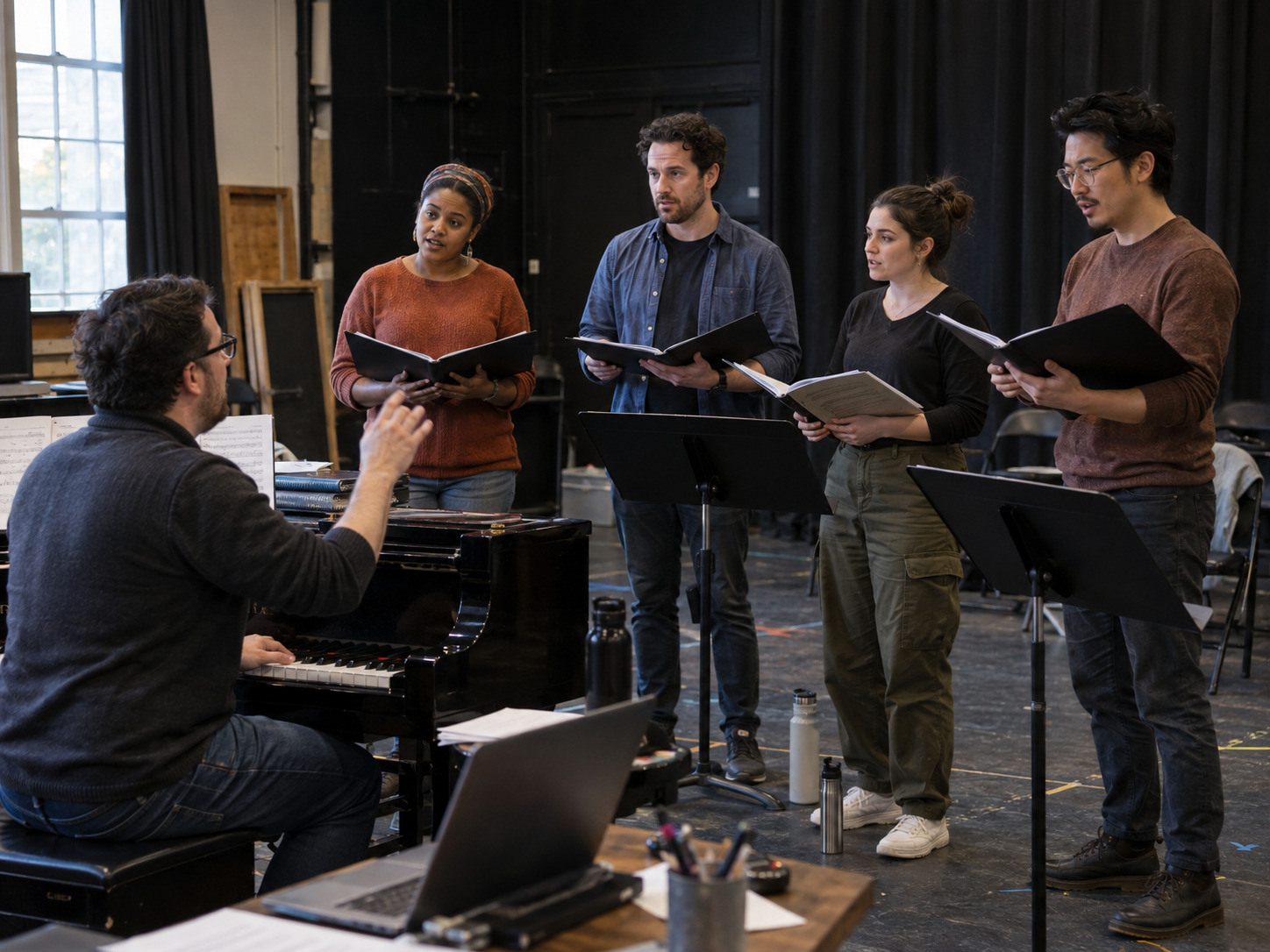
- the approved musical lead-in;
- the final key, cut, and tempo;
- the clean audience-facing start;
- and only the cues the company actually needs in the show.
Name the versions by function. Opening - Rehearsal Count-In and Opening - Performance are easier to trust than new intro and final final.
Move the cast toward the performance version early enough to prove the entrance without the rehearsal aid. A count-in has done its job when performers no longer depend on a sound that will disappear on opening night.
The Broadwaytrax article on (guide-vocal rehearsal planning) uses the same principle: learning support should lead toward independent performance, not become a permanent crutch.
Decide whether the audience should hear it
Not every click or spoken number is wrong in performance. Some styles, dance events, educational presentations, and deliberately exposed playback designs may use one intentionally. The decision belongs to the production's artistic and technical plan.
Ask four questions:
- Does the sound belong to the world of the production?
- Does it give performers information they cannot receive more cleanly another way?
- Can the audience mistake it for a technical error?
- Has the company rehearsed the exact transition with the final sound system?
If the entrance can be supported by a musical pickup, conductor preparation, or stable stage-management cue, an exposed count may be unnecessary. If the count is essential, make it deliberate: consistent volume, exact length, clear purpose, and one approved version.
Keep the conductor and operator in the same plan
With fixed playback, the conductor cannot silently ask the file for another beat. The operator cannot infer whether the conductor wants to reset unless the recovery language is rehearsed.
Mark:
- who gives the playback cue;
- whether the conductor prepares before or after playback begins;
- what the performers listen for;
- whether the count-in is audible to the audience;
- what happens if someone misses the entrance;
- and where the next safe restart point lives.
The (Broadwaytrax conducting guide) separates fixed time inside the track from live musical leadership. That distinction is especially important at the opening of a number.
Avoid two leaders giving different tempos. If the count-in establishes one pulse and the conductor prepares another, the company has been given conflicting instructions before the music even starts.
Write a custom request someone can build
A useful request identifies the current file, the entrance event, the performers' problem, and the behavior the revised version should provide.
For example:
Use case: school musical rehearsal and performance. The ensemble enters after the scene-change blackout. Keep the song's current key and tempo. Add four audible beats to the rehearsal version so dancers can establish pulse. For the performance version, replace the exposed clicks with a two-bar musical lead-in that gives the same tempo and first pitch. The stage manager calls the cue after the deck is clear. The music director will approve both proofs.
Include:
- song and source track;
- rehearsal, audition, or performance use;
- current key and tempo;
- exact cue before playback;
- desired number of beats or bars;
- whether the aid should be musical, clicked, spoken, or removed;
- first sung or movement entrance;
- separate version needs;
- rehearsal date for the proof;
- and one approval contact.
Broadwaytrax (custom track production) can support confirmed lead-ins, count-ins, keys, cuts, tempos, cues, and performance-ready versions when the available file is close but the entrance does not fit the room.
Questions rehearsal rooms ask
Should every backing track start with a count-in?
No. Add one only when it solves a specific tempo or entrance problem. Many tracks already have a musical introduction that gives performers the information they need.
How many beats should the count-in use?
Use enough to establish the meter, tempo, and entrance without making performers wait. The useful length depends on the arrangement and staging. Test it with the people making the real entrance.
Is a count-in the same as a lead-in?
No. A count-in gives pulse before the music. A musical lead-in is part of the accompaniment and can also establish key, style, and character.
Should rehearsal clicks stay in the performance file?
Only when the production intentionally needs and approves them. Otherwise, keep rehearsal aids in a clearly named rehearsal version and prove the entrance with the final performance file before tech.
What if the singer still misses the entrance?
Bring Broadwaytrax the current track, exact entrance event, rehearsal use, performance use, and the musical behavior your cast needs. The custom quote flow can help shape a count-in, lead-in, key, cut, tempo, cue, or final performance version around the room using it.
Plan the Entrance EditDiagnose the layer. Check the stage cue, playback start, musical landmark, sound coverage, monitor position, performer preparation, and staging before requesting another edit.
A good entrance aid disappears into the production. It gives the room exactly enough information, then lets the music begin.