Make “Sudden Changes / Git It” a Three-Way Conversation
By Broadwaytrax Content Studio · November 6, 2026
Updated November 6, 2026
The short answer: rehearse the number as one negotiation shared by Seymour, Audrey II’s voice, the puppet operator, and the accompaniment track. Give every turn a visible cue, keep the groove underneath the scene, and make the plant’s movement answer the vocal rather than merely copy it.
Broadwaytrax offers a (“Sudden Changes / Git It” accompaniment track) and includes the number in its (complete Little Shop of Horrors album). The album pairs guide-vocal demonstrations with accompaniment versions, which is useful when a company must coordinate music, acting, puppetry, and playback without letting any one layer take over.
Bring "Make “Sudden Changes / Git It” a Three-Way Conversation" to life with custom tracks
Get the exact arrangement you need—either customize an existing accompaniment or commission a bespoke build from our team.
Don't see this show in our library yet? We'll build it for you.Treat the scene as a three-way conversation
The scene loses tension when it becomes “Seymour sings, then the plant sings.” Each participant should change the next person’s behavior.
Build three lanes:
- Seymour: hears an offer, resists it, tests it, and reveals how much he wants what the plant promises.
- Audrey II’s voice: listens for weakness, changes tactics, and keeps the persuasion moving inside the groove.
- Puppet operator: turns those choices into focus, breath, stillness, size, and attack without making every sound a mouth flap.
Run the scene once as spoken dialogue. Stop after each change of tactic and ask: who owns the next beat, and what did the previous choice make necessary? Then put the accompaniment back underneath the scene without changing those intentions.
The track should provide a dependable musical clock. The performers still have to make the negotiation feel newly dangerous.
Give the voice and puppet one shared score
An offstage voice and an onstage puppet can drift apart even when both artists know the music. Create one cue sheet that both performers can read.
Mark:
- the musical sound before each important vocal entrance;
- the first visible plant response;
- any moment when the puppet should remain still while the voice does the work;
- large physical accents that must land with the accompaniment;
- Seymour’s eye-line or movement that triggers a response;
- safe pickup points after a stop;
- the final shared release into the next scene event.
Do not write only timestamps. A timestamp may shift after an approved edit, and it gives a performer little musical information. Pair the time with an audible landmark, measure reference from the approved score, or named dramatic event.
A useful note sounds like: “On the guitar pickup after Seymour turns back, the plant focuses; the jaw opens only when the vocal phrase begins.” That connects music, movement, and scene action.
Let stillness make the puppet look alive
A large puppet is most believable when it does not move constantly. Continuous motion can make the operator tired, blur the important beats, and turn the plant into background decoration.
Choose a small movement vocabulary:
- a slow focus toward Seymour;
- a jaw preparation before an entrance;
- one sharp bite or snap for a major accent;
- a leaf, vine, or body shift that increases pressure;
- complete stillness when the plant is listening or waiting.
Rehearse those actions without singing. The operator should be able to repeat each one at performance speed without losing balance, sightline, or control.
Then add the offstage vocal. Ask the puppet to respond to intention, not every syllable. A few precise movements will usually read more clearly than constant lip-sync.
Protect the groove while the acting changes
Comedy and threat both depend on timing. If the scene slows down every time Seymour thinks, the track will feel impatient. If the performers chase the accompaniment, the bargain will feel shallow.
Find the larger pulse before adding character work. Let the actor, vocalist, and operator tap or step it together. Speak the scene’s turns over that pulse, then sing only the entrances and releases before running the complete number.
Use a rehearsal grid:
| Pass | Main question |
|---|---|
| Music only | Can everyone hear the introductions, transitions, and ending? |
| Voice + track | Does the vocalist carry the persuasion without rushing the text? |
| Seymour + track | Can the actor think and react inside fixed musical time? |
| Puppet + voice | Do movement and vocal choices belong to the same character? |
| Full scene | Does each choice make the next musical entrance inevitable? |
If the full run fails, return to the smallest pass that isolates the problem. Do not solve a missed puppet cue by asking the whole company to repeat the scene from the top.
Rehearse the operator’s real conditions
The puppet operator may work in a tight position with limited visibility, heat, weight, and delayed sound. A rehearsal-room note that seems simple from the audience can be difficult inside the mechanism.
Before tech, confirm:
- what the operator can actually see;
- whether a monitor, cue light, or stage-management call is needed;
- where the offstage voice will be heard;
- how the operator enters and exits safely;
- which movements require a second puppeteer;
- and how long the operator can sustain the sequence without losing precision.
Schedule short, focused puppet passes before long runs. Repeat the hardest transition, then let the operator reset. Fatigue should not become the production’s timing method.
Never place a performer where the puppet, scenery, or sightline creates an avoidable collision. The stage manager and puppet team should own the safety plan, and the music cue must remain secondary to a safe stop.
Put the offstage vocalist in the same room
The voice of Audrey II should not rehearse in isolation until tech. The vocalist needs to hear how the puppet breathes, how Seymour reacts, and where the audience’s focus will move.
During a shared rehearsal:
- place the vocalist where the production intends whenever possible;
- test the monitor or foldback level the vocalist will actually receive;
- agree on what happens if the stage action is late;
- decide whether the vocalist follows the track, the conductor, or a named stage cue when those signals conflict;
- and run the ending into the next scene rather than stopping on the final sound.
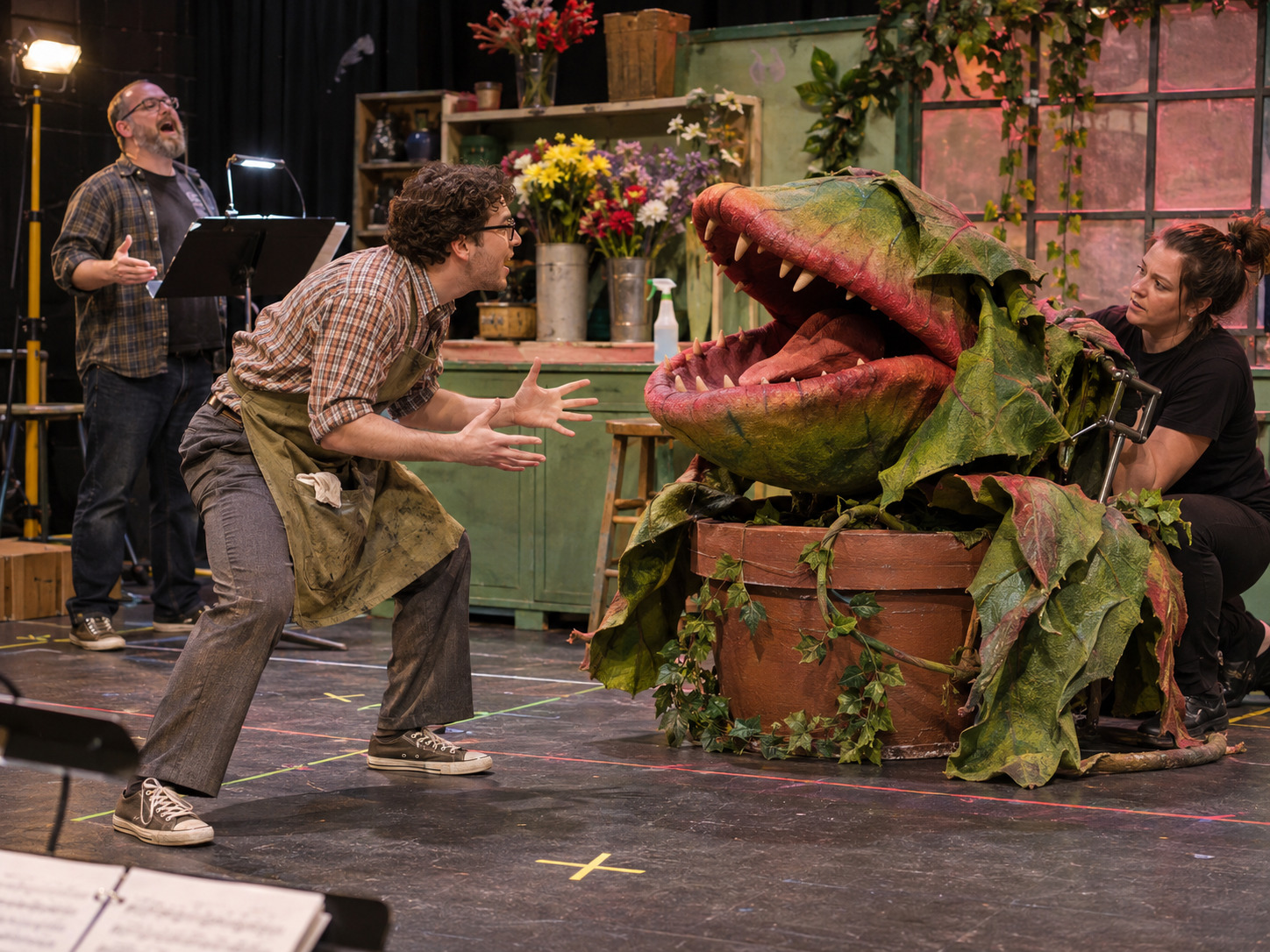
The vocalist can create character through timing, consonants, dynamics, and the shape of the offer. The puppet translates that character visually. Both artists need the same dramatic map.
Make Seymour’s listening visible
The scene is not only a technical duet between a singer and a puppet. Seymour’s choices give the bargain its stakes.
Mark what Seymour believes at each turn. Let the audience see when he dismisses the plant, when a promise lands, when he recognizes the cost, and when desire begins to outweigh caution.
Avoid standing in one fixed “reaction spot.” Give the actor a small, repeatable physical route that preserves sightlines to the puppet and keeps the next musical entrance audible. If a cross covers an important puppet action or puts the actor outside the sound focus, adjust the staging before it becomes habit.
The most useful reaction is not always the biggest. A delayed look, a stopped hand, or a step that almost happens can leave room for the accompaniment and puppet to tighten the scene.
Plan starts, stops, and safe pickups
The production will eventually need to stop for a puppet repair, line note, sound adjustment, or spacing problem. Decide how to resume before that happens.
Choose at least three pickup points:
- one before the first major exchange;
- one near the middle where all participants can identify the musical landmark;
- one before the final build or release.
For each pickup, name the track location, actor position, puppet state, and first cue. The operator should not have to guess whether the plant is open, closed, focused, or resetting when playback restarts.
Use one approved file in the live rehearsal folder. The Broadwaytrax product page provides options for key, tempo, and cut changes when the standard accompaniment is close but the production has a tested need. If a change is requested, describe the exact musical location, staging reason, and result the team will verify.
A 25-minute coordination rehearsal
Minutes 1–5: hear the map
Listen to the introduction, principal transitions, and ending. Name the audible landmarks everyone will use.
Minutes 6–10: align voice and puppet
Run the major Audrey II entrances with only the vocalist, operator, and track. Reduce unnecessary movement.
Minutes 11–15: add Seymour’s choices
Speak and then sing the negotiation turns. Make each reaction lead into the next musical event.
Minutes 16–20: test two pickups
Stop from realistic problem points and restart using the written cue sheet rather than verbal coaching.
Minutes 21–25: prove the handoff
Run the final section into the next stage event. Confirm the last sound, puppet release, actor focus, and playback stop.
Rehearsal checklist
- Seymour, the vocalist, and the puppet operator share one dramatic map.
- Each important entrance has an audible musical landmark.
- Puppet motion answers intention rather than every syllable.
- Stillness is planned and repeatable.
- The offstage vocalist has rehearsed with the actual puppet action.
- Seymour’s reactions remain visible without blocking the plant.
- Operator visibility, stamina, and safe exits have been tested.
- The room knows who may stop playback and how to resume.
- At least three pickup points are written down.
- Only the current approved track is in the live folder.
- The ending has been rehearsed into the next scene event.
- Recording-use permission and the show’s theatrical rights are handled separately.
Common questions
Should the puppet lip-sync every word?
Not necessarily. Precise focus, preparation, selected jaw movements, and stillness often create a stronger character than continuous mouth motion. Match the production’s puppet design and sightlines.
Who should the performers follow if a cue is late?
Set that rule before tech. Name the musical authority for the sequence—such as the fixed track, a conductor, or a stage-management cue—and rehearse the agreed recovery.
Can the standard accompaniment be changed for staging?
Broadwaytrax offers customization options for key, tempo, cuts, lead-ins, and endings. Test the current track first, then request the exact approved change with a clear rehearsal reason.
Does a Broadwaytrax theater-use license include the right to perform the musical?
Hear the accompaniment, then map the exact voice, puppet, actor, and playback cues your production needs.
PREVIEW SUDDEN CHANGES / GIT ITNo. Permission to use the Broadwaytrax recording is separate from the grand rights or theatrical license required to present the show.
When the number works, the audience does not see four separate systems. It sees one persuasive creature, one frightened dreamer, and a bargain tightening on every beat.