Let “Somewhere That’s Green” Stay Small Enough to Feel True
By Broadwaytrax Content Studio · November 2, 2026
The short answer: rehearse “Somewhere That’s Green” as a private picture becoming more specific, not as a general wish that gets louder. The performer needs a clear person to imagine, a sequence of concrete discoveries, and enough trust in the accompaniment to let stillness do part of the work.
That approach matters with a backing track. The arrangement will keep its pace and shape every time. It cannot wait while the actor searches for the next thought. The rehearsal task is to place each new image inside that dependable musical map without making the song feel preplanned.
Bring "Let “Somewhere That’s Green” Stay Small Enough to Feel True" to life with custom tracks
Get the exact arrangement you need—either customize an existing accompaniment or commission a bespoke build from our team.
Don't see this show in our library yet? We'll build it for you.Decide who is allowed to hear the dream
Before singing, decide whether Audrey is speaking to Seymour, to herself, to an imagined future, or to someone else in the room. A production can make different choices, but the actor needs one clear relationship for each section.
Try the scene three ways before settling on the staging:
- Direct: Audrey lets Seymour hear the dream and watches whether he understands it.
- Private: she says more than she meant to, then protects the most vulnerable details.
- Imagined: the future becomes vivid enough that the real room briefly falls away.
The strongest version may combine these, but the changes should be intentional. If the actor looks upward and smiles for the entire number, the audience sees a mood. If focus shifts because the thought shifts, the audience sees a person discovering what she wants.
Build the picture one detail at a time
The song’s power comes from ordinary details carrying extraordinary emotional weight. Do not play every image as equally important. Mark what each one reveals.
Use a rehearsal table like this:
| Musical section | New detail | What it means to Audrey | Visible change |
|---|---|---|---|
| Opening | The first glimpse of a different life | It might be possible | Focus becomes more specific |
| Middle | Domestic details accumulate | Safety has a shape | Breath and posture release |
| Turn | The fantasy includes another person | The dream is relational | Attention returns to the listener |
| Ending | The picture feels almost reachable | Hope and reality meet | Stillness replaces extra effort |
Speak through the sequence without copying the melody. Name the thought underneath each detail in plain language. Then sing with the accompaniment and keep the same discoveries.
Avoid adding comic business to every image. The scene already contains humor, tenderness, and discomfort. Let the details do the work instead of illustrating each one with a separate gesture.
Learn the accompaniment before adding emotion
The (Little Shop of Horrors album) includes guide-vocal and accompaniment versions of the show’s songs. Use them for different jobs.
Begin with the guide vocal when the performer still needs the melody, entrance, phrasing, or overall architecture. Then move to the (“Somewhere That’s Green” accompaniment track) early enough that the actor becomes responsible for the thought and breath.
On an accompaniment-only pass, mark:
- the exact start cue;
- instrumental figures that introduce a new image;
- places where the phrase continues across a breath temptation;
- moments where a physical choice could pull the voice behind the track;
- the final musical release;
- and what the scene does immediately after the last note.
Do one listening run without singing. The actor should be able to point to the musical landmarks without following another voice. Dependable landmarks create freedom: once the performer knows where the accompaniment is going, the acting can remain responsive.
Protect the conversational breath
This number can sound heavy when every phrase is treated like a vocal event. Plan breaths from the thought, not only from the bar line.
First, speak the text at the emotional pace of the scene. Mark where the actor genuinely needs to take in a new idea, respond to an imagined image, or change tactics. Then compare those points with the accompaniment.
If a dramatic pause is longer than the track allows, solve the problem in this order:
- clarify the thought before the pause;
- simplify the physical action;
- use focus or stillness instead of added time;
- rehearse the next entrance alone;
- consider a custom edit only when the production has a confirmed musical need.
Do not solve uncertainty by breathing after every short phrase. That can make the dream feel assembled line by line instead of unfolding naturally.
Let stillness be active
Stillness is not the absence of acting. It is the choice to let the audience watch a thought land.
Run the song once with the performer seated or standing in one practical location. Remove all gestures except those that happen without planning. Ask the actor to change only focus, breath, and the person being addressed.
Then add movement only where the relationship changes. A single cross toward Seymour, a turn away when the dream feels too exposed, or a final decision to remain can be more legible than continuous wandering.
Test every movement with the exact accompaniment file. A cross that works with a rehearsal pianist may make the next entrance late when the track continues at a fixed pace. The movement should grow from the thought and still leave the singer physically ready for the phrase.
Keep the performance human, not decorative
The character’s dream can invite broad period style or visual comedy. Those elements belong to the production design; the actor still needs a recognizable human need underneath them.
Ask these questions:
- Which detail is funny to the audience but completely serious to Audrey?
- Which part of the dream feels safest?
- Which part is hardest to admit?
- When does Seymour become part of the picture?
- What does Audrey know at the end that she did not know at the start?
Avoid treating the character as naïve in every beat. Specific hope is more moving than a generalized “dreamy” quality. Let the audience understand why this modest picture matters so much in the world of the scene.
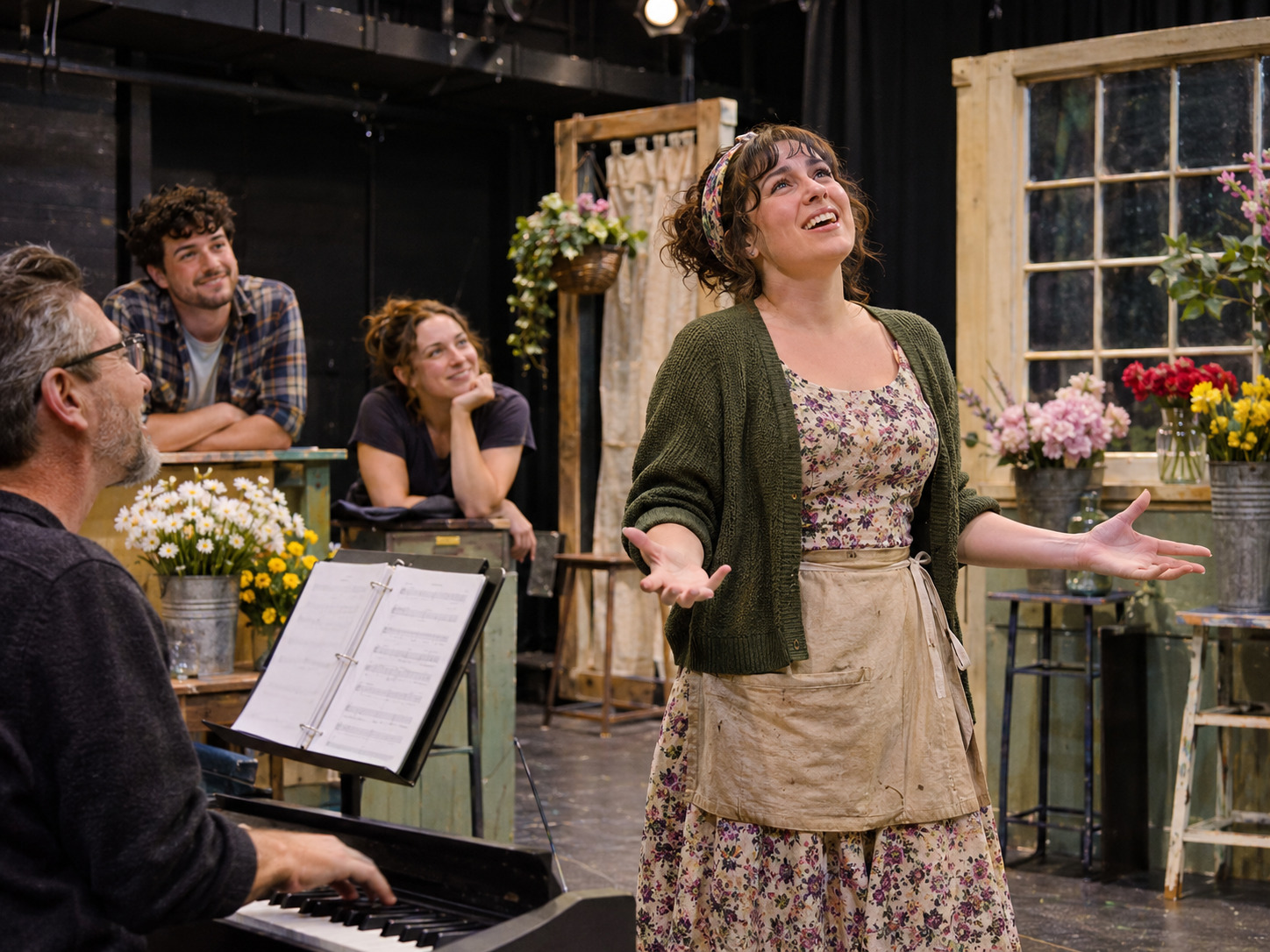
Rehearse the listener too
If Seymour is present, his listening shapes the number. Give him an active score instead of asking him to watch politely.
Mark:
- the first detail that surprises him;
- the moment he realizes he is included;
- one place where he wants to respond but does not interrupt;
- the musical cue that changes his distance or focus;
- and the silence after the song.
Run the scene from dialogue before the track begins through the first exchange after it ends. The listener should not anticipate the dream’s turns merely because the actors have rehearsed them many times.
Balance voice, track, and room
The words need to stay intelligible without forcing the singer to overproject. Sound-check the quietest phrases, not only the largest ones.
Listen from several audience positions and confirm that:
- the accompaniment supports rather than covers the text;
- consonants remain clear without becoming percussive;
- the singer hears enough track to trust the entrance;
- the microphone position stays consistent through movement;
- the listener’s reactions do not pull focus from essential text;
- and the final note releases into the intended silence or dialogue.
Record one complete run from audience distance. Listen once for words, once for breath and pulse, and once for the sequence of images. Fix the earliest unclear moment first. A muddled opening cannot be repaired by making the ending more intense.
A focused 30-minute rehearsal
Minutes 0–5: name the listener
Decide who hears each section and what Audrey wants that person to understand.
Minutes 5–10: map the images
Speak the sequence and give each new detail a meaning, not a gesture.
Minutes 10–15: listen to the accompaniment
Mark the start, transitions, breath risks, final release, and next scene cue.
Minutes 15–20: sing without staging
Use accompaniment only. Keep the conversational thought alive and remove decorative phrasing.
Minutes 20–25: add one meaningful movement
Choose a cross, turn, or change of distance that clarifies the relationship.
Minutes 25–30: run into and out of the song
Begin with the preceding dialogue and continue through the silence or response after the final note.
Common questions about rehearsing the song
Should the performer stay on the guide vocal until staging is finished?
No. Use the guide vocal to learn melody and entrances, then move to accompaniment while the acting choices are still developing. The performer needs time to own the phrasing without another voice leading it.
Does a quiet song need much playback rehearsal?
Yes. Quiet material exposes uncertain entrances, covered words, long physical moves, and unclear endings. Rehearse the exact file, microphone, and final transition before tech.
How much movement should the actor use?
Only enough to clarify a change in thought or relationship. Start with active stillness, then add movement that remains secure against the accompaniment.
What if the chosen key or timing does not fit the performer?
Confirm the issue over several full passes, then describe the exact key, cut, tempo, lead-in, or ending the production needs. Broadwaytrax can support production-specific changes through its custom-track service.
What should the playback operator know?
Preview the accompaniment and matching guide-vocal track, then confirm the key, cues, staging, and theater-use option your rehearsal or production needs.
Preview Somewhere That's GreenThe approved filename, start trigger, first entrance, any exposed musical landmark, final release, next dialogue or scene cue, and backup playback plan.
The goal is not to make the dream bigger. It is to make it more believable. When the actor knows who is listening, trusts the accompaniment, and discovers each detail in sequence, a small imagined room can hold the entire emotional life of the scene.