A Stumble-Through Should Show You Where the Track Plan Breaks
By Broadwaytrax Content Studio · August 20, 2026
Updated August 20, 2026
The short answer: a musical-theater stumble-through should reveal where the production loses its shared plan—not prove that the show is already polished.
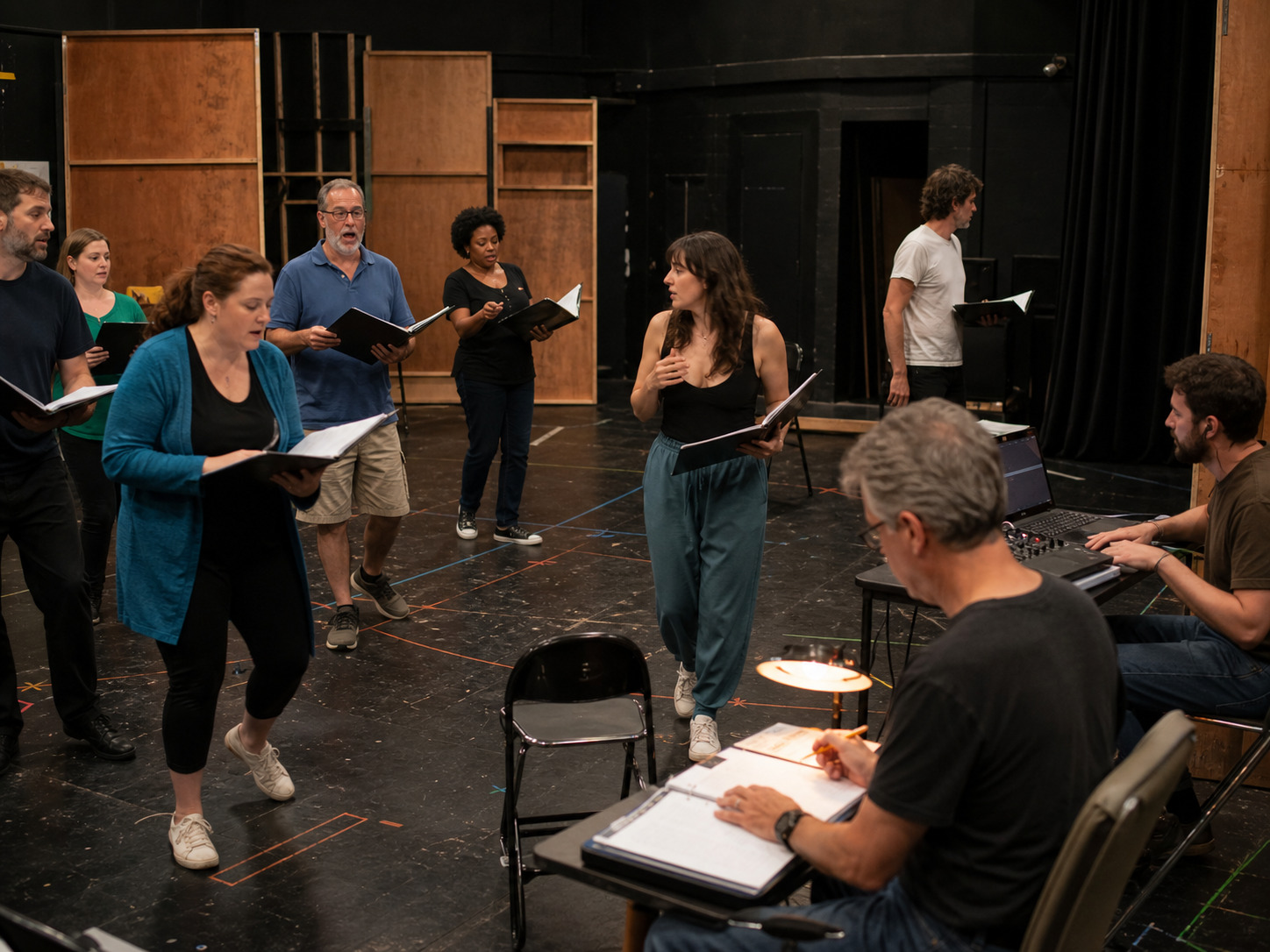
This is usually the first rehearsal that asks scenes, songs, movement, dialogue pickups, and backing-track cues to continue in sequence. The cast may still carry scripts. Choreography may be marked. Scene changes may be approximate. Stops are expected.
What matters is that each rough edge becomes useful information. The team should leave knowing which gaps belong to performance, staging, cueing, playback, or the track itself—and who owns the next fix.
What is a stumble-through rehearsal?
A stumble-through is an early continuous run of a scene, act, or complete musical. It connects material that has previously been rehearsed in pieces so the company can see how the production travels from one moment to the next.
Unlike a final run-through, a stumble-through is allowed to be visibly unfinished. Unlike a cue-to-cue, it includes enough performance to expose continuity problems rather than jumping only between technical events.
With backing tracks, the rehearsal should test more than whether each file plays. It should reveal whether dialogue, movement, singing, choreography, scene changes, and playback share the same sequence.
Decide what the run is supposed to prove
“Let’s see how far we get” is not a complete rehearsal goal.
Choose a useful scope before the first cue:
- connect the opening through the first major production number;
- run Act One without resetting between scenes;
- test every dialogue-to-song handoff;
- check whether scene changes fit the current musical timing;
- identify numbers that are not ready to run continuously;
- or prove that the cast can move from guide-vocal support to accompaniment-only files.
Tell the room what will cause a stop. A music director may stop for an unsafe entrance, a lost ensemble section, or a structural disagreement. A director may stop when blocking makes the next cue impossible. A stage manager may stop when the wrong file or version appears.
The stumble-through becomes more useful when everyone knows which roughness is expected and which roughness needs an immediate diagnosis.
Start from one approved rehearsal package
Do not build the run from personal downloads, old email attachments, and files named “final” on several devices.
The operator should have one show-order playlist or folder that identifies:
- the cue number and song title;
- whether the file is a guide vocal or accompaniment track;
- the approved key, cut, tempo, and ending;
- separate dance breaks, scene-change music, vamps, buttons, or stings;
- the spoken line or stage action that triggers playback;
- a clear restart point;
- and the next event after the file ends.
If the production is still learning with guide vocals, label those files so they cannot be mistaken for performance accompaniment. Broadwaytrax (guide vocal tracks) can support melody, entrances, and structure early in rehearsal, but the company should also hear the matching accompaniment-only version before the track plan is treated as settled.
Run the handoff, not only the song
A song can sound secure when it begins from silence and still fail inside the show.
Begin each musical sequence from the event that actually releases it:
- Run the preceding line, movement, or scene-change action.
- Let the cue owner call or signal the track.
- Start playback from the operator’s real position.
- Listen for the first audible landmark.
- Enter, move, or sing from that landmark.
- Continue through the ending and into the next action.
This exposes the seconds that a song-only rehearsal hides. A performer may know the first lyric but not how quickly it follows the line. A dance break may work from a counted reset but not from the scene. A button may land cleanly while the next blackout arrives late.
The (cue-to-cue backing-track guide) can help later when the production needs a more technical pass through those same edges.
Give every stop a diagnosis
A stumble-through can become a long collection of opinions unless each stop answers one question: what layer actually failed?
| What the room saw | Check first | Likely next action |
|---|---|---|
| Singer missed the entrance | Was the cue and audible landmark clear? | Restore the pickup before changing the file |
| Dance phrase drifted | Did the company begin on the same count? | Rehearse the lead-in and first eight-count |
| Scene change ran past the music | Is the movement unfinished or the duration truly fixed? | Time the approved staging before requesting an edit |
| Wrong track played | Were the cue number and filename unambiguous? | Repair the playlist and file map |
| Dialogue covered the musical entrance | Did the spoken pace or cue point change? | Reset cue ownership and timing |
| Ending felt weak | Is the company releasing together? | Rehearse the cutoff before changing the button |
| Cast could not recover after a stop | Is there a named restart point? | Add and rehearse a safe restart |
Write the diagnosis in plain language. “Track problem” is too broad. “Scene 4 change currently takes 18 seconds; approved transition file ends at 13 seconds” gives the director, stage manager, and editor something specific to solve.
Protect unfinished staging from premature edits
The first connected run often makes fixed music feel unforgiving. That does not automatically mean the track should change.
Before requesting a longer intro, slower tempo, extra vamp, or new ending, ask:
- Has the blocking been taught consistently?
- Are performers using the agreed path and pace?
- Is the cue being called from the correct event?
- Did the cast hear the same lead-in used in music rehearsal?
- Is the section expected to remain flexible after staging is settled?
- Would a track edit solve a repeatable need, or only today’s unfinished work?
Record a provisional timing note when the staging is not ready to judge. Test it again after the movement has a stable plan. This prevents the team from paying for, learning, and replacing an edit that addressed a temporary rehearsal condition.
When a repeatable production need is clear, Broadwaytrax (custom tracks) can support keys, cuts, tempos, lead-ins, vamps, cues, endings, orchestration adjustments, and full-show planning around the approved production.
Use restart points that keep the room moving
Restarting every number from the first measure wastes time and hides whether the company can recover inside the sequence.
Choose landmarks such as:
- the spoken cue before a song;
- the beginning of a verse or chorus;
- the top of a dance break;
- the entrance after a vamp;
- a scene-change cue;
- or the phrase before the final button.
The operator should be able to find the point without scrubbing blindly. The music director or conductor should know what count or pickup restores the performers. The stage manager should know which cue is active when the run resumes.
For a long full-show file, consider whether separate, clearly labeled cue files would make rehearsal and performance safer. The useful choice depends on the show, the rights and materials provided, and the production’s approved plan.
Keep the notes small enough to act on
Do not turn every stumble into a full rehearsal report during the run.
Capture each issue with four fields:
| Cue | Observed gap | Owner | Next proof |
|---|---|---|---|
| A12 | Ensemble enters before the brass pickup | Music director | Repeat from dialogue cue with accompaniment track |
| A18 | Scene change is five seconds longer than current file | Director and stage manager | Time settled movement at next rehearsal |
| A24 | Operator cannot distinguish rehearsal and performance versions | Playback owner | Relabel folder and verify show order |
| A31 | Vamp exit signal is not visible from playback position | Director and operator | Choose and test one visible release cue |
The (musical-theater rehearsal report guide) explains how to turn those observations into controlled revision decisions after the room is released.
A practical 75-minute stumble-through plan
Adapt the timing to the production, but keep the sequence deliberate.
First 10 minutes: package and rules
Confirm the run scope, approved files, operator, cue owner, stop rules, note-taker, and restart language.
Next 20 minutes: first continuous section
Run without coaching unless the agreed stop condition appears. Mark smaller issues for the note pass.
Next 15 minutes: diagnose the edges
Return to the dialogue pickups, transitions, dance-break starts, and endings that failed. Identify the layer before proposing a fix.
Next 20 minutes: second continuous section
Continue from a named restart point. Test whether the company can apply the clarified cue or staging note without rebuilding the sequence.
Final 10 minutes: ownership and proof
Name each remaining issue, owner, due point, and next rehearsal test. Confirm which track package remains approved until a verified replacement exists.
Musical-theater stumble-through checklist
Before ending the rehearsal, confirm that:
- the run used one approved rehearsal package;
- guide-vocal and accompaniment files were clearly separated;
- songs were tested from real dialogue or movement cues;
- every stop received a performance, staging, cue, playback, or track diagnosis;
- unfinished staging was not mistaken for a permanent audio need;
- critical internal restart points were named;
- the operator could locate the correct file and restart quickly;
- vamps, holds, buttons, and scene-change music have clear owners;
- each unresolved issue has one owner and one next proof;
- and no replacement file enters the package before it is reviewed and tested.
FAQ: stumble-through rehearsals with backing tracks
Should a stumble-through run without stopping?
Not necessarily. It should be continuous enough to expose how the show connects, but the team may stop for safety, structural confusion, the wrong track, or another agreed rehearsal priority. Record smaller polish notes instead of interrupting every time.
Should the cast use guide vocals?
Guide vocals can support unfinished learning, but label them clearly and repeat important sections with accompaniment-only tracks. The track plan is not performance-ready until the cast can carry its entrances without the reference singer.
When is a track edit justified?
Request an edit when stable staging and repeated rehearsal evidence show that the approved key, cut, tempo, cue, duration, vamp, or ending cannot support the production’s approved need. Describe the exact cue and effect rather than asking for a vague improvement.
Who should take notes?
Use one designated note-taker who can capture cue, issue, owner, and next proof without stopping the operator or conductor from doing their jobs. The stage manager often owns the formal rehearsal record, but the production may assign another person.
What is the best final question?
Ask whether the company now knows where the show loses continuity—and whether each gap has one practical next test.
The useful test
Turn the rough notes into one rehearsal-ready track plan with the keys, cuts, tempos, lead-ins, cues, vamps, endings, and full-show support your production actually needs.
Build the Rehearsal Track PlanAt the end of the stumble-through, ask: Did the rough run turn uncertainty into a smaller, owned list of things the production can actually fix?
If the answer is yes, the rehearsal did its job. The show does not need to look finished yet. It needs a track plan that becomes clearer every time the company connects the pieces.