A Brush-Up Rehearsal Should Restore the Show, Not Rebuild It
By Broadwaytrax Content Studio · August 19, 2026
Updated August 19, 2026
The short answer: a musical-theater brush-up rehearsal should restore the approved performance version—not reopen every musical decision the company already settled.
After a dark week, holiday break, rotating performance schedule, or long gap between rehearsals, the cast may remember the show in broad strokes while losing the exact details that make backing-track playback dependable. Entrances blur. Dance breaks drift. Dialogue pickups arrive late. Someone reaches for an old file because its name looks familiar.
A useful brush-up puts the current track package, cue map, and recovery plan back into the room. It tests the moments most likely to decay, then finishes with one verified set of files ready for the next performance.
Start with the performance version
Do not begin by asking everyone which version they remember. Put the approved performance package in front of the team first.
That package should identify:
- the current accompaniment file for every number;
- approved keys, cuts, tempos, and endings;
- separate dance breaks, scene-change cues, bows, buttons, and stings;
- any guide-vocal files used only for rehearsal;
- the show-order playback list;
- cue owners and exact release signals;
- restart points;
- and the location of the backup copy.
If more than one file appears to be current, stop and resolve that version question before the cast rehearses it again. A brush-up built on mixed versions creates fresh uncertainty instead of restoring the show.
Use clear filenames that distinguish rehearsal help from performance playback. A label such as Final_v7_revised_NEW.mp3 does not tell an operator whether the file is safe. A useful label connects the cue number, song, approved version, and job.
Test the places memory fades first
Running the whole musical from the opening downbeat can spend valuable time on material that is already secure. Begin with the transitions and entrances most likely to weaken during a gap.
Prioritize:
- dialogue into music;
- pickups after applause or laughter;
- underscoring beneath spoken action;
- dance breaks with fixed counts;
- exits that trigger scene-change music;
- vamps with a called exit;
- reprises that begin before the room fully resets;
- blackout cues;
- the first entrance after intermission;
- and bows or exit music.
Ask the stage manager, conductor or music director, playback operator, and dance captain where the last performance felt least automatic. Their notes usually identify the brush-up list faster than a complete run.
Restore the first audible landmark
After time away, performers may remember the song but not the sound that tells them exactly when to enter.
For every tested cue, name the first audible landmark:
- two counted clicks;
- a piano pickup;
- a brass hit;
- a held string chord;
- a drum fill;
- a spoken count;
- or a specific melodic phrase.
Then rehearse the cue from the line or action that triggers it. Do not repeatedly start ten seconds before the vocal entrance if the real performance begins from dialogue, movement, or a stage-manager call.
A clean brush-up repetition includes the trigger, the operator's action, the audible landmark, and the performer's response.
Separate forgotten staging from a track problem
When a cue misses, diagnose the layer that failed before changing the audio.
| What happened | First question | Likely brush-up action |
|---|---|---|
| Singer entered late | Was the pickup heard and recognized? | Rehearse the landmark and preparation |
| Dance phrase drifted | Did the group begin on the same count? | Restore the lead-in and first eight-count |
| Scene change finished late | Did the staging or music duration change? | Rehearse the move before requesting an edit |
| Operator started the wrong file | Were names and cue numbers unambiguous? | Fix the show-order map and file labels |
| Dialogue covered a musical entrance | Was the spoken pickup placed correctly? | Restore pacing and cue ownership |
| Vamp exit felt uncertain | Was the release signal visible and named? | Rehearse the exact exit cue |
The track may need an edit, but a brush-up should not turn every rusty performance choice into an audio revision. Confirm whether the approved version still works when the company performs the approved staging.
Rehearse recovery, not only success
The first performance after a gap is safer when the team knows how to recover from a missed cue.
Choose practical restart points that do not require scrubbing through a long file while the cast waits. For important sequences, document:
- the nearest safe restart;
- who calls it;
- what the cast does while playback resets;
- whether the conductor gives a new count;
- and how the operator confirms the correct file.
Test at least one planned recovery during the brush-up. A recovery instruction that has never been spoken or tried is still only a theory.
The (sound-operator cue-sheet guide) explains the broader cue information that belongs in the performance document.
Use guide vocals for recall, then remove them
Guide vocals can help a cast restore harmony, lyrics, or an entrance after time away. They should not quietly become the default performance file.
Use them for a defined job:
- review a difficult ensemble entrance;
- check a harmony split;
- restore a dance break after the vocal phrase;
- or confirm the structure of a cut.
Then run the same section with the accompaniment-only performance track. The final brush-up evidence should come from the file the audience will hear.
If your cast needs a clearer learning reference, Broadwaytrax (guide vocal tracks) can keep rehearsal help separate from the performance accompaniment.
Give the operator a real brush-up
The playback operator needs more than a sound check. They need to restore the physical sequence of running the show.
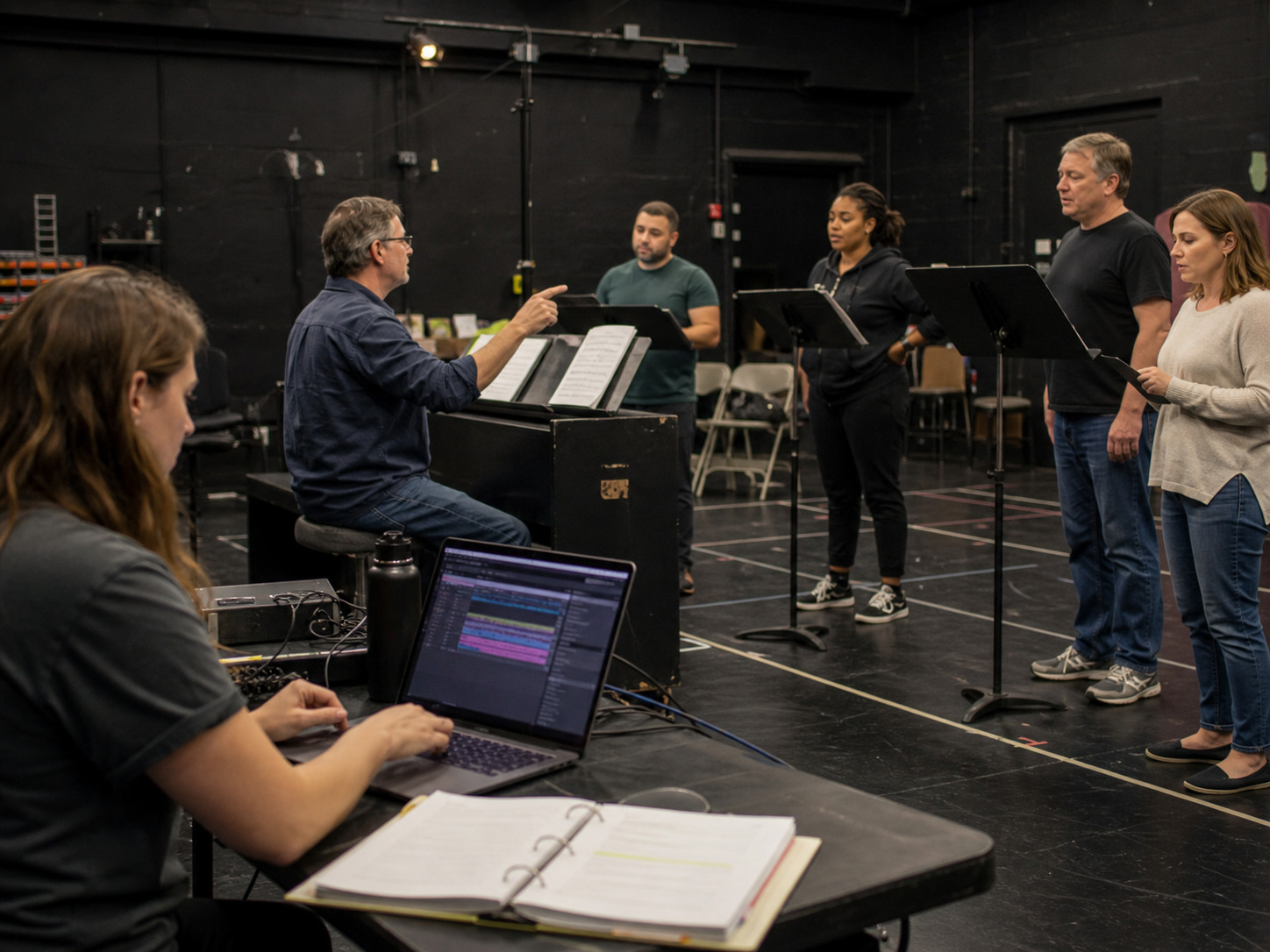
Ask the operator to practice:
- selecting the next file without searching;
- confirming the cue number before GO;
- starting from the actual trigger;
- stopping or fading only where documented;
- moving to a restart point;
- switching to the backup system;
- and recognizing any file that must never be used in performance.
Use the exact performance device, playback software, output route, and backup method whenever possible. A cast-only brush-up may sound confident while leaving the most important technical handoffs untested.
Protect the approved show from late drift
A brush-up often surfaces requests such as “Can we hold that longer?” or “Didn't this ending used to be different?” Record those questions without changing the show in the room.
Use a simple decision rule:
- If the approved track and staging still work, restore them.
- If the current production has a repeatable problem, document the exact cue and effect.
- If an edit is needed, assign one decision owner and one replacement deadline.
- Test the replacement before it enters the performance package.
- Remove or archive the superseded file so it cannot be chosen accidentally.
This keeps one uncertain memory from spreading into several conflicting versions.
A 60-minute brush-up structure
For a production that does not need a complete run, a focused hour can restore the highest-risk material.
First 10 minutes: package check
Confirm the show-order list, performance device, current files, backup, operator, cue sheet, and notes from the last performance.
Next 15 minutes: musical entrances
Test dialogue-to-song pickups, reprises, first entrances after scene changes, and any section whose audible landmark is easy to miss.
Next 15 minutes: movement and flexible cues
Run dance-break starts, vamps, applause holds, buttons, stings, blackouts, and scene-change releases.
Next 10 minutes: recovery
Practice one missed start, one safe restart, and one backup-system handoff.
Final 10 minutes: performance proof
Run the most vulnerable sequence with accompaniment-only files, then confirm the approved package and unresolved notes.
Adjust the timing to the production, but keep the order: establish the version, restore the risky handoffs, test recovery, and finish with performance evidence.
Brush-up checklist
Before the next audience enters, confirm that:
- the cast and operator are using one approved performance package;
- old or rehearsal-only files cannot be mistaken for performance tracks;
- dialogue pickups and audible landmarks are secure;
- dance breaks begin on a shared count;
- vamps and holds have one cue owner;
- scene changes fit the current staging;
- guide-vocal review has been repeated with accompaniment-only tracks;
- at least one restart and backup handoff has been tested;
- new edit requests have an owner and deadline;
- and the final show-order map matches the files on the playback device.
FAQ: musical-theater brush-up rehearsals with backing tracks
Should a brush-up rehearsal run the whole show?
Only when the production needs a complete continuity run. If most material is secure, a risk-based rehearsal that tests entrances, transitions, dance breaks, flexible cues, and recovery points can be more useful.
Which tracks should the cast use after a long break?
Use the current approved rehearsal references for recall and the current approved accompaniment files for performance proof. Do not rely on personal copies whose version cannot be verified.
When should a backing track be changed during a brush-up?
Change it only when the approved staging and performance expose a repeatable musical or cue problem that the existing file cannot support. Document the exact problem before requesting the edit.
Who decides which version is final?
Assign one production owner—commonly the music director, director, or another named leader—to approve musical versions. The stage manager and operator then need one matching performance package.
What is the most important final test?
Run the highest-risk sequence with the exact accompaniment files, device, cue owner, operator, and recovery plan intended for the next performance.
The useful test
Build or revise the keys, cuts, cues, vamps, endings, and restart points your cast and operator need for a dependable return to performance.
Restore the Performance PackageAt the end of the brush-up, ask: Could the company perform the next show from this exact playback package without relying on someone's memory of an older version?
If the answer is yes, the rehearsal restored the production. If the answer is no, the remaining issue needs an owner, a precise next action, and a verified replacement before the house opens.