Make “Mushnik and Son” Change Tactics on Every Beat
By Broadwaytrax Content Studio · November 9, 2026
Updated November 9, 2026
The short answer: rehearse “Mushnik and Son” as a negotiation that keeps changing tactics. The accompaniment supplies a fixed comic clock, but the scene lands only when Mushnik and Seymour listen, counter, interrupt, and finally make the adoption offer feel like a genuine turn—not just the next section of the song.
Broadwaytrax offers a (“Mushnik and Son” accompaniment track), a separate guide-vocal track, and the number inside the (complete Little Shop of Horrors album). That gives a school or community-theater team a useful rehearsal path: learn the musical map with the guide, then prove the acting and timing against the accompaniment version.
Bring "Make “Mushnik and Son” Change Tactics on Every Beat" to life with custom tracks
Get the exact arrangement you need—either customize an existing accompaniment or commission a bespoke build from our team.
Don't see this show in our library yet? We'll build it for you.Start with the deal, not the dance
The number can become a string of amusing moves if the actors begin with choreography. Before staging it, name what each character wants.
- Mushnik wants security, control, and a way to keep Seymour—and the shop’s new success—close.
- Seymour wants belonging, recognition, and relief from the life he has known, but he still has to decide whether Mushnik’s offer is real.
Speak the scene over a quiet pulse before singing. At every change, ask:
- Who just gained leverage?
- What new tactic follows?
- Is the next musical entrance an offer, objection, test, celebration, or decision?
- What does the other actor hear that changes the scene?
When those answers are clear, the physical comedy has something to reveal. Without them, even precise steps can feel decorative.
Give every section a different tactic
Do not play the whole number at one level of excitement. Divide it into playable units and give each unit a verb.
Possible rehearsal verbs include:
- probe — Mushnik tests whether Seymour might stay;
- sell — he makes the future sound irresistible;
- doubt — Seymour questions the offer or his place in it;
- pressure — the deal becomes harder to refuse;
- imagine — both characters see what the new relationship could mean;
- claim — the adoption offer becomes public and specific;
- celebrate — the agreement releases the built-up tension.
The exact labels can change with the production. What matters is that the actors can name the turn before they add more movement or volume.
Run the number once with only these tactics and the accompaniment track. The audience should be able to follow the deal even if the staging is minimal.
Rehearse interruptions as handoffs
Fast duet writing often fails at the seams. One actor finishes a phrase, the other actor waits, and the accompaniment exposes the pause.
Mark every handoff with three pieces of information:
- the audible cue in the track;
- the thought or action that launches the next entrance;
- the breath that belongs to the incoming actor.
Avoid telling an actor only to “come in faster.” A better note is: “Take the breath while Mushnik turns the offer toward you, then answer on the brass pickup.” That combines acting, listening, and music.
Practice the handoffs without complete phrases. Let one actor deliver the last few words before a transition and the other actor enter on the agreed cue. Repeat until the exchange sounds immediate rather than memorized.
Let the accompaniment carry the comic clock
The track is dependable; the characters should not become mechanical.
Find the larger pulse together. Walk it, tap it, or speak the scene over it. Then identify which moments need to sit exactly on the accompaniment and which reactions can happen inside the available space.
Use a rehearsal grid:
| Pass | What to test |
|---|---|
| Track only | introductions, transitions, accents, ending |
| Spoken scene + pulse | tactic changes and interruptions |
| Voices + track | entrances, consonants, releases, balance |
| Movement + track | safe pathways and repeatable comic timing |
| Full scene | whether every musical change advances the deal |
If a joke stops landing, do not immediately slow the track. Check whether the setup is visible, the target is clear, and the reaction arrives before the next musical idea.
Build contrasting physical worlds
The duet is clearer when Mushnik and Seymour do not move like the same person.
Mushnik may use the shop as territory: direct routes, confident ownership, deliberate presentation. Seymour may begin smaller or more reactive, then take up more space as the offer changes his status.
Choose a few contrasts:
- straight path versus hesitant path;
- planted stance versus restless hands;
- direct eye contact versus delayed eye contact;
- broad salesmanship versus private disbelief;
- leading the movement versus being pulled into it.
Do not overload the scene with business. One repeated gesture that changes meaning can be funnier than a new gag on every measure.
Make sure shelves, counters, props, and any plant scenery leave both actors a safe, repeatable route. Comic speed never outranks a clear path.
Make the adoption offer the real turn
The title can make the number sound like a novelty duet, but its dramatic hinge is belonging. The adoption offer should change how Seymour hears the rest of the scene.
Rehearse that moment three ways:
- Too casual: the offer passes without consequence.
- Too announced: the actors signal its importance before the audience can discover it.
- Specific and heard: Mushnik makes the offer because his tactic has arrived there, and Seymour takes time inside the pulse to understand what it means.
Compare the runs. Keep the version in which the next musical phrase becomes necessary because Seymour has truly heard the offer.
The reaction may be small. A stopped movement, a changed eye line, or a delayed answer can carry more weight than a broad emotional display.
Separate guide-track work from performance-track work
The guide-vocal version is useful for learning entrances, text placement, and the relationship between the two vocal lines. It should not become the actor’s permanent scene partner.
Use the guide in an early pass to:
- confirm the musical roadmap;
- hear where phrases overlap;
- check shared releases;
- mark difficult pickups;
- compare how the lines fit over the orchestration.
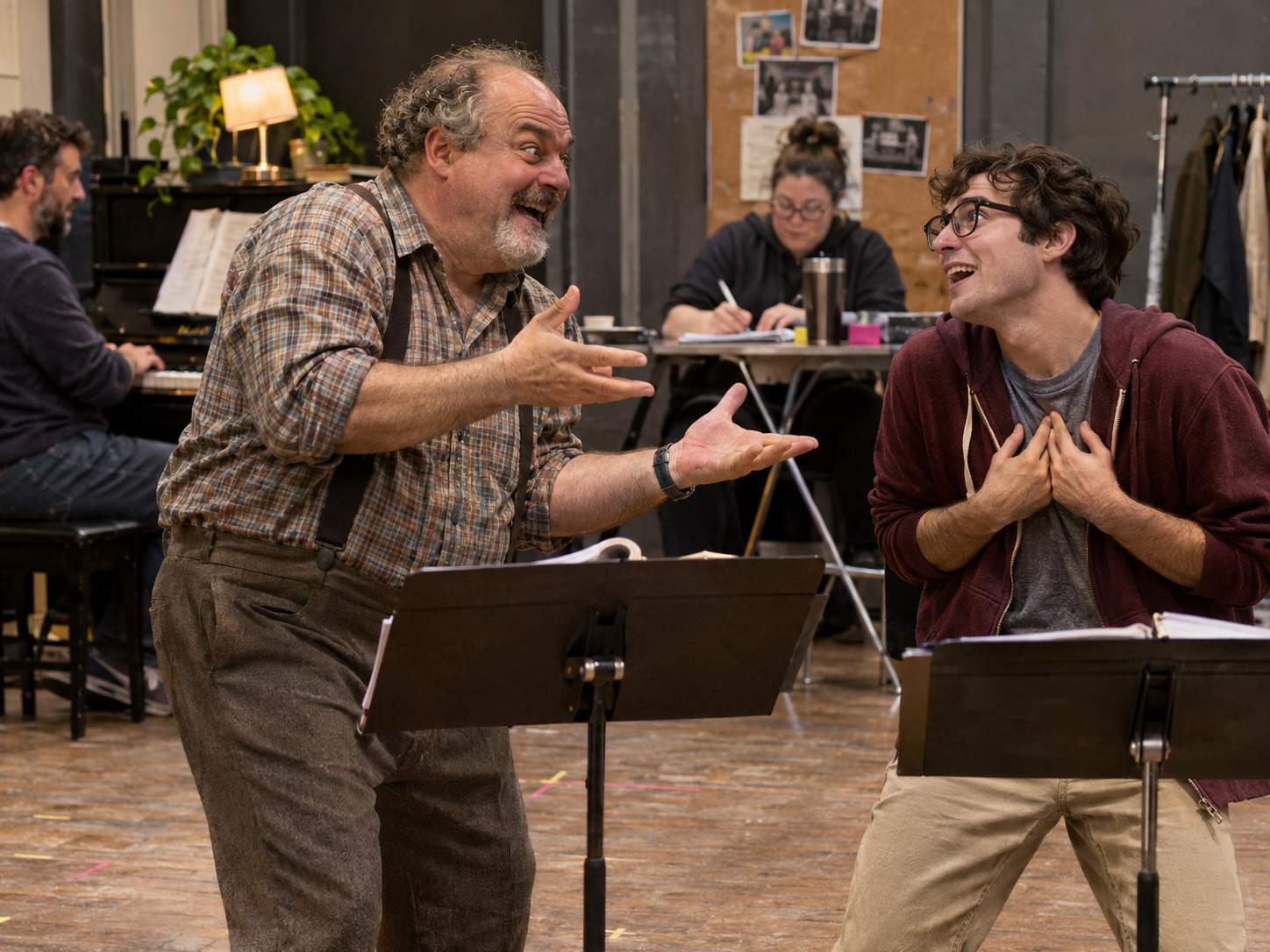
Then switch to the accompaniment track and keep it there for acting rehearsals. The performers need to own the timing without following another singer’s inflection.
Label the rehearsal files clearly. Remove preview files and alternate versions from the live playback folder so the stage manager or operator cannot start the wrong one.
Balance two voices over a busy scene
The audience needs the negotiation, not simply two loud voices.
Listen from the center and sides of the room. Confirm that:
- each actor’s text remains understandable;
- overlapping material has a clear focus;
- the accompaniment supports the groove without covering consonants;
- movement does not pull a performer out of the microphone pattern;
- laughter space does not cause the next entrance to drift;
- the ending leaves room for the next stage action.
If one voice disappears, solve the cause before adding overall level. Check mic position, balance, diction, blocking, and whether the actor is turning away at the crucial moment.
Rehearse laughter without waiting for it
Comedy needs room, but performers cannot predict exactly where or how long an audience will respond.
Mark the difference between:
- a line that needs a clean landing;
- a reaction that can absorb laughter;
- an entrance that must stay with the track;
- a movement that can continue while the room responds.
Run the scene once with the rehearsal room creating short, medium, and no-response conditions. The actors should keep the deal clear in all three without fighting the accompaniment.
Never plan to hold a fixed track indefinitely for a laugh unless the approved recording and playback plan provide a tested way to do it. Instead, place flexible reactions where the music already allows them.
Plan practical pickup points
Choose three places where rehearsal can restart without returning to the beginning.
For each pickup, write down:
- the track landmark;
- the actors’ exact positions;
- who owns the first thought;
- the first breath or spoken cue;
- any prop or scenery reset.
Useful pickup points usually sit before a new tactic, the adoption offer, and the final release. Test them with the actual playback operator.
If the standard track is close but the production has a tested need, the Broadwaytrax product page offers customization choices for key, tempo, cuts, lead-ins, endings, and comments. Request only a precise change the team can verify. A vague request to “make it easier” does not tell the producer what should change.
A 25-minute duet rehearsal
Minutes 1–5: hear the musical map
Listen to the introduction, major transitions, adoption-offer turn, and ending. Name the audible landmarks.
Minutes 6–10: speak the tactics
Run the negotiation as dialogue over the larger pulse. Make every change of leverage visible.
Minutes 11–15: drill the seams
Repeat only interruptions, overlaps, and handoffs. Pair each entrance with an acting cue and track cue.
Minutes 16–20: add the physical contrast
Test the actors’ routes, shop territory, sightlines, and one or two repeatable comic actions.
Minutes 21–25: prove the turn
Run into and out of the adoption offer, then continue through the ending and the next scene action.
Rehearsal checklist
- Mushnik and Seymour can name what they want.
- Every section has a distinct tactic.
- Interruptions have audible and dramatic cues.
- The actors share the larger pulse.
- Movement reveals character contrast instead of decorating the music.
- The adoption offer changes the scene.
- The guide-vocal track is used for learning, not final performance timing.
- Overlaps remain understandable from audience distance.
- Laughter space is planned without abandoning the fixed track.
- Props and pathways are safe at performance speed.
- At least three pickup points are documented.
- Only the approved accompaniment file is in the live folder.
- The ending has been rehearsed into the next stage action.
- Recording permission and the show’s theatrical rights are handled separately.
Common questions
Should the duet be rehearsed with choreography first?
No. Establish the negotiation, tactic changes, handoffs, and pulse first. Add movement after the actors can make the deal clear against the accompaniment.
How do we keep fast entrances from sounding rushed?
Prepare the breath during the other actor’s action, and link the entrance to an audible track landmark. Fast does not have to mean late or panicked.
When should we switch away from the guide vocal?
Once the performers understand the vocal map and overlaps, use the accompaniment track for acting and staging work. That makes the actors responsible for their own choices and timing.
Can the accompaniment be customized?
Give Mushnik and Seymour a dependable musical clock for every offer, objection, and turn.
PREVIEW MUSHNIK AND SONBroadwaytrax provides options for key, tempo, cuts, lead-ins, endings, and production comments. Test the standard track first, then describe the exact musical location, reason, and result the team needs.
The duet works when the audience hears a deal being invented in real time. Keep the musical clock steady, let the tactics change, and make the adoption offer land because both characters have earned the turn.