“Magic Foot” Is Funnier When Every Step Lands on Purpose
By Broadwaytrax Content Studio · October 19, 2026
The short answer: rehearse the footwork as a musical cue, not as decoration. In “Magic Foot,” the joke reads when the performer, ensemble, and playback operator all know exactly which step, reaction, and release belongs to each musical landmark.
That does not mean making the number rigid. It means giving the actor enough rhythmic security to stay playful. When the accompaniment is dependable and the room knows where to listen, the physical comedy can feel spontaneous without becoming late, noisy, or hard to follow.
Bring "“Magic Foot” Is Funnier When Every Step Lands on Purpose" to life with custom tracks
Get the exact arrangement you need—either customize an existing accompaniment or commission a bespoke build from our team.
Don't see this show in our library yet? We'll build it for you.Broadwaytrax offers a (“Magic Foot” accompaniment track) for The 25th Annual Putnam County Spelling Bee. Use the track as the shared clock for the performer, scene partners, director, choreographer, and playback operator.
Give the routine one clear musical map
Before adding full movement, listen through the track and mark a few landmarks everyone can name. Avoid notes that only one department understands.
| Landmark | Performer’s job | Room’s job |
|---|---|---|
| Start cue | Be physically ready before playback begins | One person gives the cue; everyone else stays quiet |
| First rhythmic idea | Establish the movement vocabulary clearly | Watch rather than adding extra reactions |
| Pattern change | Shift energy, direction, or focus | Track the new pattern and protect the sightline |
| Comedic reveal | Let the audience understand what changed | React after the idea is legible, not before |
| Final musical turn | Commit to the last physical choice | Prepare the next scene or spoken pickup |
| Button or cutoff | Finish in one readable picture | Hold long enough for the moment to land |
The names do not need to be technical. “First toe pattern,” “turn to the spellers,” or “final pose” may be more useful than a measure number if those are the phrases the room already uses.
Learn the rhythm before decorating it
Physical comedy gets harder when the performer tries to solve rhythm, character, staging, and audience response at the same time.
Build the number in layers:
- Clap or speak the important rhythmic pattern with the track.
- Mark the footwork at half energy while facing one direction.
- Add the actor’s focus and character objective.
- Place the movement in the actual stage space.
- Add ensemble reactions only after the main action reads.
- Run the ending into the next line or cue.
If the actor loses the track during step two, more choreography will not solve the problem. Return to the audible landmark and make the physical accent simpler. The audience needs to understand the idea before it can enjoy the detail.
Keep the comedy inside the beat
A funny number does not require every beat to contain a new joke. Too many added gestures can blur the rhythm that makes the scene funny in the first place.
Choose three kinds of moment:
- Setup: the audience sees the rule of the movement.
- Development: the rule becomes more specific, confident, or surprising.
- Payoff: the performer and room arrive at a clear musical result.
Rehearse the setup cleanly. If the first version of the footwork is hard to read, the later variation has nothing to build on. Let the accompaniment create forward motion instead of asking the actor to fill every space.
This is especially important with a fixed track. A live player can sometimes wait for a laugh or follow an improvised pause. A recording keeps moving. The production should decide which comic moments fit inside the existing music and which would require a planned edit rather than an unreliable delay.
Assign ensemble reactions like choreography
The other spellers and adults in the scene help the audience know where to look. Their reactions should support the featured action, not compete with it.
Ask each ensemble member to identify:
- the first moment they notice the routine;
- the point when their reaction changes;
- whether they look at the performer, another character, or the authority figure;
- how large the reaction should be from the audience’s distance;
- and when they must reset for the next cue.
Run the scene once with no reactions. Then add them in groups. This makes it easier to find the moment when the stage picture becomes busy or a laugh begins too early.
The goal is not synchronized facial expression. The goal is a shared focus that lets distinct characters react without covering the main action.
Rehearse sightlines and sound together
Footwork can be rhythmically accurate and still disappear from part of the house. Test the routine from several seats before tech week.
Check whether:
- tables, chairs, music stands, or other actors block the feet;
- the performer travels out of the useful light;
- the floor surface changes the sound or safety of a step;
- microphones, costumes, or footwear restrict movement;
- the track remains audible from the performer’s position;
- and the audience can see the final picture.
Do not simply raise the playback volume because the performer loses the beat. First check speaker placement, monitor coverage, room noise, and whether the movement itself is masking a quiet musical cue.
Use performance footwear as soon as it is safe and practical. A step that feels precise in rehearsal shoes may sound or move differently in costume.
Decide how the number survives a laugh
The production cannot predict the exact length of an audience response, but it can protect the most important information.
Identify any spoken or physical beat that must be understood before the next musical event. If a likely laugh falls there, test three options:
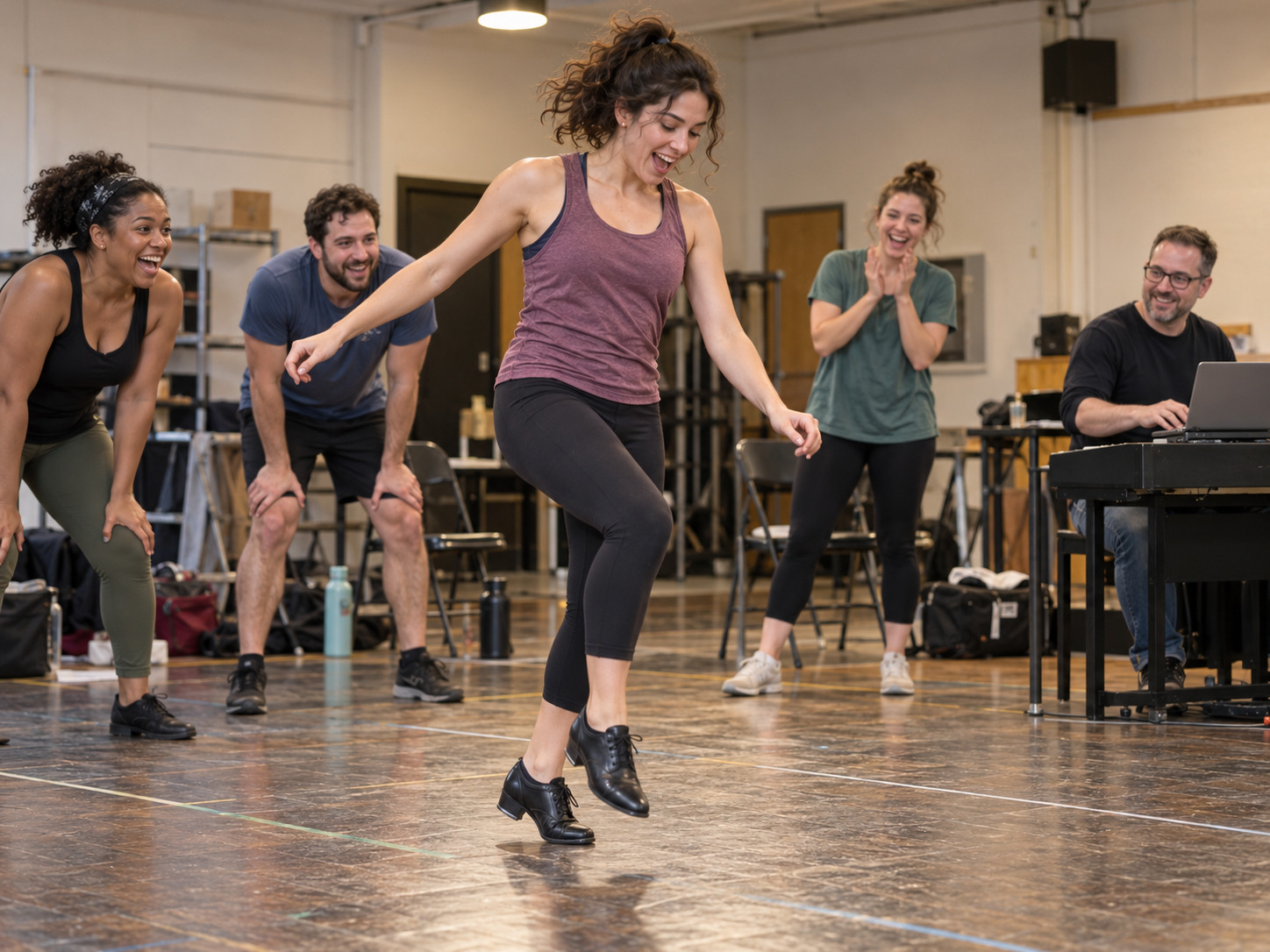
- make the action clearer and earlier;
- keep the performer physically active while the track continues;
- or request a production-specific edit only after the timing need is proven.
Do not build a plan around stopping and restarting the track in a different place every night. If a moment truly needs flexible time, document the requirement and solve it before performances.
The broader (Spelling Bee backing-track cue guide) can help the production connect this song-specific work to the show’s dialogue, interruptions, and scene transitions.
Give the operator a useful cue card
The playback operator should not have to interpret choreography from the booth. Provide a short, production-facing card:
- exact approved filename;
- who gives the start cue;
- what the performer is doing during the introduction;
- two or three audible landmarks;
- the final musical event;
- the first line or action after the track;
- and one tested recovery point.
Keep guide-vocal, rehearsal, and performance files clearly separated. If the production needs a different key, tempo, cut, lead-in, or ending, (Broadwaytrax custom-track support) can shape a request around the confirmed staging need.
A focused 25-minute rehearsal
Minutes 1–5: hear and mark
Listen once without full movement. Name the start, pattern change, reveal, final turn, and cutoff.
Minutes 6–11: build the feet
Mark the core rhythm and pathway at reduced energy. Simplify any step that hides the beat.
Minutes 12–16: add focus and reactions
Set the performer’s eyeline and introduce ensemble reactions in small groups.
Minutes 17–21: test the room
Run in the real playing space with planned footwear, furniture, speakers, and sightlines.
Minutes 22–25: connect the edges
Start from the preceding dialogue or action, then carry the final musical picture into the next cue.
Final checklist
- One person owns the playback cue.
- The performer can mark the rhythmic pattern without full choreography.
- The routine has a clear setup, development, and payoff.
- Ensemble reactions begin after the main idea is readable.
- Likely laugh points were tested against the fixed track.
- Footwear, floor surface, props, and costume limits were checked.
- The performer can hear the accompaniment from every stage position.
- The final picture and next scene cue were rehearsed together.
- Guide, rehearsal, and performance files are clearly labeled.
- Any requested edit names the exact practical timing need.
FAQ: rehearsing “Magic Foot” with a backing track
Should the choreography be finished before using the accompaniment track?
No. Use the track early to establish rhythm and musical landmarks, then add staging in layers. The cast should not learn a flexible timing pattern and discover later that it does not fit the recorded accompaniment.
How can the performer stay spontaneous with fixed playback?
Make the important landmarks dependable and leave the acting between them alive. Rhythmic security gives the performer more freedom to focus on character, focus, and audience connection.
What should the ensemble rehearse?
Rehearse when each character notices the routine, where they look, how the reaction develops, and when they reset. Add reactions only after the featured movement reads clearly.
What if an audience laugh covers the next moment?
Test whether the action can happen earlier or remain visually clear while the track continues. If the scene consistently needs more time, document the exact need before requesting an edit.
What belongs in the operator’s notes?
Use the Broadwaytrax Magic Foot accompaniment track as the shared rhythmic map for footwork, reactions, stage traffic, and playback cues. Preview the track, then test the exact staging with the file your production will use.
Preview the Magic Foot TrackInclude the exact file, start cue, introduction action, audible landmarks, ending, next scene event, and a tested recovery point.
The strongest version of the number is not the one with the most movement. It is the one in which every musical step has a purpose, every reaction helps the audience look, and the final beat arrives with the whole room ready for it.