Let “I Can Hear the Bells” Build One Thought at a Time
By Broadwaytrax Content Studio · September 29, 2026
Updated September 29, 2026
The short answer: rehearse “I Can Hear the Bells” as a chain of discoveries, not one long burst of excitement. Mark what the character imagines at each turn, let the accompaniment carry the pace, and make every new thought change the body, focus, and sound.
That approach is especially useful when moving from a guide vocal to an accompaniment-only track. The guide can teach the musical route. The actor still has to make the scene feel as if it is happening for the first time.
Start with the exact track version
Broadwaytrax lists an (“I Can Hear the Bells” accompaniment track) from Hairspray. The (complete Hairspray album) includes both guide-vocal and accompaniment versions of the score.
Use those two file types for different jobs:
- The guide vocal helps a performer learn melody, rhythm, entrances, and the arrangement’s complete shape.
- The accompaniment track removes the reference singer so the actor carries the storytelling and vocal line.
- A custom edit may help when an approved production or audition plan needs a different key, cut, tempo, lead-in, or ending.
Confirm the file before rehearsal. A folder labeled only with the song title makes it too easy to practice with the guide and accidentally send the wrong version to a coach, operator, or audition room.
Turn the song into playable scene beats
The number moves because the character’s imagination keeps getting more specific. A useful rehearsal map does not need to copy every lyric into the notes. It needs to identify the change in thought.
Try a five-beat map:
- The first surprise. Something ordinary suddenly feels charged with possibility.
- The imagined future. The character sees beyond the present moment and begins building a complete story.
- The private certainty. The fantasy becomes emotionally real, even if no one else can see it.
- The expanding world. More people, places, and consequences enter the imagination.
- The final claim. The actor finishes with a clear decision about what this vision means.
Write one active verb beside each beat: notice, test, picture, claim, invite, or another playable action that fits the production. Avoid a note such as “get more excited.” Excitement is a result. An action gives the performer something concrete to do.
Let the accompaniment reveal each turn
A fixed backing track will not wait for an actor to search for the next idea. The performer needs to know which sounds in the arrangement release the next thought.
Listen once without singing and mark:
- the length and character of the introduction;
- the first vocal entrance;
- changes in instrumental energy;
- short spaces where an acting reaction can land;
- transitions into larger sections;
- and the final musical button or cutoff.
Then speak the scene beats over the track without trying to match every word. The purpose is to feel how quickly the imagination has to move. If a new idea repeatedly arrives late, identify the musical landmark before it rather than telling the actor to “catch up.”
The track should make the sequence dependable without making the performance mechanical.
Move away from the guide vocal in short sections
Do not wait until the whole number feels perfect before removing the reference singer.
Use this progression:
- Listen with the guide vocal and mark the arrangement.
- Sing one scene beat with the guide.
- Repeat that same section with accompaniment only.
- Continue through the next transition before stopping.
- Join two or three beats together, still on accompaniment.
- Run the complete number without returning to the guide unless a specific passage needs repair.
This keeps the guide in its proper role: a learning tool. If the performer can reproduce the notes only while hearing another singer, the acting work is not yet resting on an independent musical foundation.
Give physical comedy a musical address
The song invites physical imagination, but adding a gesture to every phrase can make the scene look illustrated instead of lived.
Choose a few moments where the body changes because the thought changes. For each one, name:
- the musical cue that begins the action;
- where the actor’s focus moves;
- how long the action takes;
- whether it affects breath or sound;
- and what releases the performer into the next beat.
Rehearse large stage business at half size first. Once its timing is musical, expand it to the production’s style. A turn, cross, prop action, or comic reaction should finish in time for the next vocal entrance without making the performer rush the text.
If choreography or blocking keeps covering the same words, treat that as a design problem. Moving the speaker louder is not the only answer.
Keep the character in front of the sound
An energetic arrangement can tempt a singer to push. Test balance from the audience or camera position, not only beside the playback speaker.
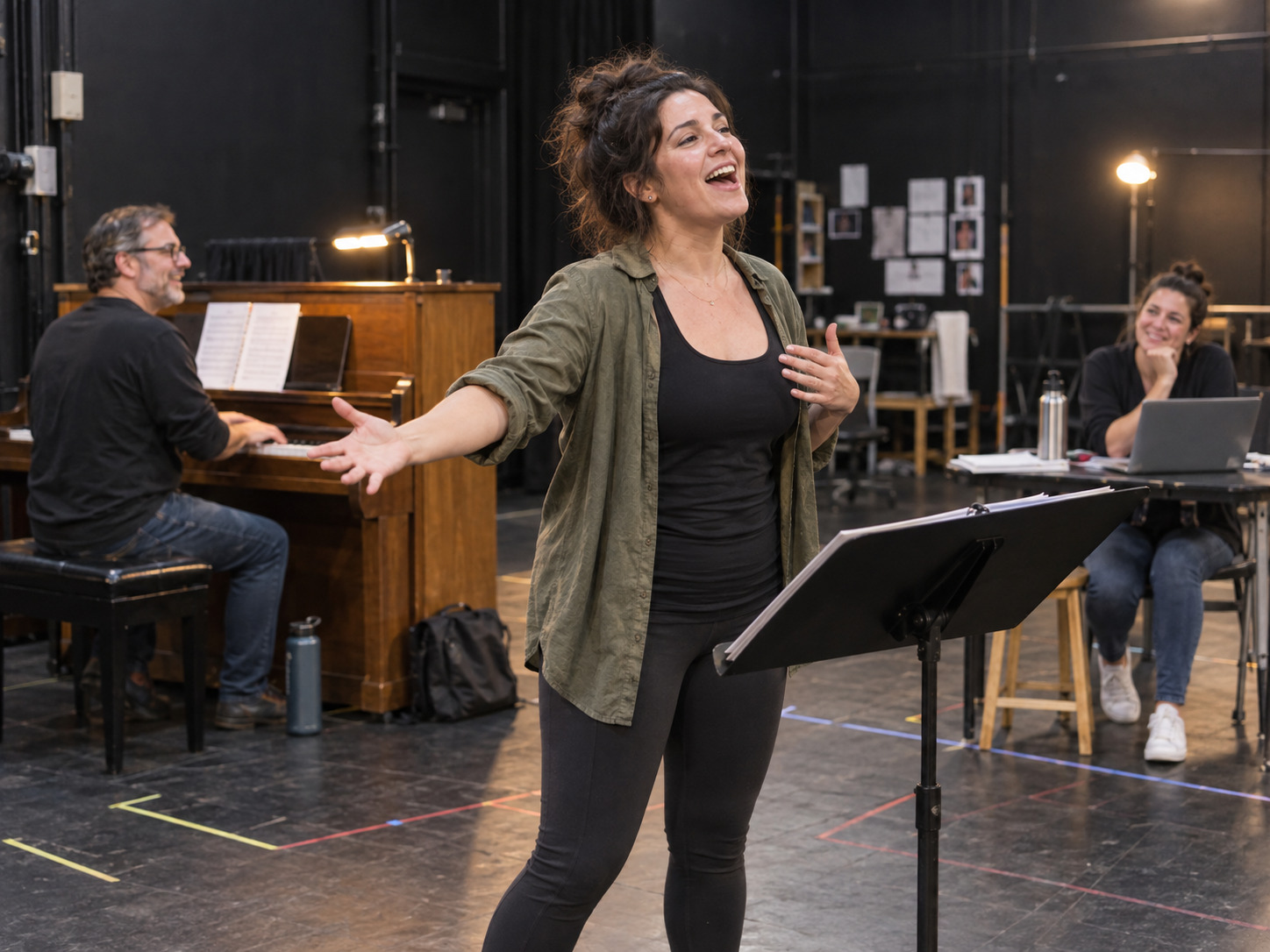
Check three things separately:
- Words: can a listener understand the thought without reading along?
- Tone: does the voice stay free when the arrangement becomes fuller?
- Focus: does the performer still appear to be thinking, or only keeping up?
For a self-tape or studio recording, keep the playback source far enough from the vocal microphone that the track does not overwhelm the voice. For a stage rehearsal, test the actual speaker placement after blocking is added. The performer should not have to turn toward a speaker to find the next entrance.
Rehearse the opening and ending with the operator
The first and last moments need their own plan.
At the opening, decide who starts playback, what the actor is doing before the first sound, and which musical landmark releases the entrance. Begin the run before anyone presses play. That is the only way to test whether the scene flows into the track.
At the ending, agree on the final physical position, musical release, and next event. Continue through the silence after the track. A strong final button can lose its effect if the actor, operator, and scene partner all react at different times.
The cue sheet should name the exact file, start trigger, first entrance, a safe restart point, final cutoff, and what follows.
A 30-minute rehearsal plan
Minutes 1–5: listen and map
Hear the complete guide-vocal or accompaniment version. Mark the introduction, five scene beats, transitions, and ending.
Minutes 6–12: speak and move
Speak the beat changes over the accompaniment. Add only the physical actions that clarify a change in thought.
Minutes 13–20: guide-to-accompaniment handoff
Use the guide for one difficult section, then repeat it immediately with accompaniment only. Join that section to what comes before and after.
Minutes 21–26: audience-position check
Run the number while a director, coach, or classmate watches from the house or camera position. Note clarity, balance, and any movement that disrupts breath or cue recognition.
Minutes 27–30: opening and ending
Run from the scene before playback through the first complete phrase. Then run the last section through the next line, movement, or blackout.
Rehearsal checklist
- The performer knows whether the file is guide vocal or accompaniment only.
- Every major scene beat has a playable action.
- Musical landmarks release each change in thought.
- Physical business fits the track without rushing the next entrance.
- The words remain clear when the arrangement grows.
- The performer can sing independently without a reference voice.
- The operator has one approved file and complete cue notes.
- The opening and ending connect to the surrounding scene.
FAQ: “I Can Hear the Bells” backing tracks
Should the actor practice with the guide vocal every time?
No. Use it to learn or repair a specific musical passage, then return to accompaniment so the performer owns the line and the scene.
Is the accompaniment track appropriate for an audition?
Follow the audition instructions first. If tracks are allowed, confirm the requested length and format, build a clean cut, and use accompaniment rather than a guide vocal for the submitted or live performance unless the notice says otherwise.
What if the standard key or cut does not fit?
Test the complete selection with the singer before requesting a change. The product page provides a route for key, tempo, and cut customization. Describe the exact musical need rather than asking generally for an easier version.
How much movement should the performer use?
Preview the accompaniment version, then use one approved file to rehearse the scene beats, physical timing, opening cue, and final button.
Preview the AccompanimentEnough to make the changing imagination visible, but not so much that every phrase receives a gesture. Choose a few actions that grow naturally from the scene beats and fit the musical timing.
The final test is simple: can a listener follow each new discovery even without scenery or a costume? When the acting beats, vocal line, and accompaniment all point in the same direction, the number feels spontaneous without becoming musically uncertain.