“Dentist!” Gets Funnier When Every Beat Has a Target
By Broadwaytrax Content Studio · October 13, 2026
Updated October 13, 2026
The short answer: “Dentist!” gets funnier when the performer treats the backing track as a scene partner with exact comic beats—not as music underneath a collection of jokes. Decide who each beat is aimed at, rehearse the spoken-to-sung handoffs against the exact file, and keep the physical choices simple enough that the rhythm can do its work.
That matters in Little Shop of Horrors because the number has to move with confidence while still feeling dangerous, specific, and alive. A fixed accompaniment can make the comic structure dependable, but only if the actor, director, music director, and playback operator agree on the same map.
Bring "“Dentist!” Gets Funnier When Every Beat Has a Target" to life with custom tracks
Get the exact arrangement you need—either customize an existing accompaniment or commission a bespoke build from our team.
Don't see this show in our library yet? We'll build it for you.Start with the target, not the punch line
Before singing, answer one question for every section: Who is Orin trying to affect right now?
The target may be a person in the room, an imagined audience, or Orin himself. What matters is that each phrase is doing something. “Be funny” is not playable. Boast, intimidate, recruit, demonstrate, dismiss, and celebrate are playable actions.
Speak through the number as a scene without copying the melody. Mark where the tactic changes. If the actor uses the same grin, volume, and body shape throughout, the audience sees a pose instead of a character making choices.
A useful first map has four columns:
| Musical section | Target | Action | Visible change |
|---|---|---|---|
| Opening setup | The room | Establish authority | Still, direct focus |
| First escalation | A specific listener | Demonstrate control | One deliberate shift |
| Comic acceleration | The audience | Invite them into the logic | Quicker thought, not quicker tempo |
| Final drive | Everyone | Claim the whole space | Broader focus, clean finish |
The exact choices can change with the production. The point is to make the progression legible before adding more movement.
Learn the groove before adding business
Comic acting often speeds up when the performer feels an audience response coming. The accompaniment will not follow that impulse. Rehearse the groove first so a laugh, gesture, or prop does not pull the entrance late.
Run the (Broadwaytrax Little Shop of Horrors album) once without singing. Tap only the main pulse and mark:
- the first vocal entrance;
- the pickups that are easy to anticipate;
- instrumental figures that cue a new idea;
- moments where a physical choice could obscure the next breath;
- the final button and the silence after it.
Then speak the text in rhythm over the accompaniment. Keep the pitch out of the exercise. This exposes late consonants, swallowed setup lines, and places where the actor is waiting for a joke instead of continuing the thought.
When the rhythm is secure, add the melody without staging. Physical comedy comes last. That order protects the musical drive and makes each later choice easier to judge.
Use the guide vocal as a map, then remove it
The album includes guide-vocal and accompaniment versions of the show’s songs. The guide vocal can help establish entrances, phrasing, and the relationship between the vocal line and the arrangement. It should not become the permanent leader of the performance.
Use a three-step handoff:
- Guide vocal: listen for the architecture and confirm every entrance.
- Alternating passes: rehearse one section with the guide, then repeat it with accompaniment only.
- Accompaniment only: make the actor responsible for the breath, intention, and timing.
Do not keep switching among files from different sources. Small differences in lead-in, tempo, or ending can teach the performer to hesitate. Name one approved rehearsal file and use that same timing for staging, sound check, and performance.
Rehearse the edges of every laugh
A laugh can change from night to night, but the track keeps moving. The production does not need to predict the exact length of every response. It needs a plan for what the actor does while the music continues.
For each likely laugh point, rehearse three versions:
- No response: the actor completes the thought and stays in tempo.
- Small response: the actor listens without adding time, then continues.
- Strong response: the actor remains active, protects the next entrance, and lets the music carry the scene forward.
Avoid adding an extra pause that the accompaniment does not contain. If the line before an entrance is consistently covered, test a clearer consonant, simpler gesture, or different focus before changing the track.
The audience should feel that the character is listening, not that the actor is waiting for permission to continue.
Give physical comedy one job at a time
Busy staging can make the number less funny because the audience does not know where to look. Build the physical score from a few readable choices.
Try this sequence:
- Run the number standing in one place.
- Add one motivated cross that changes the target.
- Add one prop interaction only if it sharpens the action.
- Add one held picture that lets the musical beat land.
- Remove any movement that makes the next entrance uncertain.
Use neutral rehearsal props until the production’s final items are safe and approved. A performer should never sacrifice footing, breath, or awareness of scene partners for a gag. Directors should also check sightlines from several parts of the room; a choice that reads from the front row may disappear from the back.
Because the song is associated with a dentist character, it can be tempting to fill rehearsal with detailed dental business. The scene does not need realistic instruments or risky physical contact to communicate power. Suggestion, focus, and timing are usually clearer—and safer—than literal action.
Keep the ensemble inside the scene
If other performers watch, react, or help frame the number, give them exact musical landmarks. General instructions such as “react more” tend to create constant noise.
Assign each observer:
- the moment they first understand the character’s logic;
- one musical cue that changes their distance or focus;
- one place to stay still and let the principal performer own the picture;
- the exact cue into the next scene beat.
Rehearse the observers with accompaniment only. They should be able to track the musical form without following the principal performer’s volume or improvisation. That keeps the frame alive even if a laugh lands differently.
Balance the vocal, track, and room
Comedy depends on intelligible language. A backing track that feels exciting near the speaker may cover setup words in the audience.
During sound check:
- test the quietest text, not only the largest note;
- listen from the center and sides of the room;
- keep the microphone position consistent through physical choices;
- check whether the track’s strongest moments mask consonants;
- confirm the performer can hear the pulse without oversinging;
- rehearse the final button and the transition after it.
Record a full run from audience distance. Listen once for words, once for musical timing, and once for comic progression. Fix the earliest problem first. A covered setup line cannot be repaired by making the later punch line larger.
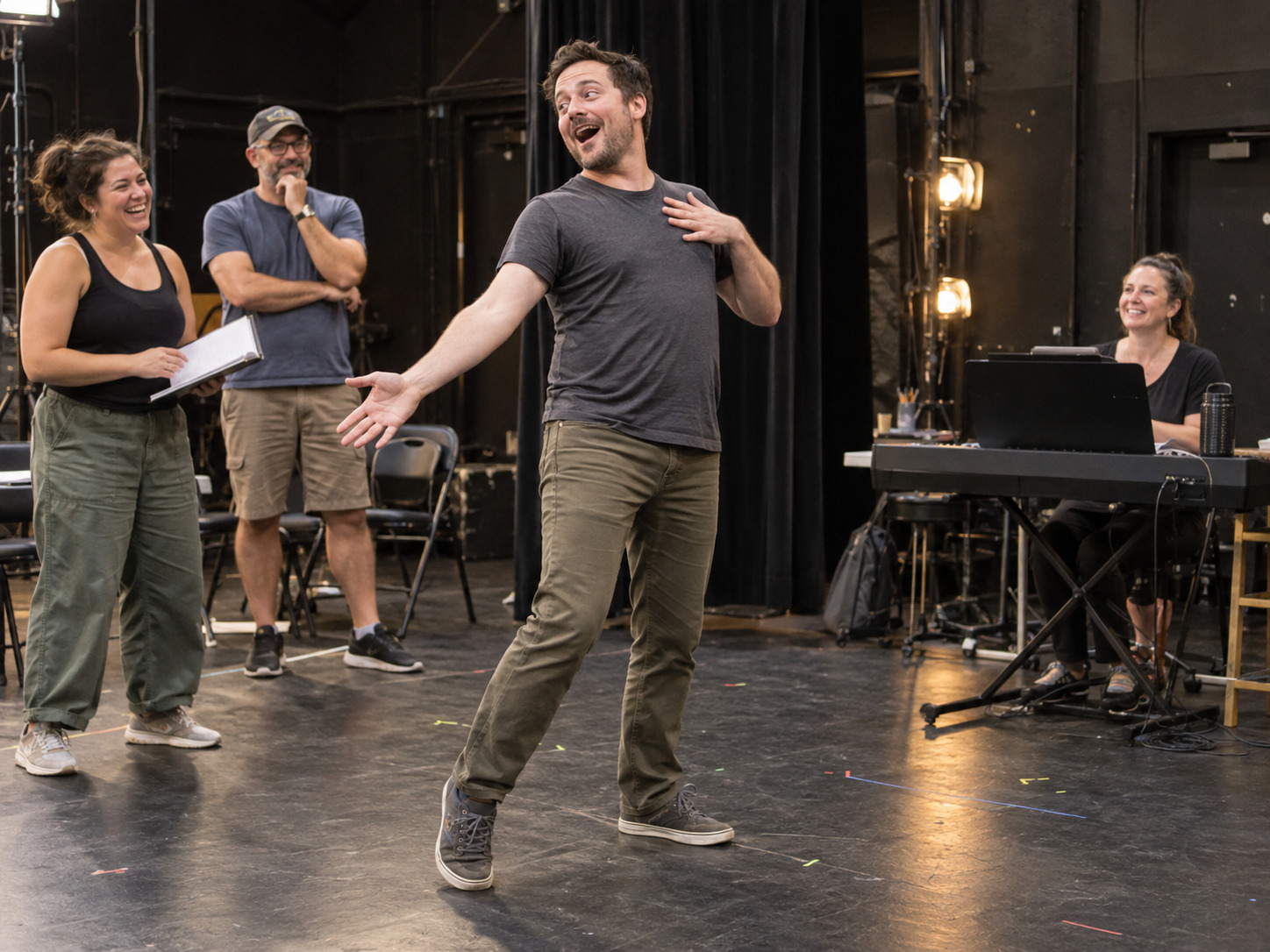
Make custom decisions before tech
If the production needs a different key, cut, tempo, lead-in, or ending, settle that version early. Broadwaytrax offers (custom track services) for production-specific adjustments.
Before requesting a change, describe the practical need precisely:
- which file and section are involved;
- what the performer or staging cannot currently accomplish;
- the exact key, cut, repeat, tempo, cue, or ending requested;
- how the revised track will be used in rehearsal and performance.
Do not ask for a change merely because the number feels difficult on the first pass. First confirm the entrance, breath, target, and physical score. A custom edit solves a musical or production requirement; it does not replace rehearsal.
For a staged production, also confirm the show’s theatrical rights with the appropriate publisher or licensing organization. Permission to use a Broadwaytrax sound recording is separate from permission to present the musical. The (Broadwaytrax guide to backing tracks and grand rights) explains that distinction.
A 30-minute comic-timing rehearsal
Minutes 0–5: name the targets
Speak the scene and identify who each section is trying to affect.
Minutes 5–10: mark the accompaniment
Listen without singing. Note the first entrance, pickups, musical changes, likely laugh points, and final button.
Minutes 10–15: speak in rhythm
Run the text against the accompaniment. Keep the pulse steady and make every setup understandable.
Minutes 15–20: sing without staging
Use accompaniment only. Confirm breaths, consonants, and each tactical change.
Minutes 20–25: add three physical choices
Add one cross, one prop interaction, and one held picture. Remove anything that disrupts the next cue.
Minutes 25–30: test audience response
Run the likely laugh points with no, small, and strong reactions while protecting the exact musical entrance.
Common problems and practical fixes
The actor rushes after a laugh
Return to the pulse and rehearse the next entrance three times without the preceding joke. Then reconnect the setup while keeping the same timing.
The number feels like one long joke
Change the target and action at each major musical section. Let the character’s logic escalate instead of adding more mugging.
The staging covers the words
Reduce movement during setup lines. Save the largest physical picture for a moment when the audience already understands the thought.
The actor depends on the guide vocal
Alternate one short section between guide and accompaniment versions, then remove the guide entirely. Keep the same file timing and entrance map.
The track feels inflexible
Identify the places where the actor can listen, change focus, or shift tactics without changing the tempo. The musical map is fixed; the behavior inside it remains live.
FAQ: rehearsing “Dentist!” with a backing track
Should we begin with the guide vocal or accompaniment track?
Use the guide vocal to learn entrances and structure, then move to accompaniment early enough that the performer owns the phrasing and comic timing.
How do we handle audience laughter with a fixed track?
Rehearse several response levels. Keep the actor active, avoid adding unsupported pauses, and protect the next musical entrance.
Does the number need elaborate props?
No. A small number of safe, motivated choices is often clearer. Use neutral rehearsal props until final items and choreography are approved.
Can the track be changed for our production?
Broadwaytrax can help with custom keys, cuts, tempos, lead-ins, and endings. Settle any revision before late rehearsals and use one approved file afterward.
What should the playback operator know?
Preview the Little Shop of Horrors guide-vocal and accompaniment tracks, choose one approved rehearsal file, and build every comic beat against a dependable musical map.
Preview the Little Shop TracksThe exact filename, start cue, microphone state, likely laugh points, final button, next transition, and backup playback plan.
When the targets, rhythm, and physical score are clear, the accompaniment does more than keep time. It gives the performer a dependable comic structure—and gives the audience room to follow every dangerous little idea.