The Ballad of Sweeney Todd Needs One Shared Pulse
By Broadwaytrax Content Studio · October 16, 2026
Updated October 16, 2026
The short answer: rehearse the opening ballad as one ensemble telling the same warning, not as a row of performers each trying to sound ominous. The company needs a shared pulse, precise consonants, clear responsibility for every entrance, and a planned build that grows through focus rather than speed.
That discipline matters with a backing track. The recording will not wait for a late breath, a slow cross, or a consonant that lands after the beat. A strong rehearsal plan lets the ensemble use that fixed musical shape as a source of tension instead of fighting it.
Bring "The Ballad of Sweeney Todd Needs One Shared Pulse" to life with custom tracks
Get the exact arrangement you need—either customize an existing accompaniment or commission a bespoke build from our team.
Don't see this show in our library yet? We'll build it for you.The Broadwaytrax (Sweeney Todd album) contains 16 guide-vocal tracks and 16 accompaniment tracks in the original show keys and tempos. Use the guide version to establish the complete musical map, then move deliberately to accompaniment-only rehearsal so the live company owns the words, rhythm, and storytelling.
Give every return of the ballad a dramatic job
The recurring ballad is not simply the same chorus appearing between scenes. Each return should tell the audience something new about the world of the story.
Before staging, label the job of each section in plain language. One passage may invite the audience into the tale. Another may sharpen the danger. A later return may connect consequences that the characters cannot yet see. The final use may feel less like an introduction and more like a verdict.
Write those jobs on the rehearsal score and cue sheet. If the cast knows only that a section should be “darker” or “bigger,” performers will often add volume, facial tension, or extra movement without changing the story. A playable function gives the ensemble something specific to do together.
Ask three questions for every return:
- What does the audience understand now that it did not understand before?
- Who or what is the ensemble asking the audience to watch?
- Should this section feel like an invitation, a warning, an interruption, or a conclusion?
The answers should affect focus, spacing, articulation, and dynamics—not just mood.
Find the shared pulse before adding character
The opening can lose its force when every actor treats the rhythm as a personal dramatic choice. Begin with the company standing neutrally and speaking the text in rhythm over the accompaniment.
Have one leader mark the underlying beat. Do not ask the cast to imitate every instrumental attack. Instead, identify the larger pulse that carries the phrase from beginning to end. Then add pitch while keeping the same physical steadiness.
Use a three-pass drill:
- Speak the text together with no staging.
- Sing on a neutral syllable while watching the conductor.
- Restore the words and keep the same unified rhythm.
If the third pass suddenly becomes slower, heavier, or less precise, the cast is using “darkness” as an excuse to abandon the pulse. Suspense is stronger when the timing is exact.
Build diction from releases as well as entrances
Ensemble clarity is not only about starting consonants. Final consonants and releases often determine whether the audience understands a phrase.
Mark a few shared diction points rather than correcting every word. Choose:
- the first consonant that establishes the company’s attack;
- one fast phrase where internal consonants can blur;
- a word whose final consonant must release together;
- and the last word before an instrumental or scenic transition.
Rehearse those points at speaking volume, then sing them through the track. The cast should feel one collective release without punching the ends of words or making the text artificial.
When the accompaniment becomes dense, resist the urge to solve clarity with volume alone. A clean vowel, aligned consonant, and unified release usually communicate more than a louder but less coordinated sound.
Separate the musical map from the stage picture
The ensemble should be able to sing the complete section accurately before complicated crosses, levels, props, or scenic traffic are added.
Once the musical map is secure, stage the number in layers:
| Layer | Rehearsal question |
|---|---|
| Focus | Is everyone looking toward the same dramatic event or deliberately away from it? |
| Shape | Does the group picture guide the audience toward the important voice or image? |
| Movement | Does every cross happen for a story reason and finish before the next musical demand? |
| Transition | Does the final position prepare the scene, cue, or entrance that follows? |
Run each new layer with the exact accompaniment. A movement that works in silence may be too long once the track is moving. A formation that looks strong from the stage may hide faces or pull singers away from useful monitor coverage.
For a community production, simple staging often produces the strongest result. A unified change of focus can be more unsettling than seven unrelated gestures.
Let intensity grow without rushing
This music can make a cast lean forward and accelerate. The backing track keeps the tempo fixed, but singers may still place words early, shorten rests, or take breaths before the phrase has finished.
Choose three landmarks in the accompaniment:
- the first entrance;
- the strongest change in texture or dynamic energy;
- the final cutoff or handoff.
Ask the ensemble to arrive at each landmark together. Conduct the space between phrases, not only the sung material. Silence and instrumental motion are part of the tension.
Then rehearse the build at two dynamic levels below performance energy. If the dramatic arc disappears when the cast is not singing loudly, the storytelling is depending too heavily on volume. Restore intensity through eye line, text, breath, and group focus before returning to the full sound.
Give the conductor and playback operator separate jobs
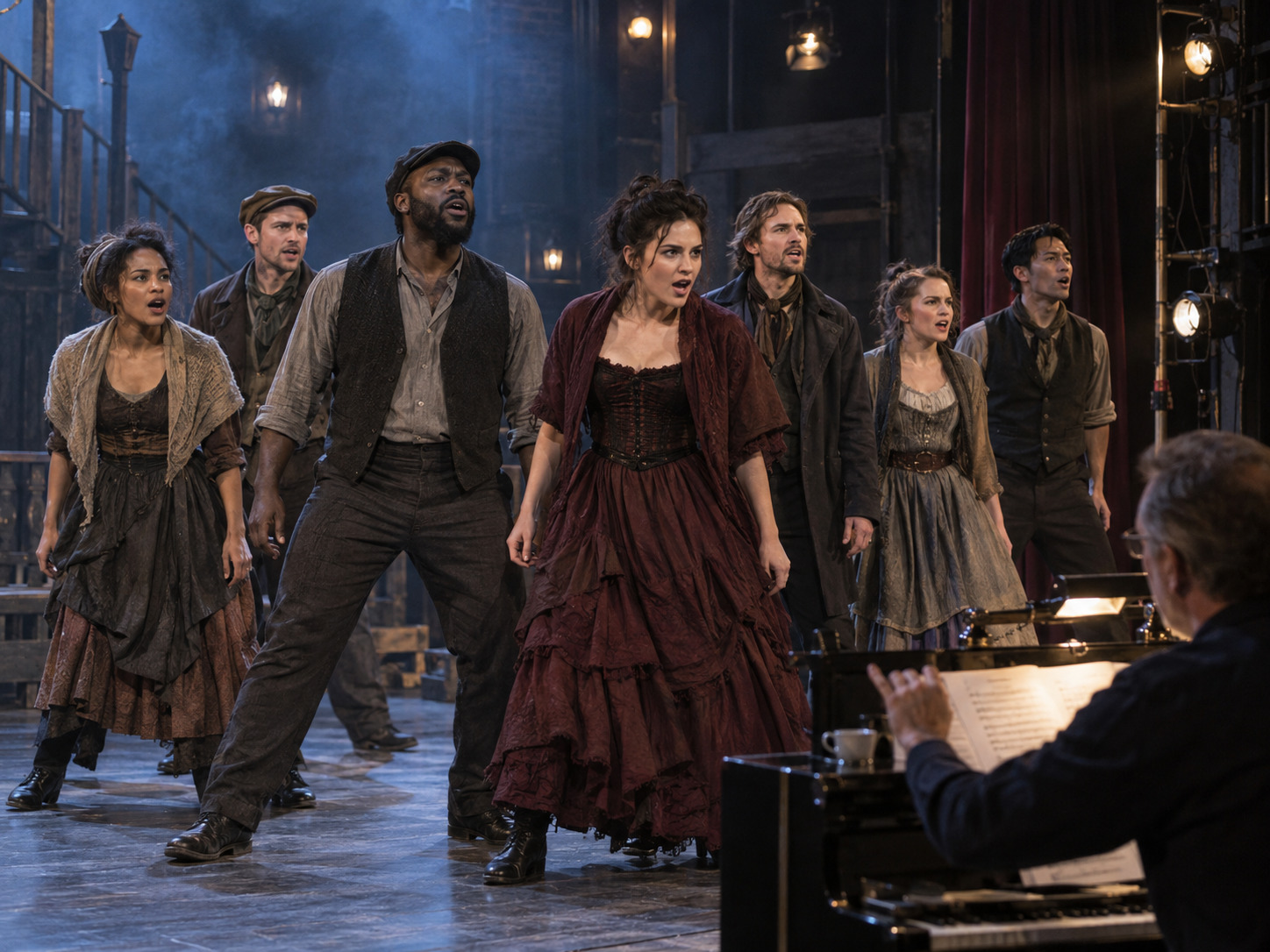
The backing track supplies the musical timeline. The conductor still has to prepare live entrances, shape releases, and keep the company connected to the stage action. The playback operator has to start the correct file at the correct cue and know exactly what happens at the end.
Write a cue note that includes:
- exact approved filename;
- guide-vocal or accompaniment status;
- the spoken line, movement, or stage-manager call that releases playback;
- the first audible musical landmark;
- who gives the ensemble’s preparation gesture;
- the ending behavior;
- and the next scenic, lighting, dialogue, or music cue.
Do not leave the operator to infer whether the cast is ready. Use a visible or called cue. If the section follows applause, dialogue, or a scene change, rehearse that handoff from the moment before the track begins.
Move off the guide vocal on purpose
Guide vocals can help an ensemble learn notes, rhythm, pronunciation, and the relationship between voices and orchestration. They should not become the performance the cast follows indefinitely.
Use a clear progression:
| Pass | File | What to prove |
|---|---|---|
| Learn | Guide vocal | The company recognizes the form and entrances |
| Align | Guide vocal | Consonants, releases, and pulse are unified |
| Transfer | Accompaniment | The ensemble can carry the complete text without a recorded voice |
| Stage | Accompaniment | Movement and spacing do not disturb the musical map |
| Prove | Final performance file | The cue, balance, build, and ending run without coaching |
If a section falls apart after the guide vocal is removed, return only to the exact problem. Listen to that entrance, phrase, or release once, then switch back to accompaniment. Repeating the whole guide track can hide the place that still needs independent work.
Sound-check the first whisper and the fullest chord
Test more than the loudest section. The opening may expose room noise, weak monitor coverage, or unclear entrances. A fuller passage may cover consonants or tempt microphones toward feedback.
During sound check, listen from the audience area for:
- whether the first words are understandable;
- whether singers can hear the accompaniment without the house mix overwhelming the text;
- whether performers on the edges of the formation still receive a useful cue;
- whether scenic movement masks an entrance;
- and whether the final release lands before the next cue.
Use the same file, device, routing, and stage positions planned for performance. Keep a verified local backup, and remove old rehearsal versions from the live playback folder.
Keep recording permission and show rights separate
Purchasing or licensing a Broadwaytrax recording does not replace permission to stage the musical. Keep the sound-recording paperwork with the production’s separate show-rights documents, and confirm any recording, streaming, or video questions with the appropriate rights holder.
Broadwaytrax’s guide to (backing tracks, theater use, and grand rights) explains the distinction for schools and theatres.
A focused ensemble rehearsal sequence
When time is limited, use this order:
- Name the dramatic job of the section.
- Speak the text in rhythm over the accompaniment.
- Align four important diction and release points.
- Sing with guide vocals once, then switch to accompaniment.
- Mark the opening, strongest build, and final handoff.
- Add focus and stage shape before adding movement.
- Run the cue from the preceding scene or stage action.
- Sound-check the quietest and fullest passages.
- Save one approved performance file and backup.
The sequence keeps rehearsal centered on storytelling while giving the cast, conductor, stage manager, and operator one dependable musical plan.
Frequently asked questions
Should every ensemble member use the same expression?
No. Individual characters can hold different relationships to the story, but the company still needs shared rhythm, diction, cue awareness, and a common understanding of what the section tells the audience.
When should the cast stop using guide vocals?
Switch once the ensemble recognizes the form and basic entrances. Move early enough that singers learn to carry the text and harmony without following a demonstration voice.
How can the ballad become more intense without getting faster?
Use clearer consonants, more unified breath, stronger focus, purposeful spacing, and a planned dynamic arc. Rehearse the rests and instrumental spaces so the cast does not rush toward the next entrance.
What should happen if staging takes longer than the track allows?
Identify the exact stage action and musical location. First test whether the movement can be simplified or cued earlier. If the production truly needs more time, request an approved vamp, lead-in, cut, or custom edit instead of asking performers to chase an unworkable version.
Does the operator need the guide-vocal file?
Keep learning files available for rehearsal, but the live playback folder should contain only the approved performance files, clearly named and ordered for the show.
Explore the Sweeney Todd guide-vocal and accompaniment tracks, give every ballad return a dramatic job, and rehearse one approved performance file with the complete cue plan.
Explore the Sweeney Todd AlbumThe useful test
At the end of rehearsal, the company should be able to begin from the real cue, carry the text without a recorded singer, intensify without rushing, and land the final release together. When the pulse, diction, focus, staging, and playback plan all serve the same warning, the ensemble feels inevitable—and the audience is drawn into the story before the next scene begins.