“Agony” Is Funniest When the Princes Share the Beat
By Broadwaytrax Content Studio · October 6, 2026
Updated October 6, 2026
The short answer: rehearse “Agony” as a contest in which each prince keeps trying to win the same conversation. The comedy comes from specific listening, matched musical timing, and increasingly serious reactions to an increasingly absurd comparison—not from two singers independently showing how funny they can be.
Broadwaytrax offers both an (“Agony” accompaniment track) and an (“Agony” guide vocal track) from Into the Woods. Each product page identifies the recording as 146 seconds long. That compact shape makes every entrance, interruption, shared phrase, and ending matter.
Bring "“Agony” Is Funniest When the Princes Share the Beat" to life with custom tracks
Get the exact arrangement you need—either customize an existing accompaniment or commission a bespoke build from our team.
Don't see this show in our library yet? We'll build it for you.Start with two different problems
If both performers enter with the same emotional temperature, the scene becomes a duet exercise. Before singing, each actor should write one plain-language sentence:
I need my brother to understand that my problem is worse because ______.
The answers should not be interchangeable. One prince may need sympathy, status, attention, or proof that his romantic obstacle is uniquely impossible. The other may hear every detail as a challenge he has to top.
Speak the scene once without music. Do not add comic poses. Listen for the moment when one person stops reporting his own trouble and starts reacting to the other prince’s claim. That is where the competition becomes active.
Learn the map before adding the joke
The recording will keep moving whether the actors are ready or not. Listen to the complete track with the approved score and mark:
- the length and character of the introduction;
- the first dependable entrance;
- the places where one singer hands the thought to the other;
- any shared or overlapping musical material;
- the orchestral changes that raise the stakes;
- a safe restart point;
- and the exact ending.
Then rehearse the sequence with neutral staging. The goal is to hear the structure before decorating it. If a gesture, pause, or look makes the next cue late, the joke is costing the scene its musical engine.
The guide vocal version can help both performers confirm pitches, phrasing, and the relationship between the two parts. Move to the accompaniment version before the scene feels finished. Without the reference voices, the actors have to create the handoffs themselves.
Put the same pulse under different characters
Comic contrast does not require loose tempo. In fact, a shared pulse makes the differences between the performers easier to see.
Try this rehearsal sequence:
- Walk the beat together while the track plays.
- Speak the text in rhythm without singing.
- Sing while keeping both bodies almost still.
- Add only the reactions that clarify who has just gained or lost ground.
- Run the complete number without stopping.
One prince can be expansive while the other is precise. One can rush emotionally while the other appears to savor his own misery. Those character choices should sit on top of the same musical map.
When a line consistently lands late, ask whether the actor is waiting for laughter, adding an unplanned pause, or watching the other performer instead of listening to the orchestral cue. Fix the cause before asking the playback operator to compensate.
Treat every handoff as a new challenge
The duet works when each new entrance changes the score between the brothers. A useful rehearsal table can be simple:
| Handoff | What the first prince claims | What the second prince hears | Visible reaction |
|---|---|---|---|
| Opening exchange | My suffering deserves attention | I have been invited to compete | Interest becomes challenge |
| First escalation | My obstacle is impossible | Your obstacle is not impressive enough | The response gets larger |
| Shared momentum | We agree that this is terrible | I still need to be the greater sufferer | Temporary unity cracks |
| Final approach | My case is settled | I will not let you win the ending | Both commit to the finish |
Use the categories, not these exact acting choices, as a rehearsal tool. The production’s director and licensed materials determine the scene. What matters is that each handoff has a consequence.
Loop one handoff at a time. Begin before the first singer’s final phrase, continue through the second singer’s response, and stop only after the new pulse is established. This teaches listening instead of isolated line delivery.
Make the physical comedy readable
A backing track fixes the musical time, but the stage picture can still breathe. Choose a few repeatable physical rules:
- Each performer has a clear home position.
- A move happens because the other prince said or did something.
- The audience can see the listener, not only the current singer.
- Large gestures do not hide the next breath or cue.
- Crosses and turns finish before musically dense exchanges.
Avoid constant motion. If both performers pace, pose, point, and compete for the center at once, the audience cannot tell which change matters. Stillness can be the stronger joke when one prince is forced to absorb an especially grand claim.
Record a rehearsal from the center of the room. Watch it once without sound. The contest should still be legible. Then listen without watching. The words, handoffs, and musical shape should remain clear. Only after both tests pass should the team combine the full staging and playback.
Plan for laughter without chasing it
An audience may laugh over a transition or reaction. The fixed track will not wait, so the cast needs a plan that protects both the joke and the next entrance.
Mark likely laughter points during rehearsal, but do not build a long pause into every one. Decide:
- which reaction can continue silently while the music moves;
- which consonant or word must remain audible;
- whether the next singer can begin on time even if the room is still responding;
- and where a custom edit would be required if the production truly needs more musical space.
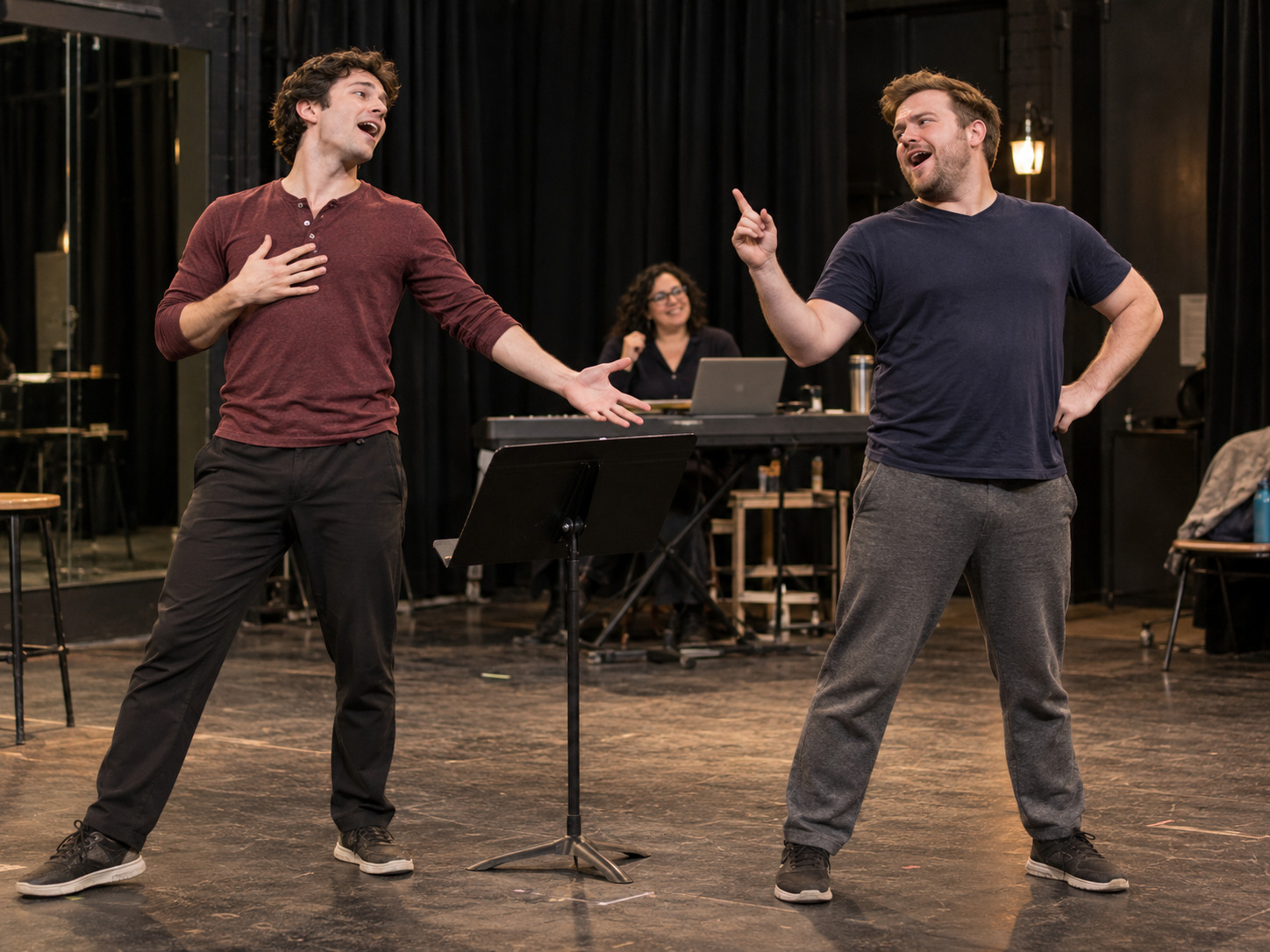
Run the number once with the rehearsal room deliberately making noise at the likely laugh points. The performers should keep listening to the track, maintain the scene, and deliver the next important phrase without shouting.
For a production, any track edit should be coordinated with the approved score, the production’s licensed materials, and the permissions that apply. Broadwaytrax’s (guide to theater use and grand rights) explains why permission to use a recording and permission to present or alter a musical are separate questions.
Balance two voices against one track
At sound check, set both microphones for comparable clarity before increasing playback. The performers do not need identical vocal colors, but the audience should understand both sides of the contest.
Check from the seating area:
- whether each first entrance is audible;
- whether faster text remains clear;
- whether one microphone is consistently hotter;
- whether shared phrases blend without becoming muddy;
- whether stage movement changes the balance;
- and whether the ending lands together.
If one performer disappears, adjust placement, technique, or microphone gain before asking that actor to sing harder. Comic urgency should not become vocal pressure.
A 20-minute “Agony” rehearsal
Minutes 1–4: map the track
Listen to the full accompaniment. Mark the introduction, handoffs, shared material, orchestral escalations, restart point, and ending.
Minutes 5–8: speak and react
Speak the scene on pulse. Give each entrance a reason and make the listener’s reaction visible.
Minutes 9–12: use the guide vocal
Confirm pitches, rhythm, and the relationship between the two parts. Fix uncertain handoffs in short loops.
Minutes 13–16: switch to accompaniment
Remove the reference voices. Keep the same cues, breaths, and competitive arc.
Minutes 17–20: prove the performance edges
Run from silence through the first entrance, then rehearse the final escalation and ending. Add simulated audience laughter once.
Final checklist
- Each prince has a distinct objective.
- Both performers can describe how the contest changes.
- The complete 146-second track has been mapped.
- The guide vocal was used for learning, not as a permanent crutch.
- Every handoff has an audible cue and an acting consequence.
- Both performers share the pulse without sharing the same character.
- The listener’s reactions remain visible.
- Physical choices finish before difficult entrances.
- Likely laughter points do not erase important text or cues.
- Microphone and playback balance were checked from the house.
- The ending is rehearsed as precisely as the opening.
- Any edit or performance use has been checked against the applicable permissions.
FAQ: “Agony” backing tracks
Is the Broadwaytrax accompaniment track a duet recording?
It is an accompaniment track for the two performers; the product page distinguishes it from the separate guide vocal track.
How long is the recording?
Both Broadwaytrax product pages list a duration of 146 seconds.
When should the cast stop using the guide vocal?
Use it to learn the musical relationship between the parts, then move to accompaniment early enough that the performers must own every entrance, reaction, and handoff.
Should the actors pause for every laugh?
No. Identify likely audience responses, protect the next essential line, and rehearse how the scene continues while the fixed track moves. A planned silent reaction is often safer than an added musical pause.
What should the playback operator know?
Preview the exact 146-second accompaniment track, then rehearse every entrance, handoff, reaction, and ending from one approved file.
Preview the Agony TrackGive the operator one approved filename, the start cue, a safe restart point, any confirmed edit, the ending, and what happens immediately after the number.
The strongest final test is not whether both princes are individually funny. It is whether the audience can watch one claim make the other prince’s predicament suddenly, competitively worse.