“Ya Got Trouble” Needs a Town That Listens
By Broadwaytrax Content Studio · October 8, 2026
Updated October 8, 2026
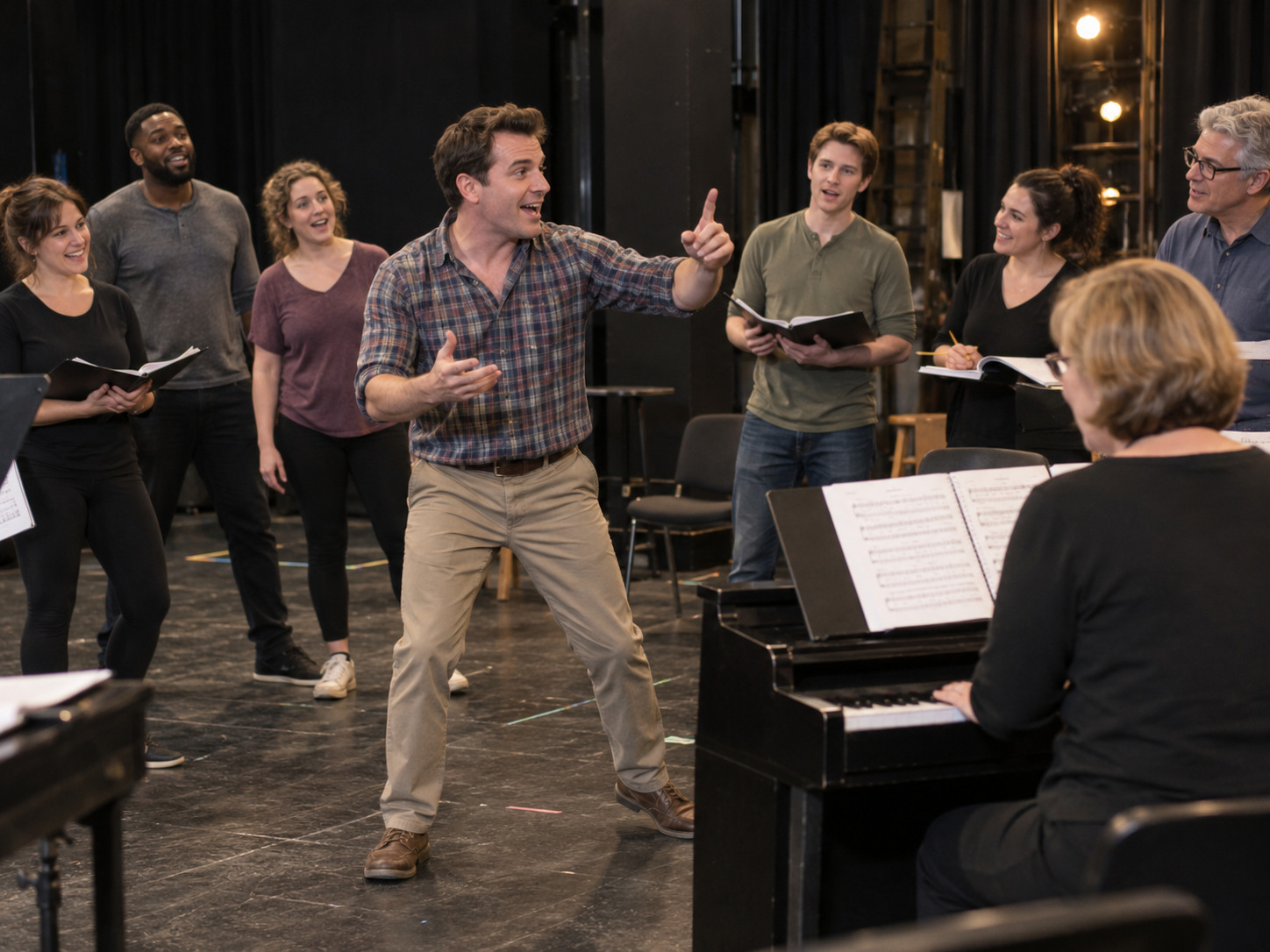
The short answer: rehearse “Ya Got Trouble” as a sales pitch that the whole town helps create. The lead performer supplies the words, but the ensemble’s listening, interruptions, physical reactions, and growing agreement turn a fast solo into a scene.
That distinction matters when you use a backing track. The recording will keep moving whether the cast has understood the thought or not. A useful rehearsal plan therefore does more than chase speed. It gives the lead a clear argument, gives the ensemble specific discoveries, and gives the playback operator a dependable cue map.
Bring "“Ya Got Trouble” Needs a Town That Listens" to life with custom tracks
Get the exact arrangement you need—either customize an existing accompaniment or commission a bespoke build from our team.
Don't see this show in our library yet? We'll build it for you.Start with the argument, not the tempo
Fast musical-theater text becomes clearer when the performer knows what each section is trying to accomplish. Before singing with the track, speak the scene at a conversational pace and divide it into a few persuasive moves:
- Notice an ordinary detail.
- Make it sound suspicious.
- Connect it to a larger fear.
- Offer the town a way to feel informed and united.
- Let the crowd begin selling the idea back to itself.
The precise acting choices belong to your production, but the basic rehearsal principle is portable: every acceleration needs a reason. If the singer treats the entire number as one unbroken rush, the audience hears impressive diction without following the pitch.
Ask the performer to name the listener for every section. One sentence may target a skeptical adult; the next may pull in curious teenagers; another may invite the whole crowd to agree. Those changes of target create natural emphasis and keep the lyric from flattening into a recitation.
Make the ensemble active before it sings
The ensemble should not wait for its first vocal entrance to join the scene. Give each performer a private starting point: amused, doubtful, distracted, intrigued, defensive, or eager to belong. Then mark the exact moments when that opinion changes.
A simple reaction score works well:
- First notice: someone realizes the speaker may be addressing them.
- First shared concern: two or three people exchange a look.
- First public agreement: one response gives the crowd permission to react aloud.
- Momentum turn: the town begins anticipating the next point.
- Collective buy-in: the ensemble moves and sings as a community, not a collection of extras.
Run these beats without singing. Let the lead speak the text while the ensemble practices only eye lines, spacing, and reactions. Then reverse the exercise: play the accompaniment and let the ensemble mark the reaction score while the lead listens. When you combine the two, the crowd will feel responsive without becoming visually noisy.
Build diction from stressed words outward
The goal is not to make every syllable equally loud. Audiences follow important words, contrasts, and sentence endings. Start by underlining the words that carry the argument. Speak only those words in rhythm with the accompaniment. Add the connecting language once the structure is secure.
For difficult passages, use this sequence:
- Speak the phrase slowly with clean consonants.
- Speak it in rhythm without pitch.
- Sing it on a neutral syllable to feel the musical shape.
- Restore the text at three-quarter energy.
- Run it at performance pace without pushing the volume.
Record one rehearsal from the audience’s distance. If the stressed words disappear, do not immediately ask for more volume. Check whether the performer is breathing too late, over-articulating every consonant, or using the same emphasis on each phrase. Clarity usually improves when the thought becomes more specific.
Rehearse breaths as part of the scene
A backing track cannot wait for an improvised breath. Mark breathing points in the same score used by the performer, music director, and playback operator. Whenever possible, place a breath after a completed idea rather than in the middle of the sentence that sells it.
Some breaths can also become acting moments. A short pause may let the singer notice that the crowd is listening, choose the next target, or enjoy a reaction. The audience then reads the breath as thought instead of fatigue.
Do not rehearse every passage at maximum speed for an entire session. Alternate short precision loops with full scene runs. A focused loop should answer one question—diction, breath, target, or timing—then return to the larger argument.
Give the crowd one shared pulse
The number becomes harder when different parts of the ensemble feel the beat differently. Teach the accompaniment’s pulse before adding blocking. Let everyone step or tap it lightly, then speak ensemble responses in time. The cast should be able to enter together without copying one person at the last second.
Next, assign a few listening leaders across the stage. They are not extra conductors; they are reliable performers who can feel the track and model the preparation for an entrance. Place them where different sections of the ensemble can see them naturally.
If the staging includes crosses, clusters, or fast re-formations, decide whether each movement begins on a musical cue, a spoken idea, or another actor’s reaction. A movement without a shared trigger tends to drift. A specific cue lets the town appear spontaneously energized while the company remains musically precise.
Protect the lead from the mix
Patter needs space in the sound system. During the first room rehearsal, test the exact performance file through the actual speakers and have the lead deliver the busiest section at realistic energy. Listen from several seats, including the back and sides.
Use the smallest useful adjustment. Lowering the track slightly may help more than raising the microphone. If the arrangement has a dense section, avoid trying to solve it only with vocal force. Confirm microphone placement, speaker coverage, and whether the performer is facing away during crucial text.
The (“Ya Got Trouble” accompaniment track) is an instant-download MP3. Broadwaytrax also offers track customization for changes such as key, tempo, and cuts. If your production needs an edit, settle it early enough that the cast can rehearse the final file rather than adapting in tech week.
Create a playback cue sheet
Keep the cue sheet short enough to use under pressure. Include:
- the approved filename and version date;
- who calls the start;
- the exact visual or verbal start cue;
- microphone state before playback;
- any planned pause, cut, or transition;
- what happens immediately after the track ends;
- the backup device and who can operate it.
The operator should run the scene with the cast, not just test the file alone. A correct button pressed at the wrong dramatic moment is still a bad cue.
For public performances, also separate the show rights from the recording rights. Broadwaytrax explains the distinction in its guide to (backing tracks, theater use, and grand rights). Confirm the theatrical-performance rights for the show with the appropriate publisher or licensing organization, then make sure the recording license matches your use.
A 30-minute rehearsal plan
Minutes 0–5: map the pitch
Speak the text and name the persuasive move in each section. No track yet.
Minutes 5–10: mark ensemble discoveries
Run the lead’s text while the town practices only reactions and opinion changes.
Minutes 10–16: clean the fastest phrases
Use the speak-rhythm-sing sequence. Mark breaths and stressed words.
Minutes 16–22: add pulse and entrances
Play the track. Rehearse ensemble responses, listening leaders, and movement triggers.
Minutes 22–27: test the room balance
Run the busiest section through the performance speakers and microphone. Make one documented mix change at a time.
Minutes 27–30: run without stopping
Perform the complete scene. Note only the two changes that will most improve the next run.
Common problems and practical fixes
The words are fast but the story is slow
The performer may be saying everything clearly without changing tactics. Revisit the persuasive moves and choose a new listener for each turn.
The ensemble looks busy instead of convinced
Remove unspecific motion. Restore the reaction score and give each cross or grouping a trigger.
The crowd enters a fraction late
Practice the preparation, not just the sound. Everyone should know what they hear one beat before the entrance.
The microphone wins but the text still disappears
Check stressed words, breath placement, and where the actor is facing before adding more gain.
The scene changes every time the file changes
Choose one approved playback file, name it clearly, and stop rehearsing from downloads scattered across personal devices.
FAQ: rehearsing “Ya Got Trouble” with a backing track
Should the lead practice at full tempo from the beginning?
No. Learn the argument and breath plan first, then bring short sections up to speed. Full-tempo runs are useful after the performer can keep the thought specific.
How much should the ensemble move?
Enough to show changing opinion and growing momentum, but not so much that the lead’s persuasion becomes hard to read. Movement should answer a thought or musical cue.
Can a backing track work for a scene with flexible comic timing?
Yes, when the cast decides where reactions live inside the fixed musical map. Rehearse laughter, looks, and handoffs so the scene feels alive without asking the recording to wait.
What should the playback operator rehearse?
Preview the exact accompaniment track, then rehearse the sales-pitch arc, ensemble reactions, patter, movement cues, playback balance, and ending from one approved file.
Preview the AccompanimentThe exact start cue, file, mix, transition, and backup plan. The operator should also hear the scene from the room so the cue supports the actors rather than merely starting on time.
When the lead, ensemble, and operator share the same map, speed becomes the result—not the objective. The audience can follow the pitch, the town’s reactions become part of the music, and the number keeps its theatrical bite all the way to the final beat.