“Tonight” Works When Both Performers Hear the Same Moment
By Broadwaytrax Content Studio · September 30, 2026
Updated September 30, 2026
The short answer: rehearse “Tonight (Duet)” as two people discovering the same moment, not as two soloists taking turns over a backing track. Both performers need the same musical map, but each entrance should still sound like a response to the other person.
Broadwaytrax offers both a guide-vocal version and an (“Tonight (Duet)” accompaniment track) from West Side Story. Use the guide to learn the musical route. Move to accompaniment early enough that the actors have to listen, breathe, and build the scene together.
Bring "“Tonight” Works When Both Performers Hear the Same Moment" to life with custom tracks
Get the exact arrangement you need—either customize an existing accompaniment or commission a bespoke build from our team.
Don't see this show in our library yet? We'll build it for you.Confirm the exact duet track before rehearsal
“Tonight” appears in more than one place in the score. A duet file and an ensemble or quintet file do not have the same rehearsal job.
Before anyone sings, confirm:
- the file is labeled Tonight (Duet);
- whether it is guide vocal or accompaniment only;
- who gives the playback cue;
- what the performers hear before the first entrance;
- where the musical energy changes;
- and how the track ends.
The (complete West Side Story album) lists guide-vocal and accompaniment versions separately. Keep that distinction in the filename and rehearsal notes. A performer who practices with the guide every time can feel unexpectedly exposed when the reference voices disappear.
Give both performers one shared map
A duet can become vague when each singer prepares only their own line. Build one page that both actors can use.
Mark:
- the playback start;
- the first entrance for each performer;
- the points where one thought releases the other person’s response;
- the places where the voices overlap or join;
- a safe restart point;
- the final musical release;
- and the scene action that follows.
Use musical descriptions that still make sense on any device. “Four bars before the voices join” is more useful than a timestamp by itself. A timestamp can change when a file is edited or replaced.
The map should create security without flattening the acting. Both people know where they are going; neither should look as if they are waiting for a scheduled turn.
Rehearse listening before adding volume
Start with the accompaniment at a comfortable room level. Ask one performer to sing while the other speaks the intention of the next response in their own words. Switch roles, then sing the exchange normally.
This exposes a common duet problem: the second person enters accurately but has not received anything from the first. The note is correct, yet the scene feels disconnected.
For each handoff, identify three things:
- What changed? Name the new information or emotional pressure.
- What did the other person hear? The response should grow from something specific.
- Which sound releases the entrance? Use a dependable musical landmark in the accompaniment.
Once the handoff is clear, sing through it without stopping. Do not interrupt immediately after every imperfect detail. The actors need to experience the complete exchange, not only isolated repairs.
Move from guide vocal to accompaniment in pairs
Do not let one performer become independent while the other remains attached to the guide.
Use this progression:
- Listen to one complete section with the guide-vocal track.
- Sing the same section with the guide once.
- Repeat it immediately with accompaniment only.
- Continue through the next handoff before stopping.
- Join two sections together on accompaniment.
- Run the complete duet without returning to the guide unless a named passage needs repair.
If one singer needs additional note work, repair that passage separately, then bring both performers back to the same accompaniment-only checkpoint. The duet should not maintain two incompatible rehearsal states.
Let the accompaniment support breath and thought
The actors should not have to rush a thought simply because the track keeps moving. They do need to know how much room the arrangement actually gives them.
Listen once without singing and mark:
- the length of the introduction;
- the first clear pulse under each entrance;
- sustained moments where the voice can remain free;
- transitions that can tempt a singer to push;
- and the final approach to the ending.
Then speak the scene over the accompaniment. The goal is not to fit every word to a beat. It is to feel where a thought can turn, where silence is possible, and where the next entrance must already be prepared.
If the standard key, tempo, or cut repeatedly prevents the actors from carrying the scene, test the complete need before requesting a change. The product page provides options for key, tempo, and cut customization. Describe the exact passage and rehearsal problem rather than asking generally for the track to feel easier.
Stage connection without losing the cue
Eye contact is useful, but two actors staring at each other for an entire duet can look fixed and make it harder to hear the room.
Choose a few deliberate focus changes:
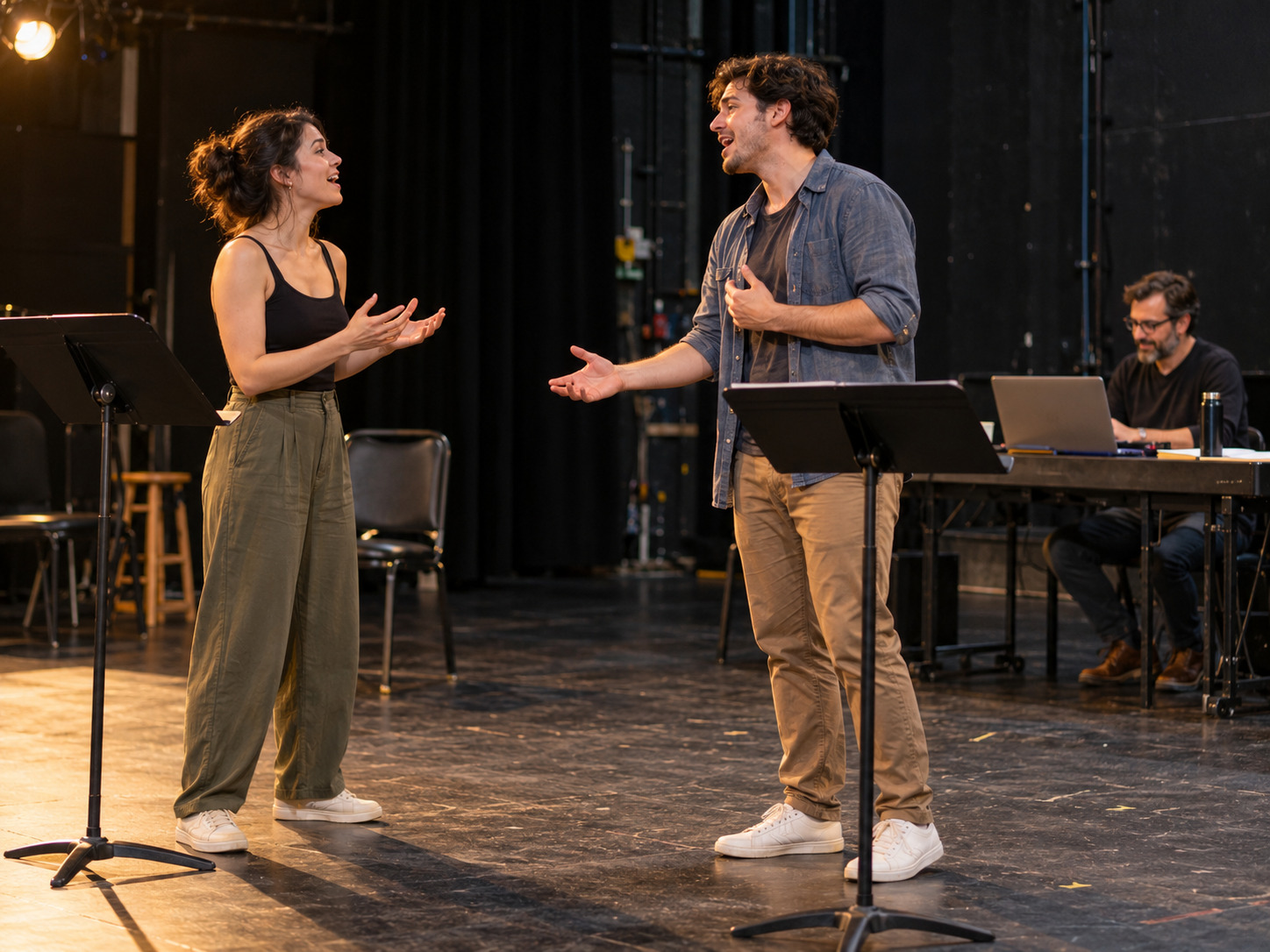
- the first moment the other person is truly seen;
- a shared outward image;
- a private thought that briefly pulls focus away;
- a return to the partner;
- and the final physical picture.
Rehearse those choices at half movement first. Make sure a turn, cross, embrace, or change in distance does not cover a breath, hide a microphone, or pull either performer away from the musical cue they need.
For a self-tape or studio exercise, test the framing and speaker placement before the full run. For a stage rehearsal, listen from the house. The actors should not have to face the playback speaker to stay together.
Prove the opening and ending with the operator
Begin before the track starts. The operator, actors, and director should know what triggers playback and what each person is doing during the introduction.
At the end, continue beyond the final sound. Hold the stage picture, silence, or next line long enough to prove that the track belongs inside the scene instead of sitting beside it.
Write the cue in plain language:
- exact approved filename;
- who calls the start;
- first entrance;
- safe restart point;
- final release;
- and what follows.
If the duet will be used in a public production, keep the recording-use question separate from permission to stage the musical. Broadwaytrax’s (theater-use and grand-rights guide) explains that distinction for schools and theaters.
A 25-minute duet rehearsal
Minutes 1–5: listen together
Confirm the file and mark the introduction, handoffs, joined passages, and ending.
Minutes 6–10: speak the exchange
Speak intentions and responses over the accompaniment. Identify what each performer hears from the other.
Minutes 11–17: remove the guide
Move one section at a time from guide vocal to accompaniment, always continuing through the next handoff.
Minutes 18–22: add staging
Run the duet with the intended focus changes, distance, and movement. Check breath, microphones, and cue audibility.
Minutes 23–25: prove the edges
Run the opening from the scene trigger through both first entrances. Then run the ending into the next event.
Rehearsal checklist
- The file is the duet, not the quintet or another score version.
- Both performers know whether the file is guide vocal or accompaniment.
- Every entrance grows from a shared musical and dramatic cue.
- The actors can complete the duet without reference voices.
- Movement does not hide breath, microphones, or musical landmarks.
- The standard key, tempo, and cut have been tested through the full scene.
- The operator has one approved file and a safe restart point.
- The opening and ending connect to the surrounding scene.
FAQ: “Tonight (Duet)” backing tracks
Should both performers rehearse with the guide vocal?
Use the guide to learn notes, entrances, and the arrangement. Move both performers to accompaniment together so listening and independence develop at the same pace.
Can the duet track be customized?
The product page offers key, tempo, and cut options. Confirm the exact musical and production need, and check proposed show changes with the appropriate rights holder or licensing materials.
What is the difference between the duet and quintet tracks?
They serve different moments in the score. Confirm the exact title and file before rehearsal; do not assume a file labeled only “Tonight” is interchangeable.
How do we stop the duet from sounding like two solos?
Preview the exact duet accompaniment, then rehearse the entrances, shared musical landmarks, staging, and final release from one approved file.
Preview the Duet TrackRehearse the handoffs. Each performer should know what changed in the other person’s thought, which musical landmark releases the response, and how the voices build a shared scene.
The best final test is not whether both singers hit every entrance in isolation. It is whether the audience can hear two people listening, changing, and arriving at the ending together while the accompaniment quietly keeps the structure secure.