Let “The Song That Goes Like This” Go Big Without Losing the Joke
By Broadwaytrax Content Studio · November 3, 2026
The short answer: play the number with complete romantic sincerity while keeping the duet on one exact musical map. The comedy comes from the contrast between the performers' enormous commitment and the song's knowingly familiar shape. If the actors wink at every phrase, the joke becomes smaller. If they believe every turn, the audience can recognize the parody for itself.
Broadwaytrax offers a three-minute (accompaniment track for “The Song That Goes Like This”) and a matching (guide-vocal demonstration). Give those files different jobs: use the guide to learn the arrangement, then move to accompaniment early enough that the two actors create the scene instead of following recorded performances.
Bring "Let “The Song That Goes Like This” Go Big Without Losing the Joke" to life with custom tracks
Get the exact arrangement you need—either customize an existing accompaniment or commission a bespoke build from our team.
Don't see this show in our library yet? We'll build it for you.Begin with the duet's shared rule
Before singing, agree on one rehearsal rule: the characters think this is the most important romantic song ever written.
That rule does not require the actors to play the same intention. One performer may be determined to make the moment magnificent. The other may be surprised by how magnificently the moment keeps expanding. The useful contrast lives inside a shared style.
Ask each actor to finish two sentences:
- I need my scene partner to understand that ______.
- The next musical turn changes my plan because ______.
Keep the answers playable and specific. “Be funny” is not a scene action. “Convince this person that our meeting has become destiny” gives the actor something to pursue while the accompaniment continues.
Map the track before adding the spectacle
A fixed backing track rewards precise listening. Both performers should be able to hear the same landmarks before costumes, props, choreography, or lighting add pressure.
Build a simple map:
| Track moment | Duet question | Rehearsal action |
|---|---|---|
| Introduction | Who owns the first choice? | Start from the real preceding cue and practice the first entrance. |
| First exchange | Are the actors responding or taking turns? | Speak the scene rhythm over the accompaniment. |
| Musical expansion | What becomes newly important? | Add one clear physical change rather than constant motion. |
| Shared singing | Do the voices and intentions meet? | Balance blend with readable text and eye focus. |
| Final build | Can the performers grow without rushing? | Mark breath, stance, and the last reliable accompaniment cue. |
| Button | What happens after the sound stops? | Continue through the reaction, applause hold, or next stage cue. |
The map should name sounds the performers can actually hear: an orchestral entrance, a rhythmic figure, a change in texture, or the final approach. Avoid notes such as “come in when it feels right.” The file will behave the same way every time, so the rehearsal language should be just as dependable.
Use the guide vocal, then remove it on purpose
The matching guide-vocal version can help the pair learn melody, rhythm, entrances, and the complete arrangement. It is especially useful when one performer has been rehearsing alone and has not yet heard the other role in context.
Use a deliberate handoff:
- Listen once while both actors mark the full musical map.
- Rehearse the most exposed entrance with the guide vocal.
- Speak the dramatic exchange over the accompaniment-only track.
- Sing the section with accompaniment only.
- Add movement after the entrance and ending are reliable.
- Run the complete number without returning automatically to the demonstration.
If a passage breaks, use the guide to diagnose that passage. Do not move the entire duet back to demonstration mode. The goal is for the actors to own the timing, not to reproduce the reference voices.
Track previews contain an audio watermark; purchased downloads do not. Use the preview to compare versions, but rehearse the production with the downloaded file that will actually be used.
Make the parody legible without underlining it
The actors do not need to announce every familiar musical-theater gesture. Choose a few visual rules and repeat them with increasing commitment.
For example:
- Begin with enough distance that later closeness has somewhere to go.
- Let a turn, reach, or shared focus happen because the other actor changed the scene.
- Finish each large movement before the next dense vocal entrance.
- Keep the listening actor visible instead of framing only the current singer.
- Save the largest shared picture for the point where the music truly earns it.
Record one rehearsal from the center of the room. Watch it without sound. The scene should still have a clear progression. Then listen without watching. The words, musical handoffs, and build should remain understandable. When both tests work, combine the staging and track again.
Protect the vocal build
Comedy does not remove the need for sustainable singing. A three-minute number can feel much longer when the performers begin at maximum volume and maximum physical effort.
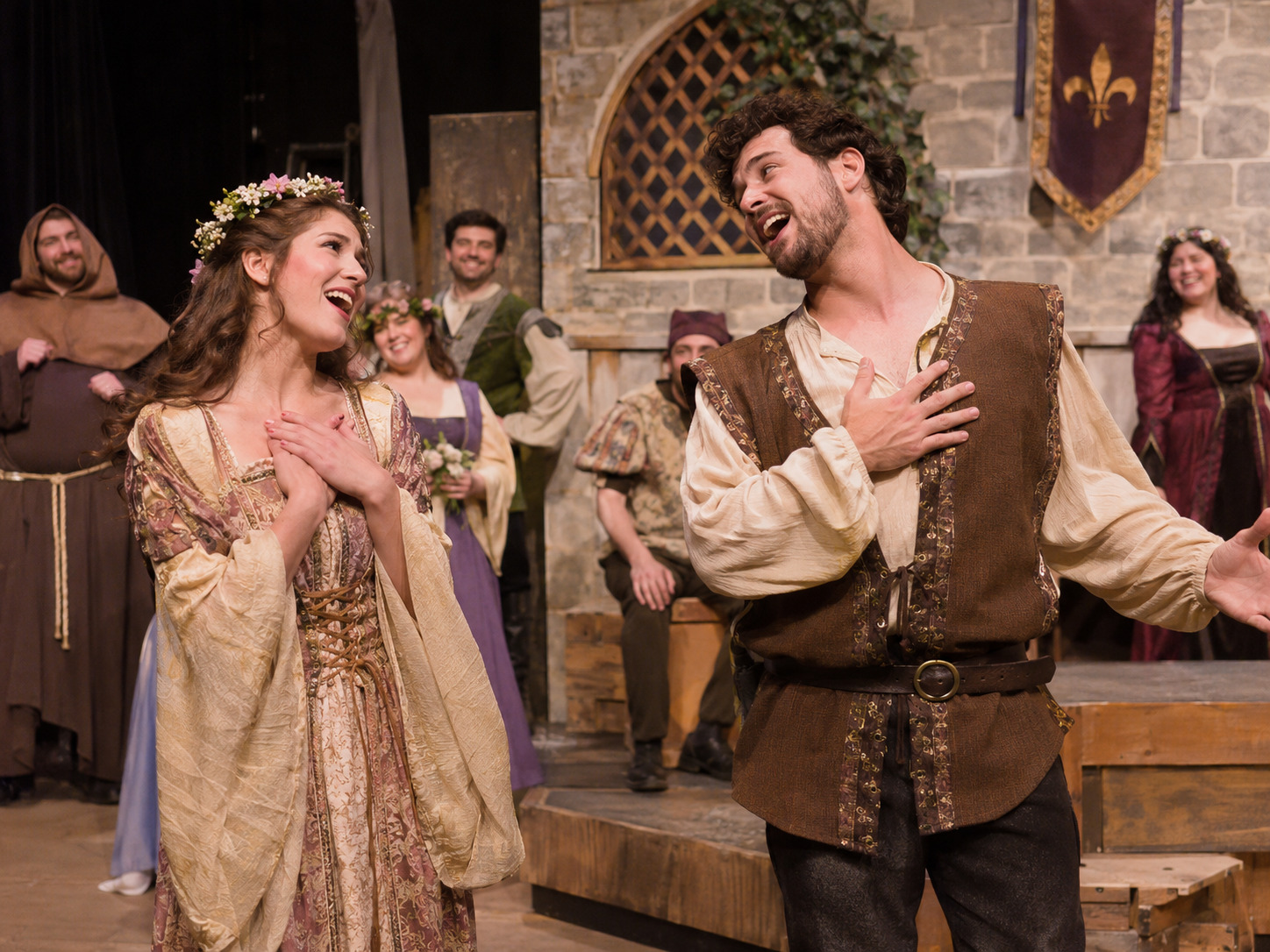
Plan the build by deciding:
- which early phrases can stay conversational;
- where resonance and breath need more space;
- when both performers must hear each other instead of competing;
- which movement can be simplified before an exposed vocal entrance;
- and how the final section grows without the tempo feeling faster.
During a full run, notice the first place where clear text disappears. The answer may be balance, breath, staging, or monitor coverage—not more volume. Test the track at audience distance and keep the accompaniment supportive enough that the scene remains intelligible.
Rehearse audience response around the fixed track
The audience may laugh at a reaction, staging choice, or musical escalation. The accompaniment will not wait automatically.
Mark likely response points, then rehearse with the room deliberately making noise. Decide which reaction can continue silently while the music moves, which word must remain audible, and which performer owns the next entrance. Do not add a long pause to every possible joke.
If the production repeatedly needs musical space that the approved arrangement does not provide, describe the exact problem before requesting a change: current file, audible landmark, stage action, desired result, and how the revision will be tested. (Broadwaytrax custom-track support) can address confirmed keys, cuts, tempos, lead-ins, cues, and endings. Any proposed change to the show itself still needs to fit the production's licensed materials and permissions.
Connect the track to the scene around it
The number does not begin when the operator presses play. Run the event that triggers the file.
Confirm:
- who calls or gives the start cue;
- where both performers are during the introduction;
- what the first singer hears before entering;
- whether a costume, prop, or cross hides that landmark;
- who can see the music director, conductor, or stage manager;
- and what the final button hands to next.
Continue beyond the ending into the next line, movement, light cue, or applause behavior. A polished duet followed by an uncertain silence will still feel unfinished.
Duet rehearsal checklist
- Both performers use the same approved key, cut, tempo, and file.
- The guide vocal and accompaniment files have different labels and jobs.
- Every entrance has an audible accompaniment landmark.
- Each musical expansion changes the dramatic action.
- Movement finishes before exposed entrances.
- The performers can hear each other and keep the text clear.
- Likely laughter does not erase the next important phrase.
- The final button connects to a planned stage event.
- The operator has the approved file and a tested backup.
Questions rehearsal rooms ask
Should the actors play the song seriously?
Play the characters' need seriously. The production can shape a heightened theatrical style, but the performers should pursue real objectives rather than comment on every joke.
When should we stop using the guide vocal?
Move to accompaniment-only rehearsal as soon as the pair understands the melody, entrances, and arrangement. Return to the guide only to solve a specific passage.
How do we keep the duet from feeling rushed?
First check whether the actors receive each other's ideas, whether movements begin early enough, and whether both performers hear the same accompaniment cues. Tempo is only one possible cause.
What should the playback operator mark?
Mark the trigger, first entrance, major internal landmarks, any safe restart point, final button, and next cue. Use the exact approved filename.
Can the track be used in a production?
Rehearse the parody with a dependable accompaniment-only track, then use the matching guide vocal while the duet learns its musical map.
PREVIEW THE ACCOMPANIMENTThe product page separates personal use from a theater-use license for the Broadwaytrax recording. Permission to use the recording does not replace the rights required to present or alter the musical. Confirm both parts of the plan before public performance.
The most reliable version of the joke is also the most prepared one. Let the duet commit fully, give both actors the same musical map, and use the accompaniment to hold the structure while the scene feels newly discovered.