The Fantasticks Works Best When the Track Leaves Room to Listen
By Broadwaytrax Content Studio · July 31, 2026
Updated July 31, 2026
The smallest musicals can expose the biggest track problems. With a compact cast, spare staging, and an audience close enough to hear every breath, The Fantasticks has nowhere to hide a rushed entrance, an overlong pause, or a backing track that pushes the scene instead of supporting it.
The practical answer is not to make the accompaniment bigger. It is to build one dependable musical map for the version your company is actually rehearsing.
Bring "The Fantasticks Works Best When the Track Leaves Room to Listen" to life with custom tracks
Get the exact arrangement you need—either customize an existing accompaniment or commission a bespoke build from our team.
Don't see this show in our library yet? We'll build it for you.The short answer: how should you plan backing tracks for The Fantasticks?
Start with the exact song list your production will use, confirm performance rights separately, and assign one approved accompaniment file to every musical moment. Rehearse the spoken-to-sung transitions, dance and movement cues, pauses, endings, and operator handoffs early. Because the show depends on intimacy and timing, the best track plan leaves room for the actors rather than asking them to chase a recording.
That makes five decisions especially important:
- which numbers and reprises belong in your licensed version;
- where dialogue hands the scene to the music;
- which pauses need to remain flexible;
- who gives each playback cue; and
- when the cast moves from learning support to the final accompaniment files.
Begin with the version, not the folder
Before anyone renames an MP3, compare the licensed materials, rehearsal script, score, and your approved production plan. The (official show information from Music Theatre International) is the right place to begin for performance-rights questions and the materials supplied for your production.
Then create a one-page music map. It does not need to be elaborate. It does need to make the same version visible to the director, music director, stage manager, choreographer or movement coach, cast, and playback operator.
| Map field | What to record | Why it matters |
|---|---|---|
| Show order | Every musical cue in sequence | Prevents a rehearsal playlist from becoming the performance order by accident |
| File name | One unique final filename | Lets another operator find the right cue quickly |
| Start cue | The exact spoken line, gesture, or stage action | Protects the handoff from dialogue to music |
| End behavior | Button, ring-out, hold, fade, or transition | Keeps applause and scene movement from colliding with the track |
| Approved change | Key, cut, tempo, lead-in, or other confirmed edit | Stops old versions from returning to rehearsal |
| Owner | The person who approves the final choice | Makes revisions deliberate instead of informal |
If the company cannot identify the approved file without opening three nearly identical versions, the map is not finished.
Let the actors own the silence
The musical language of The Fantasticks is closely tied to storytelling. A pause before a lyric, a breath shared between scene partners, or the space after a final word may carry as much meaning as the next downbeat.
During rehearsal, listen for moments when the accompaniment begins to dictate acting choices. Ask:
- Does the actor have enough time to finish the thought before the pickup?
- Can a scene partner react without missing the entrance?
- Does a transition need a clear visual cue from the stage manager?
- Is the cast adding pauses that the fixed track cannot accommodate?
- Would a small approved edit make the moment repeatable without flattening it?
Do not solve every variation with a last-minute operator guess. When a timing need is real and repeatable, write it down and decide whether the production should adjust the staging or request a track change.
Build the rehearsal sequence in layers
Backing tracks become most useful when each phase of rehearsal has a clear job.
1. Learn the music away from the scene
Use the score, vocal coaching, and other approved learning materials to establish melody, rhythm, text, harmony, and breath. The (Broadwaytrax Fantasticks accompaniment album) is accompaniment-only, so plan for a music director or teacher to supply the vocal learning support the cast needs.
2. Add the final accompaniment early
Once the musical material is secure, rehearse with the files that are expected in performance. Actors should learn how much time the introduction gives them, where the pulse changes, and how the ending resolves. Waiting until tech to introduce the final accompaniment turns ordinary musical questions into production emergencies.
3. Run every spoken-to-sung handoff
Do not test only the song. Begin before the cue line and continue after the final note. This is where the director, stage manager, and operator discover whether the file actually fits the scene.
4. Hand playback to the performance operator
The person who will run the show needs real rehearsals, not a folder and a wish. They should practice the approved cue language, stops, resets, and backup procedure before an audience is present.
Give movement its own reset points
Even an intimate production contains movement that must be repeatable. A ballet, a staged abduction, an entrance pattern, or a transition may need to be drilled in sections.
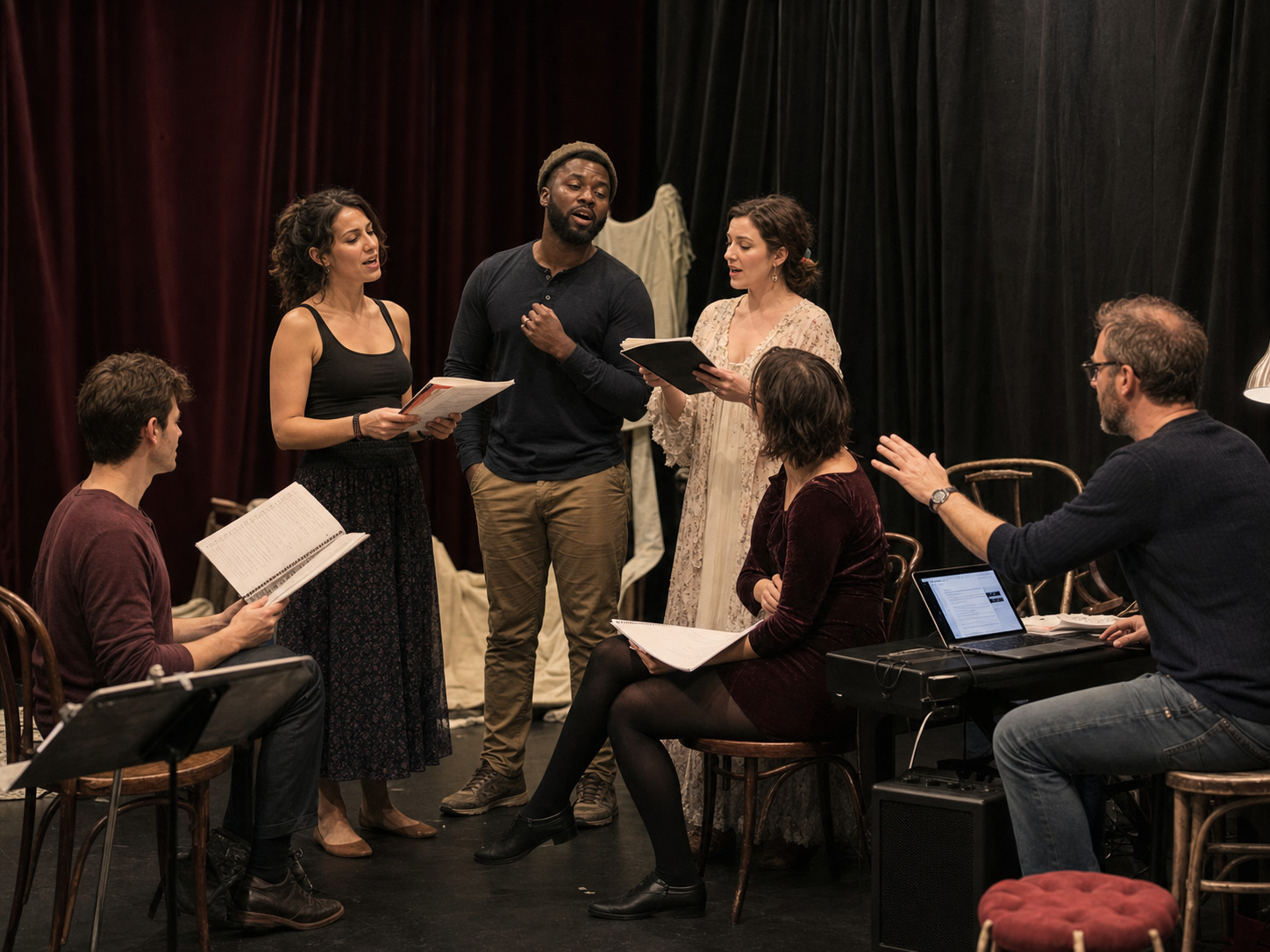
For each movement-heavy number, mark:
- the clean start point;
- one or two useful internal landmarks;
- the safe stop point;
- how the operator returns to the top; and
- whether a rehearsal-only pickup is different from the performance cue.
Those reset points belong in rehearsal notes, not inside a growing pile of casually trimmed files. If the production needs a lasting cut or a different amount of lead-in, approve it through the same process as every other change.
Keep one source of truth for revisions
A small cast does not mean a small version-control problem. One singer may ask for a key adjustment. A director may shorten a transition. A movement section may need a different tempo. If those choices live in texts, email threads, and verbal notes, rehearsals will eventually load the wrong file.
Use a simple revision record:
| Revision | Evidence to include |
|---|---|
| Key change | Song, original key, requested key, singer, and approval |
| Cut | Exact musical start and end points plus the staging reason |
| Tempo | Current tempo, requested tempo, and the section affected |
| Lead-in | Number of beats or bars and who uses them |
| Ending | Button, extension, fade, or other repeatable behavior |
| Delivery | New filename, date received, and who replaced the old file |
Archive older files outside the active show folder. Never label two different recordings “final.”
Test the room, not just the track
An intimate theater can make playback feel more exposed than a large auditorium. Test the final files through the actual speaker position and performance device. Listen from the front row, center, and side seating when possible.
The goal is clarity without making the cast fight the accompaniment. Check that:
- introductions are audible without announcing themselves too loudly;
- lyrics remain intelligible over fuller orchestration;
- quiet scenes do not gain an unwanted electronic hum;
- the operator can see the stage manager or receive the chosen cue reliably;
- notifications, sleep settings, and automatic updates are disabled on the show device; and
- a tested backup device can continue from the next cue.
For a broader performance plan, use the (Broadwaytrax guide to backing tracks, theater use, and grand rights). Permission to stage the show and permission to use a particular sound recording are separate questions, so confirm both before performance.
A practical pre-tech checklist
Before the first technical rehearsal, confirm all of the following:
- The licensed show materials and production song order agree.
- Every cue points to one uniquely named accompaniment file.
- All keys, cuts, tempos, lead-ins, and endings are approved.
- Spoken-to-sung transitions have been run in context.
- Movement reset points are documented for rehearsal.
- The performance operator has practiced with the cast.
- The show laptop or playback device has been tested in the venue.
- The backup device and recovery plan have been rehearsed.
- Older files are outside the active show folder.
- The company has secured the necessary show rights and recording-use permission.
FAQ: The Fantasticks backing tracks
Can the album be used for a full production?
The album page describes personal-use and separate theater-license options. A Broadwaytrax theater license covers use of the Broadwaytrax sound recording; it does not replace the grand-rights or theatrical license for the show. Confirm the current requirements for your production before performance.
Does the Broadwaytrax album include guide vocals?
No. The current album page lists 15 accompaniment-only tracks and says that guide vocals are not provided. Build vocal learning time with your music director, teacher, score, and other approved rehearsal materials before expecting actors to rehearse independently with accompaniment.
What if our cast needs a different key or cut?
Document the exact need and the approved production reason. Broadwaytrax offers custom track work for changes such as keys, cuts, tempos, lead-ins, cues, and endings when the request can be supported. Confirm scope and availability for the specific project instead of assuming every change is possible.
When should the final performance files be locked?
Early enough for the cast, stage manager, and operator to rehearse the exact version repeatedly before tech. If a late discovery requires a change, replace the active file deliberately, update the cue map, and rerun the affected transition.
Protect the intimacy with a clear plan
Preview the Broadwaytrax accompaniment album for 15 songs from The Fantasticks, then document any confirmed key, cut, tempo, lead-in, cue, or ending needs before your production relies on them.
Preview The Fantasticks AlbumThe best backing-track plan for The Fantasticks is almost invisible. It gives the actors room to listen, lets the stage manager call the same cue every night, and makes the accompaniment feel like part of the storytelling rather than a separate machine.
Choose the production version, map the transitions, rehearse the operator, and keep every approved file in one source of truth. That preparation is what lets a small stage feel fully alive.