“The Confrontation” Needs Two Choices Inside One Musical Clock
By Broadwaytrax Content Studio · October 21, 2026
The short answer: rehearse “The Confrontation” as one actor making two different choices inside the same musical clock. Build Jekyll and Hyde from breath, focus, posture, and intention—not from two unrelated voices—and map every switch to an exact orchestral cue.
Broadwaytrax includes “The Confrontation” in its (Jekyll and Hyde full album). The accompaniment keeps the scene moving without a guide singer, so the performer has to make each change legible while staying precisely connected to the track.
Bring "“The Confrontation” Needs Two Choices Inside One Musical Clock" to life with custom tracks
Get the exact arrangement you need—either customize an existing accompaniment or commission a bespoke build from our team.
Don't see this show in our library yet? We'll build it for you.Begin with two objectives, not two impressions
The scene becomes muddy when the rehearsal starts with “make Hyde darker” and “make Jekyll lighter.” Those are colors, not playable actions.
Write one active objective for each side of the exchange. Jekyll may need to contain, reason with, expose, or outlast Hyde. Hyde may need to tempt, humiliate, interrupt, or take control. Use verbs that can affect an opponent, even though one performer is carrying both parts.
Then speak the exchange without music. Keep the text in order and make every turn answer what just happened. If the two sides feel like separate monologues, clarify the argument before adding vocal effects.
The audience should hear a struggle developing, not a sequence of character samples.
Build the contrast from the body outward
A durable transformation begins with physical organization. A forced vocal trick can disappear under nerves, amplification, or fatigue, but a clear shift in the body gives the voice something consistent to follow.
Choose only a few repeatable differences:
| Rehearsal choice | Jekyll | Hyde |
|---|---|---|
| Center of gravity | Lifted or pulled back | Grounded or pressing forward |
| Focus | Tries to see and solve | Fixes on the weakness in front of him |
| Breath | Managed, interrupted by strain | Claimed early and spent aggressively |
| Gesture | Contains or corrects | Invades, dismisses, or seizes |
| Phrase ending | Searches for control | Finishes as if the outcome is settled |
Keep the choices economical enough to repeat through the full number. A larger physical idea is not automatically clearer. If the performer has to reset the whole body before every line, the transformation will arrive late and the track will expose it.
Protect the voice while keeping the characters distinct
Do not build Hyde by squeezing the throat, forcing a growl, or singing every phrase at maximum weight. The character difference needs to survive the complete scene and the rest of the performance schedule.
Instead, test contrast through:
- consonant attack;
- vowel shape within healthy technique;
- pace of thought;
- dynamic range;
- resonance choices agreed with the music team;
- breath timing;
- and how directly each side addresses the imagined opponent.
Work with a qualified voice teacher, vocal coach, or music director when the role demands repeated extreme colors. The performer should be able to speak comfortably after the run and repeat the scene without pain. Persistent discomfort is a stop signal, not evidence that the characterization is working.
Record a short section from the audience position. The contrast may feel enormous inside the performer and read only slightly in the room. It may also sound so exaggerated that the words disappear. Adjust from the recording instead of guessing from the stage.
Put every switch on the accompaniment map
The accompaniment will not wait for the actor to find the next character.
Listen to the full track with the score or approved materials and mark:
- the first entrance;
- every exact handoff between Jekyll and Hyde;
- orchestral figures that announce or complete a switch;
- phrases where the change happens before the next word;
- the largest musical build;
- one safe restart point;
- and the final release.
Name the cues by what the performer can actually hear. “After the low string figure” or “on the brass attack before Hyde’s next phrase” is more useful in rehearsal than an approximate timestamp that changes when someone drags the playback bar.
Practice the handoffs in pairs. Start one phrase before the switch, make the change, continue one phrase beyond it, then reset. Once each pair is reliable, connect them into longer sections.
Rehearse thought, sound, and movement separately
This number asks the performer to manage too many layers at once if everything is added on the first run.
Use three passes:
Pass one: thought
Speak the scene at a neutral volume. Keep only the two objectives and the logic of each response.
Pass two: sound
Sing with the accompaniment while standing mostly still. Confirm entrances, breaths, vocal contrast, and the exact musical handoffs.
Pass three: movement
Add the physical map, eyelines, turns, and any director-approved stage travel. Make sure the movement clarifies the switch without covering the cue that makes it possible.
Finally, combine the layers and record one uninterrupted run. If a transformation fails, diagnose whether the missed information came from thought, sound, movement, or cue timing. “Make it bigger” is rarely a precise enough repair.
Give each side a fixed place to speak from
An eyeline map can make the conflict readable without turning the stage into a tennis match.
Choose two points that fit the production’s staging and sightlines. They might be slightly left and right of center, two heights, or one forward and one withdrawn focus. The points should help the audience track who is speaking while allowing the actor to remain open enough for words and facial choices to register.
Avoid a mechanical full turn on every line. Some of the strongest moments may happen when one side interrupts before the body has completely changed, or when Jekyll recognizes Hyde’s control without moving at all. Those exceptions work only after the basic map is clear.
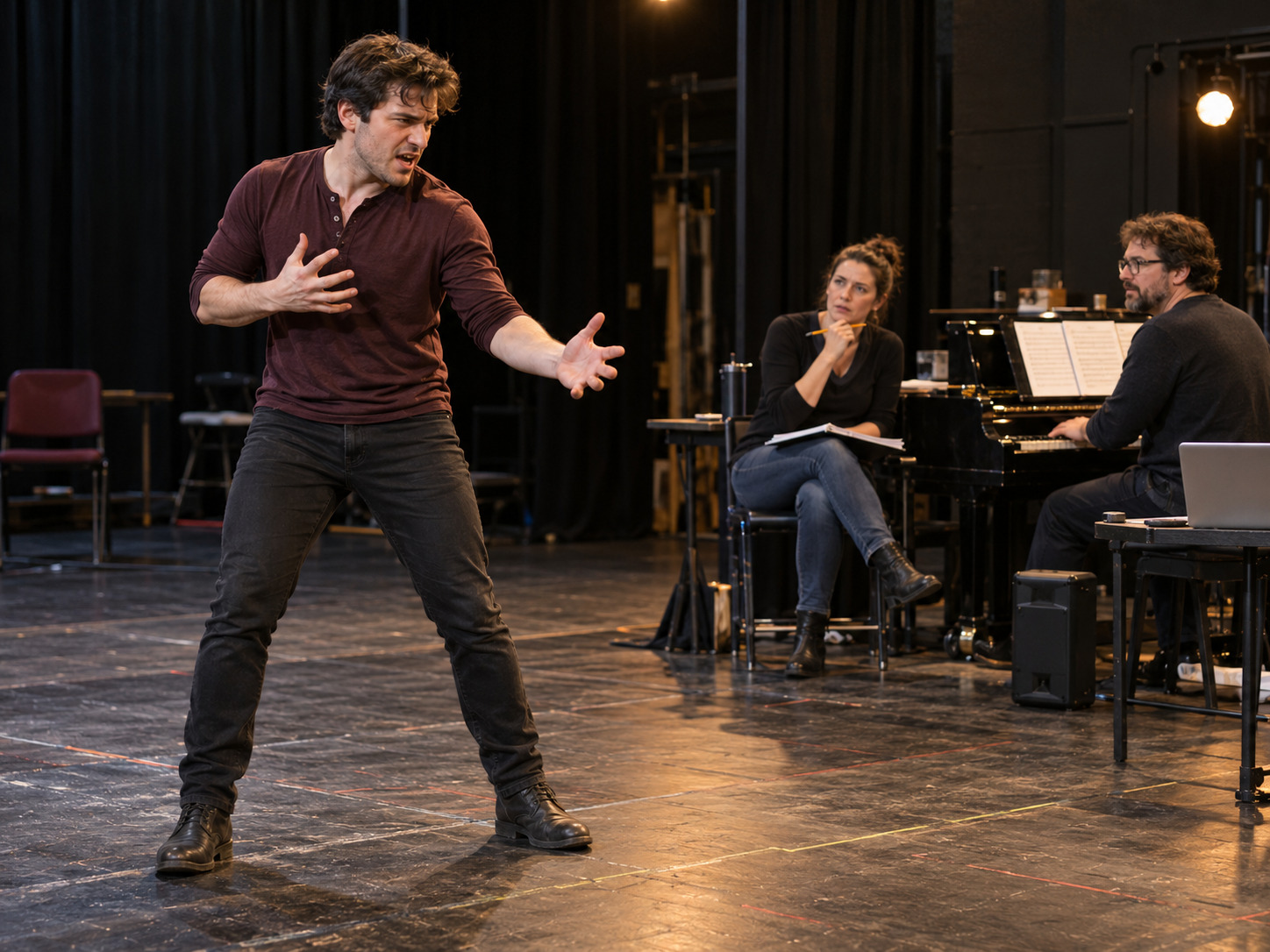
Run the scene from several audience positions. A subtle angle that reads from the center may disappear from the side. If microphones are used, check that head turns do not pull important words away from the pickup pattern.
Plan the build so the ending still has somewhere to go
If both characters begin at full intensity, the orchestration has no dramatic work left to support.
Divide the scene into three broad phases:
- Containment: Jekyll believes the struggle can still be managed.
- Destabilization: Hyde begins to control the rhythm, the space, or the terms of the argument.
- Decision: the final section no longer sounds like a debate with equal power.
The exact interpretation belongs to the production, but the energy should change for a reason. Mark where breath shortens, where interruptions become more dangerous, where physical distance collapses, and where the accompaniment stops allowing the performer to recover.
Save at least one unused color for the final phase. It may be stillness, a clearer tone, a quieter threat, a sudden loss of control, or a decisive physical choice. Contrast often reads more strongly than simply adding volume.
Coordinate sound, light, and the actor’s cues
Technical choices should reinforce the performance rather than replace it.
Before tech, agree on:
- the exact approved accompaniment file;
- playback level and monitor position;
- microphone choice and whether the actor’s turns affect clarity;
- lighting changes that support, rather than announce, each identity;
- the safe restart point;
- the final chord, pose, blackout, or next line;
- and what the operator should do if the entrance is missed.
Run the number from its real trigger, not from an operator casually pressing play. Include the spoken line, movement, light cue, or stage-manager GO that begins the track. Then continue through the final silence and whatever follows.
If the production needs a different key, cut, lead-in, tempo, or ending, document the exact tested need before requesting an edit. Broadwaytrax’s (custom track service) can shape the audio around an approved performance plan.
A focused 25-minute rehearsal
Minutes 1–5: speak the argument
Name each objective and speak the exchange without character voices.
Minutes 6–10: mark the switches
Listen to the track and identify each audible handoff, one restart point, and the ending.
Minutes 11–15: sing without staging
Test healthy vocal contrast, clear words, breaths, and exact entrances.
Minutes 16–20: add the physical map
Use the agreed posture, focus, and eyeline choices. Keep them repeatable.
Minutes 21–25: run and review
Record one uninterrupted pass. Choose one repair that will make the conflict clearer without adding strain.
Final checklist
- Each character has a playable objective.
- The contrast begins in thought and body, not throat pressure.
- Every switch is tied to an audible musical cue.
- The actor can repeat the number without pain or loss of speech comfort.
- Eyelines read from more than one audience position.
- The build changes in stages instead of beginning at maximum intensity.
- The final accompaniment file, key, cut, and ending are approved.
- The stage manager and operator know the real start trigger and restart point.
- Sound and lighting support the actor without doing the storytelling for them.
- Recording-use and production rights have been handled separately from track preparation.
FAQ: rehearsing “The Confrontation” with a backing track
Should Jekyll and Hyde use completely different voices?
They need to be clearly distinguishable, but “different” does not have to mean extreme. Breath, diction, pace, resonance, posture, focus, and intention can create contrast without unsafe vocal forcing.
How can one actor switch characters on time?
Map every handoff to a sound in the accompaniment, then rehearse one phrase before and after each switch. Build from pairs of phrases into complete sections.
Is a backing track too rigid for this scene?
It can support the scene well when the actor treats the recording as a shared score. The performer still makes expressive choices, but breaths, switches, movement, and technical cues have to live inside the track’s structure.
What should be customized first?
Start with the tested key, exact cut, lead-in, tempo, and ending. A useful request identifies the musical location, the rehearsal problem, and the behavior the revised track should support.
Should the actor rehearse with amplification?
Use the Broadwaytrax Jekyll and Hyde album as the shared musical source for The Confrontation and the complete show, then request tested key, cut, tempo, cue, or ending changes when the production needs them.
Explore the Jekyll and Hyde AlbumYes, before the final run. Microphone placement, head turns, playback level, and monitors can change how clearly the two characters read in the room.
The scene works when the audience can follow the conflict without watching the actor demonstrate a trick. Give both sides a clear objective, place every transformation on the music, protect the voice, and let the final section reveal who has gained control.