“Poor Unfortunate Souls” Works Best When the Bargain Stays Clear
By Broadwaytrax Content Studio · October 20, 2026
The short answer: rehearse the number as a bargain that changes hands beat by beat. The scene becomes compelling when the lead performer knows exactly what the other character wants, what each new promise is meant to overcome, and where the accompaniment turns persuasion into pressure.
That approach matters with a backing track. The recording supplies a fixed dramatic clock. It will not wait while a gesture grows, a reaction arrives late, or a laugh stretches past the next entrance. A useful rehearsal plan lets the actor stay dangerous, funny, and responsive without losing the music underneath the scene.
Bring "“Poor Unfortunate Souls” Works Best When the Bargain Stays Clear" to life with custom tracks
Get the exact arrangement you need—either customize an existing accompaniment or commission a bespoke build from our team.
Don't see this show in our library yet? We'll build it for you.Broadwaytrax offers a (“Poor Unfortunate Souls” accompaniment track) from The Little Mermaid. Use one approved track version as the shared reference for the performer, scene partners, director, choreographer, and playback operator.
Start with the transaction, not the villain pose
The song has more dramatic shape when the performer is trying to win something specific. Before singing, speak the scene and answer four questions:
- What does the other character want at the beginning?
- What objection must be removed first?
- Which promise makes the offer feel possible?
- At what point does the choice become difficult to reverse?
Avoid playing every phrase as equally sinister. A constant threat leaves nowhere for the scene to travel. Persuasion can begin with welcome, shift into recognition, become entertaining, and only then tighten into control.
Give each section an active verb such as comfort, diagnose, amuse, tempt, corner, or close. The exact words may change as rehearsal develops. What matters is that the actor can explain how one tactic leads to the next.
Build a shared map of musical turns
Listen through the accompaniment without staging and mark the moments that change the bargain. Use names the whole room can understand.
| Musical landmark | Lead performer’s job | Scene partner’s job |
|---|---|---|
| First invitation | Make the offer feel worth hearing | Decide why staying is easier than leaving |
| First objection | Notice resistance without rushing past it | Let the concern become visible |
| Comic or theatrical turn | Make the solution feel entertaining | Follow the new idea without agreeing yet |
| Cost becomes clear | Narrow the choices | Register what may be lost |
| Final push | Ask for a decision, not applause | Make the choice legible |
| Button or cutoff | Hold the result of the bargain | Carry the consequence into the next cue |
These labels are more useful than a long list of isolated gestures. They help the cast understand why the energy changes and give the operator a cue map that connects music to action.
Separate language, rhythm, and physicality
Dense character writing can become muddy when the performer solves text, tempo, movement, and facial expression at once. Rehearse in layers:
- Speak the text conversationally while pursuing the objective.
- Speak it in rhythm over the track.
- Sing while standing still enough to hear every consonant and pickup.
- Add one planned change of focus for each major tactic.
- Add travel only where it changes the relationship.
- Add detailed gesture after the scene already reads.
If a phrase disappears when movement begins, reduce the movement before raising the volume. The audience needs to understand the offer. A larger gesture cannot rescue language that has lost its target.
This layered process also protects breath. The performer can identify which movement helps the phrase and which movement steals the preparation needed for the next entrance.
Give every flourish a recipient
The number can support bold choices, but theatrical size works best when it lands somewhere. For each important flourish, decide who receives it:
- the character being persuaded;
- an attendant or scene partner;
- the imagined people in an example;
- the audience as a private aside;
- or the performer’s own growing certainty.
Without a recipient, movement can become decorative. With one, the same gesture becomes a tactic.
Run a section twice: once with every choice aimed only at the scene partner, then once with selected asides opened toward the house. Compare which version makes the bargain easier to follow. Keep only the outward moments that add information rather than interrupting the transaction.
Rehearse the attendants as part of the pressure
Supporting performers should not create unrelated atmosphere. Their stillness, movement, and reactions can make the lead’s tactics clearer.
Assign each attendant a small set of jobs:
- prepare or reveal an object only when the scene needs it;
- redirect the other character’s focus;
- reinforce a comic demonstration;
- close off or reopen physical space;
- and reset before the next musical turn.
Rehearse their cues first at half energy. Make sure they can hear the same landmarks as the lead. If they move early, the audience may read the next tactic before the lead has earned it. If they move late, they may cover the words or pull focus from the decision.
The attendants do not need identical reactions. They need coordinated timing and a clear relationship to the bargain.
Plan laughs without leaving the track behind
Theatrical character numbers often earn laughs in performance. A fixed accompaniment will keep moving, so identify the lines or physical beats most likely to produce a response.
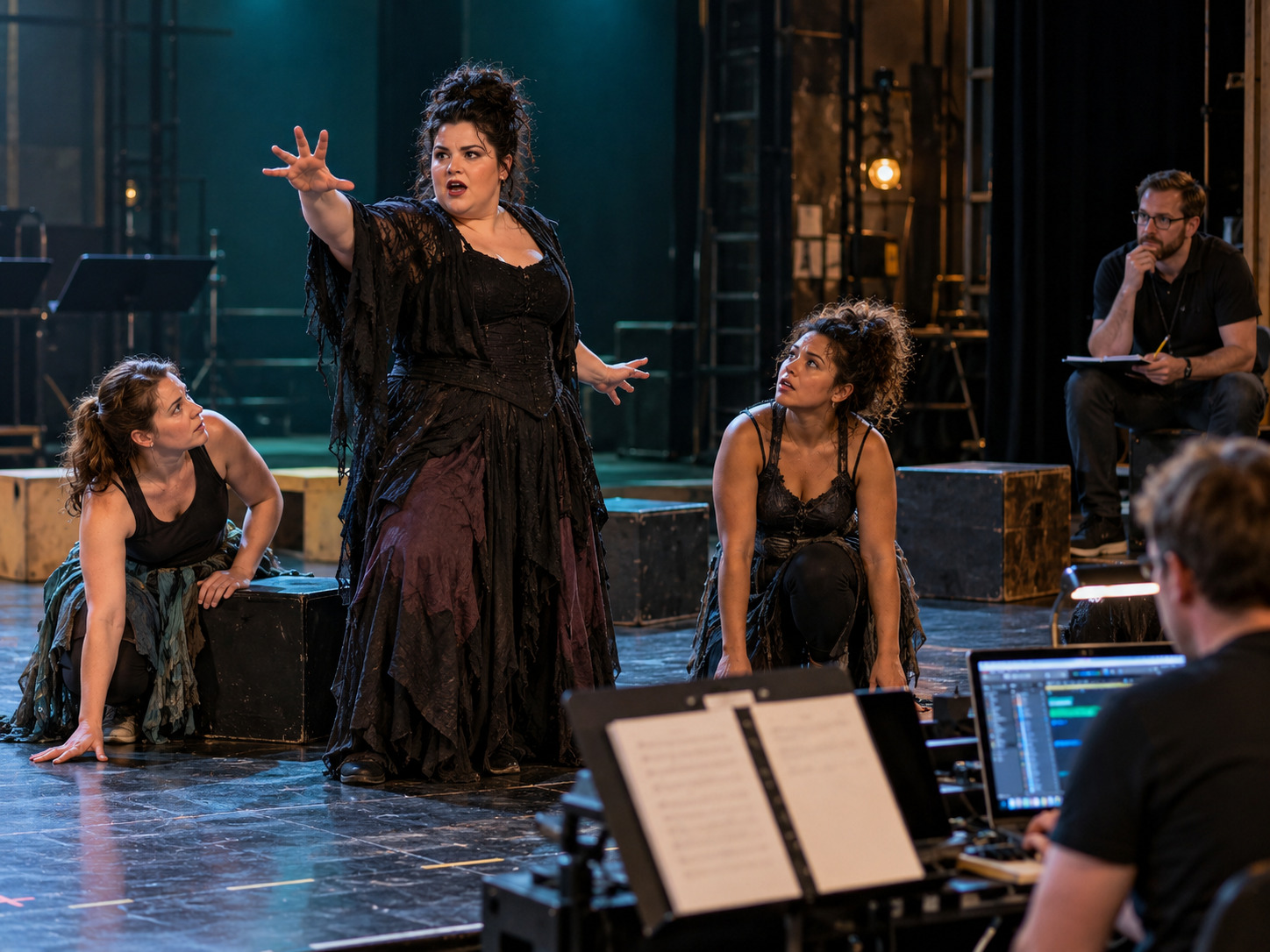
For each one, decide:
- what information must land before the laugh;
- whether the performer can continue physically while waiting to speak;
- which next word or entrance cannot be lost;
- and whether the moment fits the existing music or proves a real need for an edit.
Do not stretch every comic possibility. Protect the moments that reveal character or change the bargain. A shorter pause with a clear target is often funnier than an improvised hold that makes the next entrance frantic.
If rehearsal consistently proves that a beat needs different timing, document the exact location and test a (custom track request) rather than building a performance plan around uncertain manual pauses.
Let costume and props support the cue map
Large sleeves, a skirt, a cane, a shell, a contract, or another production prop can change breath, sightlines, and timing. Introduce important elements early enough to test them safely.
Check that the performer can:
- see the scene partner during every decision;
- reach and release props without missing an entrance;
- move through the planned path without covering another actor;
- hear the accompaniment from every position;
- and arrive at the final picture with enough breath to finish the phrase.
Avoid adding business simply because a prop is available. Keep the actions that clarify the offer, reveal its cost, or make the final choice visible.
Give the playback operator a scene-based cue card
The operator should not have to interpret the whole performance from the booth. Provide a concise card with:
- the exact filename and version;
- the verbal or visual start cue;
- the first audible landmark;
- the major tactic changes;
- any known laugh-sensitive pickup;
- the final cutoff or button;
- and the next dialogue, lighting, or scene-change cue.
Run the transition into and out of the number, not only the song itself. The bargain begins before playback and its consequence continues after the last sound.
For a broader production workflow, use Broadwaytrax’s (guide to backing tracks, theater use, and grand rights). The recording plan and the show-performance permission are separate responsibilities, and both should be clear before performance.
A focused 35-minute rehearsal plan
Use one short call to prove the dramatic and musical structure:
- Five minutes: speak the bargain and name the major tactics.
- Seven minutes: listen to the track and mark the shared landmarks.
- Eight minutes: sing with minimal movement and clear recipients.
- Seven minutes: add attendants, props, and planned travel.
- Five minutes: test the likely laugh and the final decision.
- Three minutes: run directly into the next cue and record one note for each department.
Finish with one uninterrupted pass. If it breaks, identify whether the cause belongs to text, breath, blocking, operator cue, balance, or the track itself. That diagnosis is more useful than simply running the number again.
FAQ: rehearsing “Poor Unfortunate Souls” with a backing track
What should the performer rehearse first?
Start with the transaction: what the other character wants, what stands in the way, and how each section of the song changes the offer. Add full physicality after the text and musical turns are clear.
How can the scene stay flexible with a fixed track?
Map the moments that may vary, keep the essential entrances predictable, and decide what the actor can do physically while the accompaniment continues. Request a deliberate edit when the staging truly requires different timing.
Should the attendants mirror the lead performer?
Not necessarily. They can have distinct characters, but their cue timing and focus should support the same dramatic turn instead of competing with it.
What should the playback operator know?
The operator needs the approved file, the exact start cue, recognizable musical landmarks, any laugh-sensitive pickup, the ending, and the cue that follows the song.
Can the same track be used for rehearsal and performance?
Use the Broadwaytrax Poor Unfortunate Souls accompaniment track as the shared dramatic clock for character tactics, scene-partner reactions, props, laughs, and playback cues.
Preview the Poor Unfortunate Souls TrackUse depends on the production’s recording license and show-performance rights. Confirm both, and make sure the final approved version matches the production’s key, timing, cuts, and cue plan.
The strongest version of the scene is not the one with the most effects. It is the one in which every musical turn makes the bargain harder to resist—and every performer and operator can follow the same dramatic clock.