Let “Omigod You Guys” Pass the Excitement Around
By Broadwaytrax Content Studio · October 29, 2026
Updated October 29, 2026
The short answer: rehearse “Omigod You Guys” as a relay of discoveries, not as one long burst of volume. The number stays buoyant when every entrance has a reason, each handoff lands inside one shared pulse, and the stage traffic keeps the audience’s attention moving toward Elle.
Broadwaytrax offers an (“Omigod You Guys” accompaniment track), a matching (guide-vocal track), and the complete (Legally Blonde album). That gives a company a sung reference for learning and an accompaniment-only version for proving that the live cast can carry the scene.
Bring "Let “Omigod You Guys” Pass the Excitement Around" to life with custom tracks
Get the exact arrangement you need—either customize an existing accompaniment or commission a bespoke build from our team.
Don't see this show in our library yet? We'll build it for you.Treat the opening as news traveling through a room
Fast ensemble writing becomes muddy when everyone performs the same generalized excitement. Give the cast a chain of information instead.
For each entrance, answer three questions:
- Who has just learned something?
- Who needs to hear it next?
- What changes after the information lands?
This creates a visible route through the number. One performer receives the idea, another amplifies it, a third redirects the group, and the ensemble eventually turns its attention toward the person at the center of the story.
Speak the exchanges once without music. Keep the pace active, but require every performer to make eye contact with a real scene partner. Then add the backing track and preserve that same path. If the words become less specific when the music starts, reduce movement and rebuild the relay in shorter sections.
Establish one rhythmic floor before adding excitement
The opening should feel quick, but the cast should not create speed by getting ahead of the accompaniment.
Begin with a pulse pass:
- play the accompaniment at a useful rehearsal level;
- have the company mark the underlying beat without singing;
- identify the first instrumental sound that prepares the opening entrance;
- clap or speak the fastest text in rhythm;
- and mark the final consonants that release each phrase.
Next, add only the performers responsible for the first exchange. Bring in the remaining voices one group at a time. The ensemble should feel as though it is adding detail to the same clock, not starting a new tempo every time another person enters.
If a passage rushes, do not simply ask everyone to slow down. Find the exact handoff where the pulse changes. Rehearse the outgoing line, the breath between speakers, and the incoming word as one unit.
Give every entrance a target
An entrance can be accurate and still feel empty if the performer is singing toward no one.
Build a simple entrance map:
| Moment | Performer’s target | What the audience should notice |
|---|---|---|
| First discovery | One named friend | The news matters before the full group hears it |
| Expanding relay | The next person in the chain | The excitement is spreading, not repeating |
| Group response | Elle and the immediate scene | The ensemble’s attention has a center |
| Musical lift | The room as a whole | Private excitement becomes a shared event |
Run the map with pointing replaced by focus, body angle, and travel. The audience should be able to follow the news without every performer indicating the same thing with the same gesture.
This is especially useful when the company is large. Specific targets prevent the front line from becoming the only active part of the stage while everyone behind it performs decorative enthusiasm.
Keep Elle’s preparation separate from the ensemble’s momentum
The company supplies pressure and possibility. Elle still needs an individual sequence of choices.
Rehearse her material first with only the closest scene partners and the accompaniment. Mark:
- what she is trying to make happen;
- which detail confirms that the plan is working;
- where the ensemble changes her confidence;
- and what she decides before the number moves on.
Then add the larger group in layers. Ask whether the ensemble supports the scene or forces the lead performer to compete for focus and volume.
If the lead’s text disappears, check traffic, body orientation, ensemble balance, and playback level before asking for a bigger vocal sound. A still, specific choice can read more clearly than another step forward or another increase in volume.
Design stage traffic around the vocal relay
Busy movement can help the number feel social and spontaneous. It can also hide entrances, block sightlines, and pull breath away from quick text.
For every important handoff, confirm:
- where the outgoing performer finishes;
- where the incoming performer can hear the track;
- whether the music director is visible;
- what path remains open for the lead;
- and which group owns the audience’s focus.
Use lanes rather than constant crossing. One group may travel downstage while another resets upstage. A third may stay planted long enough for a lyric to land. The picture can keep changing without every performer moving on every beat.
Run the traffic once while speaking the text, once while marking the singing, and once at performance energy. If an entrance works only from a neutral line at the front of the room, it is not ready for the staged number.
Use the guide vocal as a teacher, then remove it
The guide-vocal version can clarify melody, rhythm, text placement, and the shape of the exchanges. The accompaniment-only version reveals whether the company actually owns those details.
Move through the files deliberately:
| Pass | What to prove |
|---|---|
| Guide vocal, listening | Everyone can hear the form and locate personal entrances |
| Guide vocal, short sections | Fast text and group handoffs become accurate |
| Accompaniment, voices only | The cast can carry the relay without recorded singers |
| Accompaniment, marked staging | Entrances survive body angles and travel |
| Accompaniment, full scene | The company, lead, and operator can complete the real handoff |
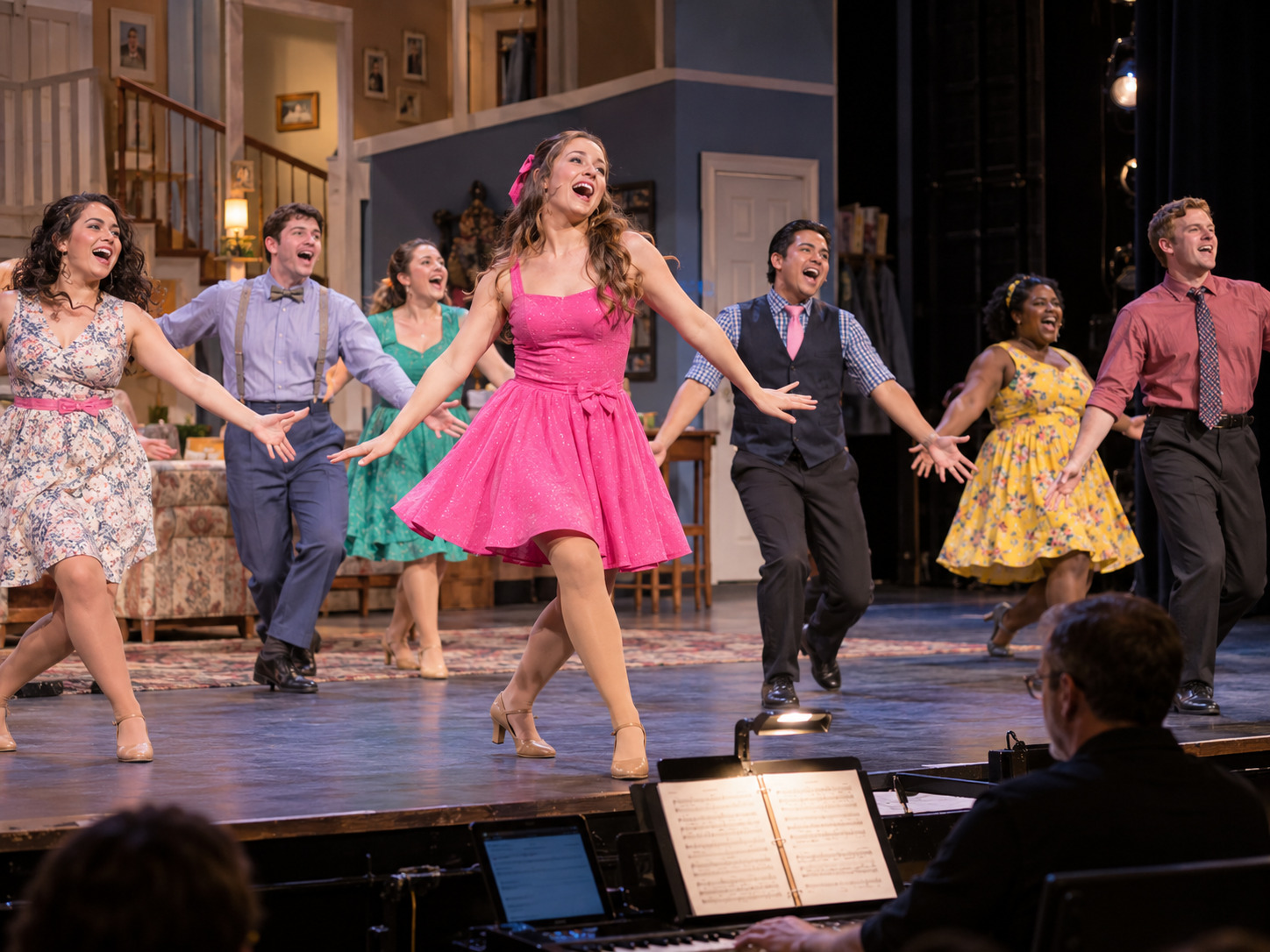
When a section breaks, return to the guide vocal for that section only. Repeat it immediately with accompaniment so the repair belongs to the live cast.
Keep guide-vocal files clearly separated from the approved performance folder. A playback operator should never have to decide between nearly identical files while the stage is waiting.
Rehearse the first and last ten seconds as scenes
The operator’s work begins before the first sound.
Practice this complete opening sequence:
- the preceding line, action, or preset;
- the exact person who gives the playback cue;
- the first audible instrumental landmark;
- the company’s first breath and entrance;
- the first visible handoff of information.
Then rehearse the ending through whatever follows it. Confirm the final musical button, company focus, applause or dialogue expectation, and the next technical cue. Starting and stopping the file in isolation will not prove that the scene can continue.
Give the operator one approved filename, one tested house level, one safe restart point, and a local backup on a second tested device. If the production needs a different key, cut, tempo, lead-in, cue, or ending, document the exact rehearsal problem before requesting a change. Broadwaytrax can (customize an existing track) around a confirmed production need.
A focused 25-minute rehearsal
Minutes 1–4: speak the relay
Name who receives each piece of news and who gets it next. Keep real eye contact and playable objectives.
Minutes 5–8: mark the pulse
Listen to the accompaniment, identify the opening landmark, and speak the fastest text in rhythm.
Minutes 9–13: layer the entrances
Build the number from the first exchange outward. Fix one outgoing-and-incoming pair at a time.
Minutes 14–18: add Elle and the scene partners
Protect the lead’s choices, text, and breath while the ensemble grows around her.
Minutes 19–22: add traffic
Test real positions, crosses, body angles, and sightlines without losing the entrance map.
Minutes 23–25: run the handoffs
Begin before playback starts and continue through the event after the final chord. Record one specific repair for the next rehearsal.
Final checklist
- The cast shares one pulse without rushing.
- Every entrance has a named target and a clear reason.
- Excitement travels through the group instead of becoming constant volume.
- Elle’s individual choices remain readable inside the ensemble.
- Fast text stays intelligible at performance energy.
- Stage traffic preserves breath, sound, and audience focus.
- The guide vocal has been removed before final staging and performance runs.
- The real playback cue, first entrance, ending, and next event have been rehearsed.
- Only approved performance files are in the operator’s live folder.
- Show rights and recording-use permissions have been confirmed separately.
FAQ: rehearsing “Omigod You Guys” with a backing track
Should the cast start with the guide-vocal version?
Use it to learn form, melody, text rhythm, and entrances. Move to the accompaniment-only file while there is still rehearsal time to repair anything the recorded singers were carrying for the cast.
How do we keep the ensemble from rushing?
Mark the underlying pulse, speak the fastest text in rhythm, and rehearse each outgoing-and-incoming handoff as one unit. Rebuild the texture in layers instead of repeating the full number faster and louder.
How should we stage a large company?
Use clear focus lanes, real scene partners, and selective movement. Not every performer needs to cross on every phrase. The audience should be able to follow the information as it reaches Elle.
What should the playback operator know?
Provide the approved filename, start cue, first audible landmark, intended level, safe restart point, ending behavior, and backup location. Rehearse those details inside the scene.
Can the track be adjusted for our production?
Preview the accompaniment and matching guide-vocal track, then confirm the key, cut, tempo, cue, and theater-use option your cast or production needs.
Preview Omigod You GuysBroadwaytrax supports custom keys, cuts, tempos, lead-ins, cues, and endings. Confirm what the show license permits, then describe the exact musical or staging behavior the recording needs to support.
The number becomes joyful when the company is listening as actively as it is singing. Build the pulse, pass the discovery from person to person, and let the choreography reveal the relay instead of covering it.