A Sitzprobe Should Prove the Music Before Tech Takes Over
By Broadwaytrax Content Studio · September 23, 2026
A sitzprobe should be the first time the cast, music team, and playback plan hear the whole score as one production—not the first time anyone discovers which file is current.
Traditionally, a sitzprobe brings performers and orchestra together to focus on music without full staging. When a school or community theatre uses backing tracks, the same rehearsal still matters. The room needs to connect live voices, dialogue pickups, conductor cues, recorded accompaniment, and the exact versions that will move toward tech.
The useful goal is not to run every song from beginning to end. It is to prove the musical handoffs that will be difficult to repair once scenery, microphones, choreography, and costume changes are added.
What is a sitzprobe with backing tracks?
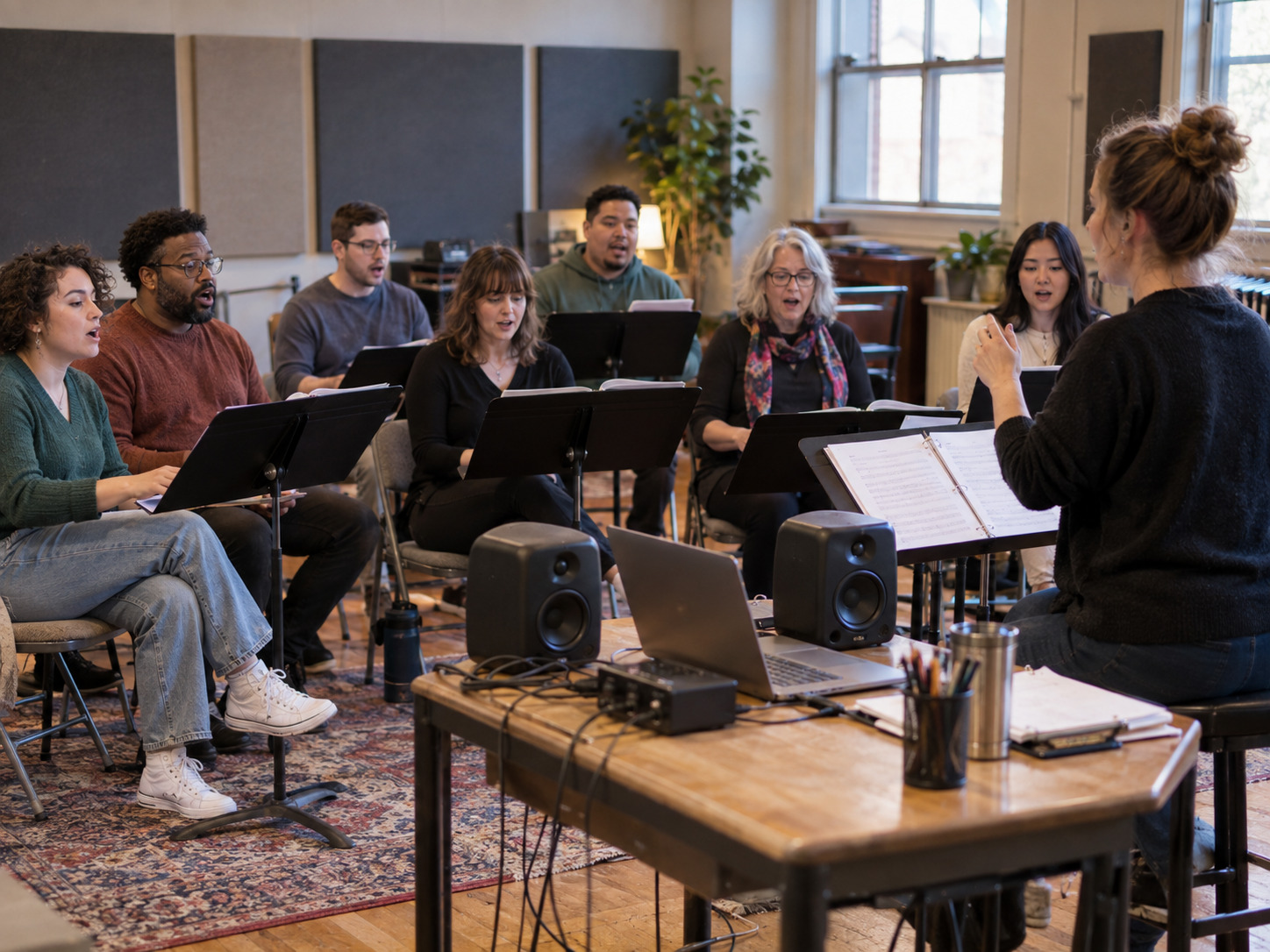
A sitzprobe with backing tracks is a focused music rehearsal in which the company sings the score with the accompaniment files intended for production. Performers may be seated or lightly staged. The music director leads the room, while the playback operator follows the same file order, cue language, and version map the team expects to use later.
It should answer practical questions:
- Can the cast hear the introductions and enter together?
- Do the approved keys and cuts fit the singers across a complete run?
- Are guide-vocal files gone from the performance playlist?
- Do dialogue-to-song and song-to-dialogue transitions have clear owners?
- Can the operator restart from useful musical landmarks?
- Which moments require a real track change before tech?
That makes the sitzprobe a bridge between music rehearsal and production rehearsal. It is not a substitute for either one.
Freeze one rehearsal-ready file set first
Do not begin with a shared folder full of possible versions.
Before the call, the music director and production lead should approve one active file for every planned musical moment. Each file should identify:
- cue or sequence number;
- song title;
- key;
- cut or complete-song structure;
- file role, such as accompaniment or rehearsal guide;
- version number or approval date;
- and whether it is rehearsal-only or performance-intended.
Move superseded exports out of the live playlist. Keep them available for history if the team needs them, but do not make the operator choose between final, final-new, and use-this-one while the company waits.
If cast members are still using guide vocals at home, give those files a different folder and an unmistakable label. The sitzprobe should usually use the accompaniment-only versions so singers can prove their entrances, harmony, and independence.
The (Broadwaytrax guide-vocal library) is useful early in learning. The sitzprobe is where the room should hear whether that learning transfers to the production accompaniment.
Give the conductor and operator the same map
A backing track does not follow a conductor. The conductor and operator therefore need one shared definition of every start, hold, restart, and ending.
Build a compact sitzprobe map:
| Field | What to record |
|---|---|
| Cue | The number used by the operator and stage manager |
| File | The exact approved filename |
| Trigger | Spoken line, conductor gesture, count, or called GO |
| First event | What the room hears before the first sung note |
| Entrance | The singer, section, or ensemble that enters first |
| Flexible point | Vamp, hold, fermata, or dialogue window, if any |
| Ending | Button, fade, cutoff, or transition into the next cue |
| Restart | One reliable landmark for a second pass |
The conductor should not have to translate rehearsal language for the operator in real time. If the music director says “top of the dance,” the operator map should identify the exact file and audible landmark that phrase means.
Start with the edges, not the easy middle
The most useful sitzprobe work often happens before and after the part everyone knows.
Prioritize:
- spoken dialogue into the first note;
- an exposed vocal pickup after a long introduction;
- ensemble entrances after instrumental breaks;
- underscoring that continues beneath speech;
- vamps or repeated sections with a called exit;
- reprises that begin differently from the original number;
- endings followed immediately by dialogue, movement, or another track;
- and transitions where applause may change the timing.
Run each edge from its real trigger. Do not prove an entrance by dragging the playhead to two seconds before it. The company needs to experience the complete lead-in and the operator needs to practice the actual start procedure.
When a handoff fails, name which layer failed. Was the file wrong? Was the cue unclear? Did the cast miss an audible landmark? Did the introduction leave too little preparation? Was the music director trying to shape a moment the current track does not support?
Clear diagnosis prevents every problem from becoming “the track felt off.”
Check keys and stamina across the whole score
A key that works in isolation may feel different after several ensemble numbers, high-energy scenes, or repeated choreography calls.
During the sitzprobe, listen for:
- a principal saving the voice early because a later number sits high;
- ensemble lines that disappear at the bottom of the range;
- a final refrain that becomes strained after the complete song;
- a duet key that favors one singer but exposes the other;
- and transitions where the new tonal center does not settle before the entrance.
Do not change keys impulsively in the room. Record the exact range or storytelling problem, confirm what the licensed production materials allow, and decide who approves the change. Then prepare a matched revision and test it against the same musical moment.
For a production-specific key, cut, tempo, lead-in, vamp, or ending, (Broadwaytrax custom tracks) can shape the audio around an approved rehearsal plan.
Rehearse vamps with a visible exit
A vamp only works when everyone knows who controls it and how the exit is communicated.
For each repeated section, decide:
- Who watches the stage action or musical condition?
- Who decides the room is ready to leave the vamp?
- What exact cue does that person give?
- Who calls or executes the playback change?
- What does the cast hear that confirms the exit?
With a fixed recording, a vamp may be pre-built to a specific number of repeats. In another system, the operator may trigger an exit section. The sitzprobe should use the actual behavior planned for the show.
Avoid phrases like “take it when it feels right.” Replace them with an observable cue: the conductor closes the left hand after the fourth repeat; the stage manager calls the exit after the scene-change confirmation; or the operator advances on the named line.
Separate performance problems from file problems
Not every rough moment requires a new edit.
A cast may need to:
- listen through a rest;
- sustain the tempo without leaning on a guide vocal;
- release consonants together;
- watch the conductor during a ritard already present in the recording;
- or learn the difference between a musical pickup and a playback cue.
The file may need attention when:
- the lead-in does not give the planned entrance enough preparation;
- the approved cut creates an awkward harmonic or dramatic jump;
- the ending does not match the staging;
- a dialogue window is consistently too short;
- the tempo prevents the intended choreography or text from reading;
- or the operator lacks a usable restart point.
Mark each note as performer, conductor, operator, mix, or track revision. That small distinction keeps the post-rehearsal work actionable.
Run one production-style sequence before ending
After solving isolated moments, choose a short sequence that crosses several boundaries. It might include dialogue into a song, a scene-change transition, a reprise, and the next spoken pickup.
Run it without stopping. Use the active playlist, normal cue language, actual conductor position, and planned operator procedure. This is not a full stumble-through. It is a proof that the repaired handoffs still work when the room stops discussing them.
Record anything that remains conditional because microphones, staging, scenery, or audience response are not yet present. “Unverified until the actor crosses to stage left” is more useful than “probably fine.”
End with one revision list
The sitzprobe should produce one current list, not a trail of private notes.
For every open item, record:
- cue and filename;
- exact observed problem;
- owner;
- proposed repair;
- approval needed, if any;
- replacement-file naming plan;
- and the rehearsal moment that will verify it.
If a track changes, keep the guide-vocal and accompaniment versions aligned where both are still in use. Update the operator map and cast packet together. Do not let an old rehearsal export remain in circulation after a production version changes.
Sitzprobe backing-track checklist
- Approve one active accompaniment file per musical moment.
- Remove guide vocals and superseded versions from the performance playlist.
- Give conductor and operator the same cue map.
- Test dialogue-to-song and song-to-dialogue edges.
- Run introductions, pickups, vamps, reprises, cutoffs, and transitions from real triggers.
- Listen for key and stamina problems across the complete score.
- Name who controls every flexible moment.
- Classify notes by performer, conductor, operator, mix, or track revision.
- Give each open item one owner and one verification point.
- Finish with a short uninterrupted production-style sequence.
- Keep a tested offline backup of the approved playlist.
FAQ: sitzprobe rehearsals with backing tracks
Can you have a sitzprobe without a live orchestra?
Yes. A production using backing tracks can still hold a focused sitzprobe to connect cast voices with the exact accompaniment, conductor cues, playback operation, keys, cuts, vamps, and transitions intended for the show.
Should the cast be seated for the whole rehearsal?
Not necessarily. Keep staging light so musical attention stays central, but let performers stand or mark movement when position, breath, or a cue depends on it.
Should guide vocals be used during the sitzprobe?
Usually, the cast should work with accompaniment-only files. Use a guide vocal briefly to diagnose a learning problem, then return to the production accompaniment so the singer or section carries the line independently.
Who should run the backing tracks?
Use the person or role that will own playback in production whenever possible. If a substitute runs the sitzprobe, use the same cue map, filenames, device behavior, and handoff language the performance operator will inherit.
What should happen after the sitzprobe?
Resolve the one shared revision list, distribute only approved replacements, update the cue map and cast packet, and verify each change at its named rehearsal moment before tech.
The takeaway
Bring Broadwaytrax the approved keys, cuts, tempos, lead-ins, vamps, cue points, and endings your sitzprobe uncovered, then move one matched file set toward tech.
Plan Production-Ready TracksA useful sitzprobe makes the production's music predictable without making the performance mechanical.
Bring one approved playlist, connect every cue to a human owner, test the difficult edges, listen across the whole score, and leave with one revision list. When tech begins, the cast and crew should already agree on what every track does and how the room moves through it.