Backing Tracks Help Rehearsal When Piano Alone Is Not Enough
By Broadwaytrax Content Studio · June 10, 2026
Updated June 10, 2026
A good rehearsal pianist can save a room. They can follow a singer, slow down a difficult entrance, repeat four bars without drama, and help a music director solve problems in real time.
A backing track solves a different set of problems.
It gives the cast the same tempo every time. It lets students practice at home with the sound they will hear in rehearsal. It gives the sound operator a real performance reference before tech week. It also helps a director hear whether choreography, scene shifts, and cue words actually fit the music.
The useful question is not whether piano or tracks are better. The useful question is which job each tool should have.
Use piano when the room still needs flexibility
Early music rehearsals often need a person at the keyboard. Singers may still be learning notes. The music director may need to isolate a harmony, change a tempo, repeat a cutoff, or coach a breath.
Piano is strongest when:
- the cast is still learning melody and rhythm,
- a soloist needs coaching on phrasing,
- the director is testing a cut or scene transition,
- the music director needs to stop and restart constantly,
- or the rehearsal is about discovery instead of consistency.
That flexibility matters. If the room is still deciding how a number should work, a fixed track can make the rehearsal feel less responsive than it should.
Use tracks when consistency becomes the problem
At some point, the cast needs to stop learning around one flexible pianist and start rehearsing against the sound, tempo, and structure they will actually use.
Backing tracks are strongest when:
- singers need the same intro every time,
- choreography depends on a reliable tempo,
- ensemble entrances need a fixed reference,
- students need practice files outside rehearsal,
- the stage manager needs cue points,
- or the sound operator needs to prepare the playback flow before tech.
That is where a track becomes more than accompaniment. It becomes a shared production reference.
Make the handoff intentional
The most common mistake is switching too late.
If the first full run with tracks happens in tech week, the team has to solve music, microphones, scene changes, choreography, playback levels, and cue timing at the same time. That is not a track problem. It is a handoff problem.
A cleaner rehearsal flow looks like this:
- Learn notes and rhythms with piano or guide vocals.
- Rehearse small sections with accompaniment tracks once entrances are secure.
- Use tracks for choreography and scene-transition rehearsals.
- Confirm final cuts, keys, tempos, and lead-ins before tech.
- Give the sound operator only the approved performance versions.
The earlier the team hears the final track structure, the fewer surprises appear when the room gets louder.
Decide what the track has to prove
Before choosing a track version, name the job it needs to do.
For a school musical, the job might be helping students practice between weekly rehearsals. For a community theater production, it might be keeping choreography stable when there is no full pit. For a voice studio, it might be giving a singer a dependable audition cut. For a sound operator, it might be learning the cue flow before tech.
Those jobs require different versions.
An early rehearsal file may need a count-off or guide vocal. A choreography file may need the exact tempo and dance break length. A performance file should remove learning aids and keep the structure clean. A custom version may need a key, cut, cue, tempo, or lead-in that matches the actual staging.
Keep guide vocals in the learning lane
Guide vocals can help singers learn entrances, harmony, style, and phrasing. They are especially useful when students are practicing alone or when ensemble parts are difficult to remember from piano rehearsal alone.
They should not become the performance plan.
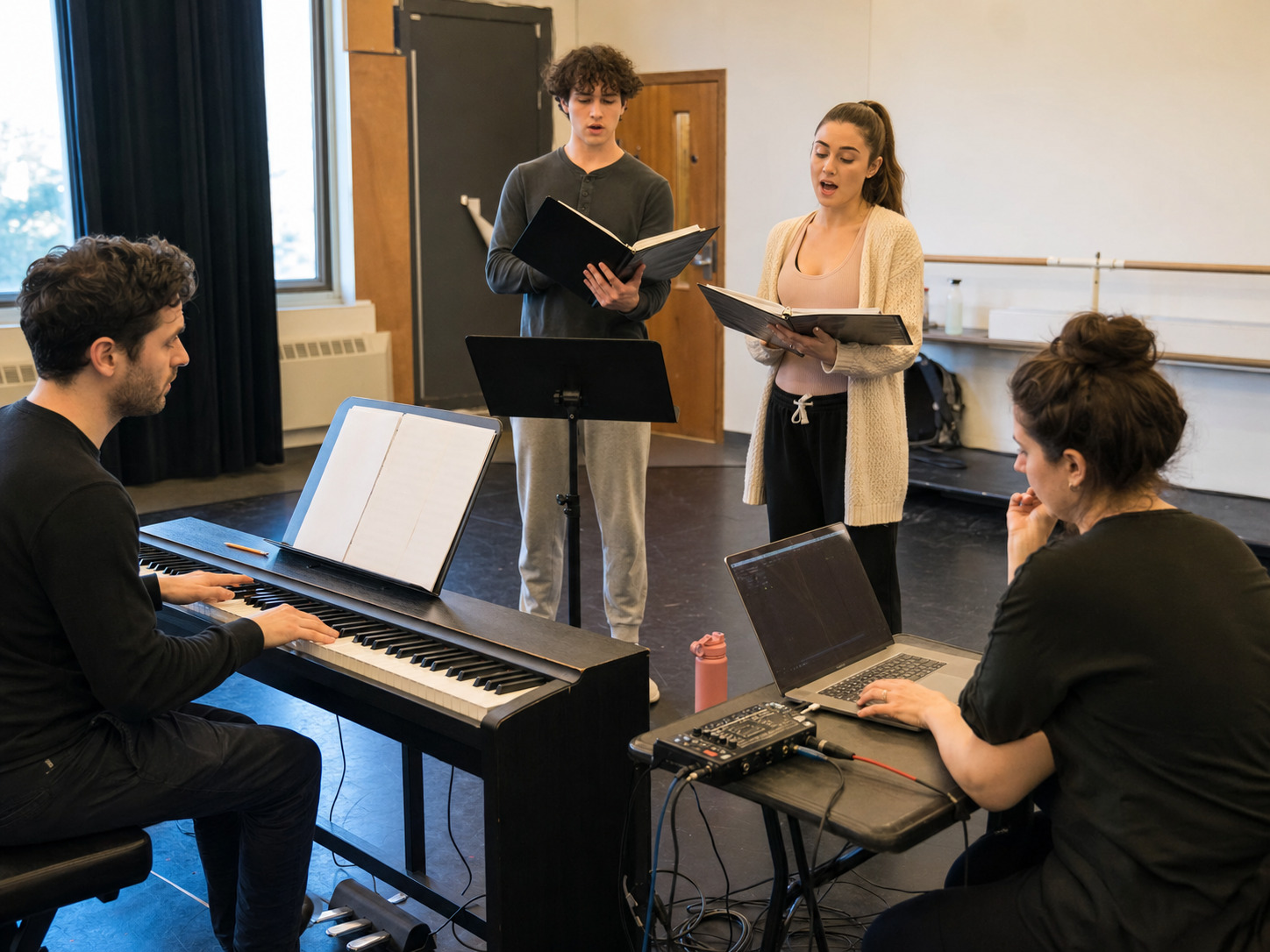
Use guide vocals early, then move singers toward accompaniment-only tracks while there is still enough rehearsal time to build independence. If a singer only discovers the missing guide vocal during final runs, the switch will feel like a loss of support instead of a normal step in the process.
Give the sound operator real information
The sound operator needs more than a playlist.
Give them:
- the approved track order,
- start and stop points,
- cue words or visual cues,
- fade notes,
- known tempo-sensitive moments,
- backup playback details,
- and the person who can approve a restart.
This matters even in small productions. A clean audio plan helps the operator support the story instead of guessing which version the director meant.
Label files for people under pressure
File names should be plain enough to understand during a stressful rehearsal.
Use names such as:
Opening - Guide Vocal - RehearsalAct One Finale - Accompaniment - Cut BDance Break - Slower Rehearsal TempoPerformance Playlist - Approved
Avoid names like new, final, final final, or use this. Those labels fail as soon as a music director, choreographer, stage manager, and sound operator all need the same information.
When a custom track is worth it
Custom work is worth considering when the available track is musically useful but practically mismatched to the room.
Common requests include:
- a different key for a specific singer,
- a shorter cut for an audition or scene transition,
- a clearer lead-in before a difficult entrance,
- a tempo adjustment for choreography,
- a vamp that fits staged action,
- or separate rehearsal and performance versions.
The goal is not to make the track complicated. The goal is to remove the one problem that keeps interrupting rehearsal.
FAQ: rehearsal piano and musical theater backing tracks
Should a school musical use piano or tracks first?
Use piano when students are still learning and the music director needs flexibility. Introduce tracks once entrances, tempos, and structure need to become consistent.
Are backing tracks useful if we already have a pianist?
Yes. A pianist can lead learning rehearsals, while tracks can support at-home practice, choreography, cue planning, and performance preparation.
When should the sound operator hear the tracks?
Before tech week. The operator should know the approved order, cue points, fades, and reset plan before microphones, costumes, and scene shifts are added.
Do guide vocals belong in performance?
Usually, no. Guide vocals are learning tools. Move to accompaniment-only tracks before performance rehearsals so singers carry the music independently.
The takeaway
Browse Broadwaytrax accompaniment tracks when your rehearsal room needs consistent tempo, clear intros, performance-ready sound, and track versions your cast can use outside the piano room.
Browse Accompaniment TracksPiano is best when the room needs a musician who can adapt. Tracks are best when the room needs the same version every time.
Strong productions use both intentionally. Learn flexibly, rehearse consistently, label every version clearly, and give the sound operator a track plan early enough to make the music feel calm when the show is ready to run.