Bye Bye Birdie Still Understands Teen Fame and Small-Town Panic
By Broadwaytrax Content Studio · December 29, 2025
Updated May 13, 2026
A town holds its breath. The phone lines buzz. A teen idol is coming to give one lucky fan a kiss on live TV. This simple stunt turns Sweet Apple, Ohio, upside down. Bye Bye Birdie still resonates because it is bright, funny, and honest about star crushes. Its mix of nostalgia, TV humor, and big teen group scenes feels both classic and current.
The show is inspired by a real event. When a famous rock star was drafted into the Army, the country watched in concern. Bye Bye Birdie spins that into a playful story about fame, family, and first love. The talented creative team includes Charles Strouse (music), Lee Adams (lyrics), and Michael Stewart (book). Gower Champion directed and choreographed the original staging with producer Edward Padula guiding the project ((Wikipedia), (Britannica)).
Bring "Bye Bye Birdie Still Understands Teen Fame and Small-Town Panic" to life with custom tracks
Get the exact arrangement you need—either customize an existing accompaniment or commission a bespoke build from our team.
Don't see this show in our library yet? We'll build it for you.Here's a brief overview of the story. Albert Peterson manages pop idol Conrad Birdie. His partner, Rose, wants him to grow up, marry her, and stop relying on his mother. To save their struggling company, Rose organizes a farewell stunt: Conrad will give "one last kiss" to a fan on The Ed Sullivan Show. They choose high schooler Kim MacAfee, who just promised to go steady with her boyfriend, Hugo. When Conrad arrives, his charm causes chaos, jealousy, and parental panic. Kim's family gets drawn into the excitement, and the TV clock is ticking. In the end, Albert finds his strength, chooses Rose, and steps away from the showbiz mess. The town breathes a sigh of relief. The kiss becomes a lesson rather than a loss (Britannica).
The original Broadway run made history. Bye Bye Birdie opened in 1960 and ran for 607 performances. It won the Tony Award for Best Musical. Gower Champion also won awards for direction and choreography, while Dick Van Dyke got recognized as Featured Actor. The original cast included stars like Chita Rivera, Paul Lynde, Susan Watson, and Dick Gautier, who shaped the show's humor and style for years ((Wikipedia), (Tony Awards)).
The score is full of crowd-pleasers. "Put On a Happy Face" floats with a light beat that invites soft-shoe charm. "The Telephone Hour" turns gossip into music with sharp, playful lines. "How Lovely to Be a Woman" helps Kim find her voice with warmth and wit. "A Lot of Livin’ to Do" packs a dance explosion. "One Boy" is tender, and "One Last Kiss" humorously spoofs early rock. Each song has vocal ranges friendly for schools and community casts: Albert is a baritone with dance flair; Rose is a mezzo with a strong belt; Kim has a youthful mix; and Conrad shines as a high baritone or tenor with swagger (Wikipedia).
The show has moved from stage to screen twice. The 1963 film kept Dick Van Dyke but shifted focus toward Kim and added the popular title song. The 1995 TV movie with Jason Alexander and Vanessa L. Williams returned closer to the stage score, introducing the story to new audiences and keeping the songs alive (Wikipedia).
Revival history helps keep its spirit strong. The Roundabout Theatre Company’s 2009 Broadway revival introduced Bye Bye Birdie to new audiences with stars like John Stamos and Gina Gershon. Reviews were mixed, but the show's energetic score and witty book still captivated family audiences (Wikipedia).
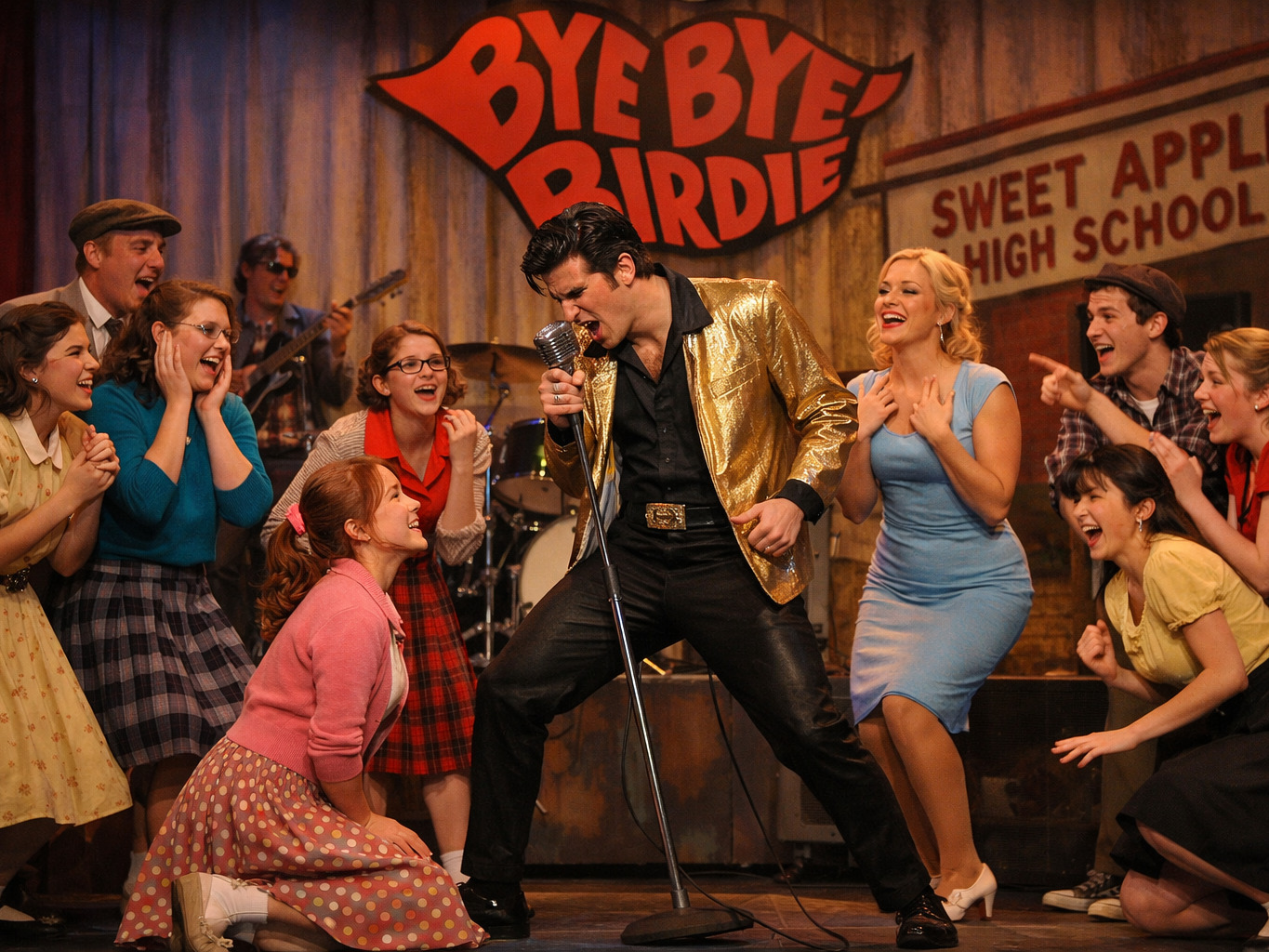
Why does Bye Bye Birdie matter today? It captures the teen culture of an age when TV became central to American life. The parody of The Ed Sullivan Show is both affectionate and sharp. Parents, kids, and pop idols all appear funny and relatable. The score has given us memorable songs, especially "Put On a Happy Face," a piece that has become part of the broader musical landscape (Britannica).
If you are putting on this show, timing is crucial. "The Telephone Hour" needs clear cut-offs and clean lines, or the jokes get lost. Map who is “calling” whom and give each group physical space, like small platforms, so the audience can follow the fun. "Put On a Happy Face" shines when the energy stays lively and light; keep the steps simple and let the charm show. "A Lot of Livin’ to Do" needs to drive the dance without overwhelming. Create clear sightlines and safe dance paths, and plan microphone handoffs early to keep the song flowing.
Comedy is all about the details. "Mr. MacAfee's Kids" works when frustration becomes rhythm. Make sure the body language highlights the words. Mae Peterson, Albert’s mother, is funnier when she believes every line; play it truthfully instead of sarcastically. For Conrad, less is often more—a well-placed declaration of being "Honestly Sincere" is better than trying too hard.
Design can be clever and effective. Using split-screen frames, box lighting, or simple projections can evoke the TV world without slowing down scene changes. The Ed Sullivan gag works best when the audience immediately recognizes it, so a precise intro card or a well-framed tableau is key.
Create fully customized tracks for your next production of Bye Bye Birdie
Get Custom TracksStart rehearsals by focusing on words and rhythm. Read "The Telephone Hour" like a radio play before adding music, then incorporate the melodies. Teach Kim’s "How Lovely to Be a Woman" as a narrative, not just a vocal showcase. Block the town’s first view of Conrad as a big reveal, letting the audience feel the excitement through the characters. Balance the spotlight on star roles with the ensemble's pride. In this show, the crowd is a character itself; when it moves together, the story truly sings.
Bye Bye Birdie is both a celebration and a reflection. It captures the joy of fandom, pokes fun at the power of television, and lets love take center stage in the end. That blend keeps it exciting and perfect for young casts wanting to laugh, dance, and listen to one another.