Little Shop Rehearsals Need Tracks That Know Every Cue
By Broadwaytrax Content Studio · June 9, 2026
Little Shop of Horrors can feel small until the cues start stacking up.
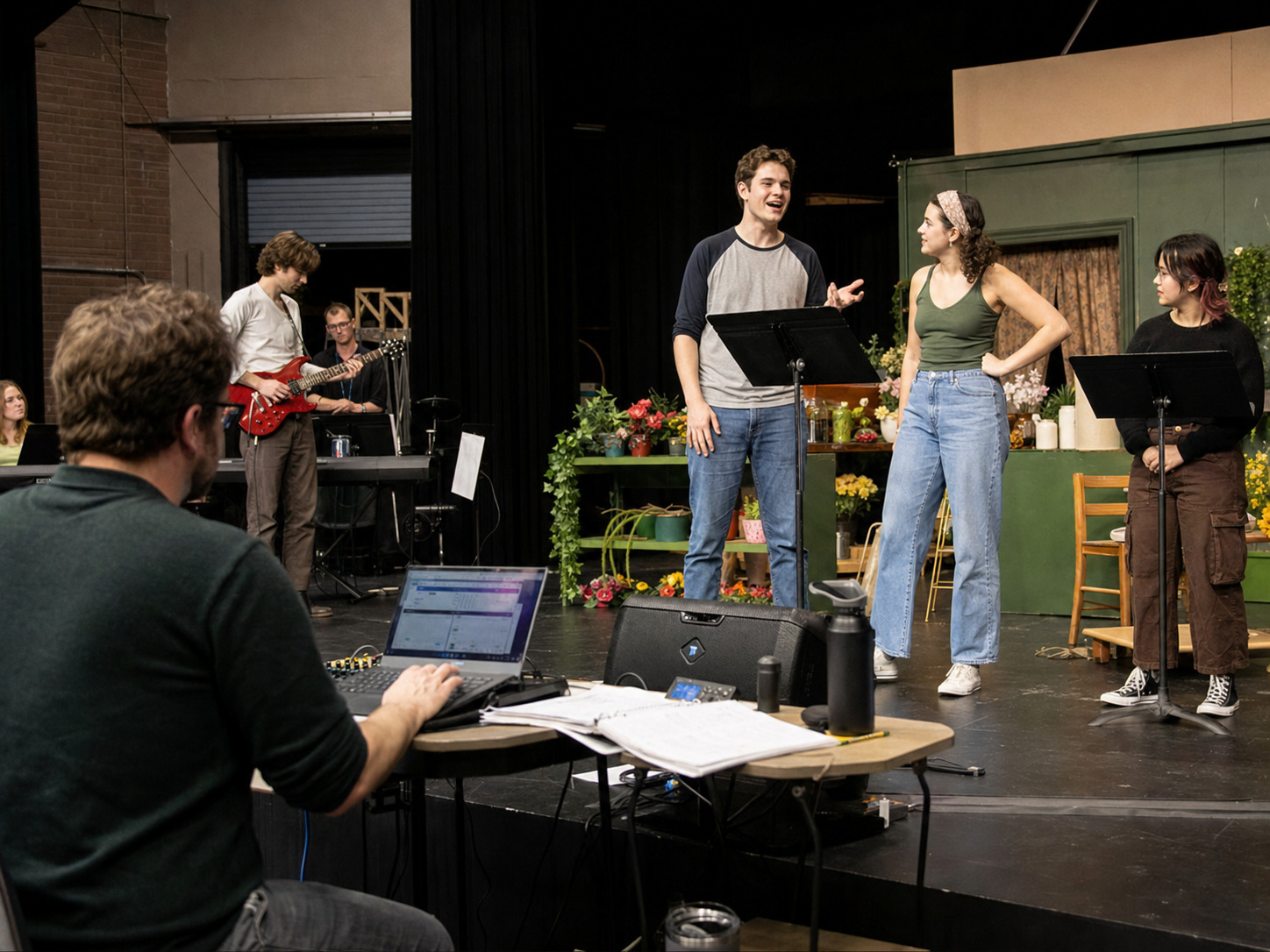
A production team may only see a handful of principal characters, a trio, a shop set, and a plant. In rehearsal, though, the show asks for very specific musical timing: quick scene shifts, doo-wop-style entrances, spoken lead-ins, character bits, underscoring, and moments where a singer needs the track to stay dependable while the stage business gets bigger.
Bring "Little Shop Rehearsals Need Tracks That Know Every Cue" to life with custom tracks
Get the exact arrangement you need—either customize an existing accompaniment or commission a bespoke build from our team.
Don't see this show in our library yet? We'll build it for you.That is why the best backing-track plan for Little Shop starts before tech. The track has to support the performers, the music director, the choreographer, and the sound operator without making anyone guess where the next cue lives.
Start with the production map
Before assigning tracks to rehearsal rooms, make a simple production map. It does not need to be fancy. It does need to be clear.
Include:
- the show order,
- accompaniment-only tracks,
- guide vocal tracks for early learning,
- any key, cut, or tempo changes,
- entrances that need a spoken count or lead-in,
- scene shifts that happen under music,
- and the final version that will be used in performance.
Little Shop has a style that depends on confidence. If the trio is uncertain, if Seymour enters late, or if the track starts before a prop handoff is ready, the room feels less playful. A cue map lets the team separate musical problems from staging problems early.
Give the trio a track routine
The trio often carries the show's energy between scenes. They are not just background singers. They frame the story, reset the style, and help the audience understand the world of the show.
For rehearsals, build a routine that moves in stages:
- Learn entrances and harmony with guide vocals.
- Rehearse cutoffs and vowel shapes with the accompaniment track.
- Add choreography or movement only after the musical entrances feel steady.
- Practice transitions into and out of scenes, not just isolated numbers.
That sequence keeps the trio from learning the music one way and then having to rebuild it once staging arrives.
Treat plant moments as cue moments
Any production with a practical plant, puppet, prop, or staged reveal needs more than a clean audio file. It needs a cue plan.
Ask these questions before tech:
- Does the track start before or after the actor is set?
- Is there enough time for a puppet, prop, or shop effect to be ready?
- Does the singer need a breath or spoken setup before the entrance?
- Is the vamp long enough for the action in this room?
- Does the sound operator know which version is final?
The goal is not to slow the show down. The goal is to keep the track from forcing a rushed entrance or an unsafe backstage move.
Decide where guide vocals stop helping
Guide vocal tracks are useful early, especially when singers are learning style, harmony, and timing outside rehearsal. They are not the final performance plan.
A practical handoff is:
- week one: guide vocals for melody, harmony, and entrances,
- week two: accompaniment tracks for individual numbers,
- staging rehearsals: accompaniment tracks with cue notes,
- tech: final show-order files only.
If performers stay on guide vocals too long, they can become dependent on another voice. If they leave them too early, the room may waste time relearning entrances. Use guide vocals as scaffolding, then remove them intentionally.
Label every version boringly
Little Shop rehearsals can move quickly. File names should not create mystery.
Use labels such as:
Little Shop - Prologue - Guide Vocal - 2026-06-09Little Shop - Dentist - Accompaniment - Cut ALittle Shop - Finale - Performance VersionLittle Shop - Scene Change Vamp - Tech
Avoid labels like new version, final, final2, or use this one. Those names break down as soon as a director, choreographer, stage manager, and sound operator all need the same file.
Build a sound-operator checklist before tech
The sound operator should not discover the structure of the show during tech. Give them a simple checklist before the first run with tracks.
Include:
- track order,
- start and stop points,
- fade notes,
- cue words or visual cues,
- known tempo-sensitive moments,
- backup playback device,
- and who has authority to call a track reset.
If the production is using a laptop, tablet, or sound board, test the exact playback setup before adding costumes, microphones, and scene changes.
When custom edits are worth it
Custom edits help when the standard track is musically right but practically wrong for the room.
Common Little Shop-style requests include:
- a clearer lead-in before a difficult entrance,
- a key change for a specific singer,
- a shorter or longer cut for a scene transition,
- a tempo adjustment for choreography,
- an added count-off for rehearsal,
- or a performance version that matches the final staging.
The best custom edit does not draw attention to itself. It simply makes the rehearsal room calmer because the track now matches the people using it.
FAQ: Little Shop backing tracks
Should we rehearse Little Shop with guide vocals?
Guide vocals can help singers learn entrances, harmony, and style early in the process. Move to accompaniment-only tracks before performance rehearsals so actors can own the timing without relying on another vocal line.
What should the stage manager know about tracks?
The stage manager should have the final track order, cue words, start and stop points, scene-change notes, and a clear backup plan. They should also know which version is approved for performance.
Can one track version work for rehearsal and performance?
Sometimes, but rehearsal often benefits from guide vocals, count-offs, or cuts that are not part of the final performance version. Keep rehearsal and performance files labeled separately.
When should custom track edits happen?
Request custom edits as soon as the production knows the key, cut, tempo, or cue problem. Waiting until tech week makes every change more stressful.
Build a calmer Little Shop rehearsal process with Broadwaytrax full-show tracks, then request custom keys, cuts, tempos, or cue edits when your production needs a version built around your singers and staging.
View Little Shop TracksThe takeaway
Little Shop works best when the tracks feel invisible. The audience should see characters, jokes, danger, style, and story. The production team should feel confident that every cue is where it belongs.