Little Mermaid Rehearsals Need Tracks That Keep the Cues Moving
By Broadwaytrax Content Studio · June 12, 2026
Updated June 12, 2026
The Little Mermaid can feel easy to plan because the songs are familiar. Then rehearsal starts, and the actual challenges arrive fast.
Entrances need to land after scene changes. Ensemble sections have to line up with movement. Soloists need enough lead-in to breathe. Underwater staging can make even a simple cue feel crowded once costumes, props, and microphones enter the room.
Bring "Little Mermaid Rehearsals Need Tracks That Keep the Cues Moving" to life with custom tracks
Get the exact arrangement you need—either customize an existing accompaniment or commission a bespoke build from our team.
Don't see this show in our library yet? We'll build it for you.That is where a clear track plan matters. The music should help the cast keep moving through the story, not make the stage manager and sound operator guess what version they are hearing.
Start with the rehearsal job
Before choosing files, decide what each version is supposed to do.
A production may need:
- guide vocal tracks while the cast is learning melodies,
- accompaniment tracks once singers need independence,
- rehearsal files for choreography,
- performance files with clean starts and endings,
- and custom notes when a key, cut, tempo, or cue needs to fit the staging.
Those are different jobs. A guide vocal file can be useful early and distracting later. A performance track can sound polished but leave students uncertain if they have not practiced entrances without the melody.
Give every cue a stage reason
A song cue is not only a musical start. It is also a stage event.
For a school or community theater production, write down what is happening when the track begins:
- Who is already onstage?
- Is there a spoken line before the music starts?
- Does a prop, set piece, or costume change need time?
- Is the first singer visible, moving, or entering?
- Does the sound operator start from a visual cue or a line cue?
This keeps the track plan connected to the production instead of sitting in a separate music folder.
Use guide vocals early, then remove the support
Guide vocals are especially helpful when students or ensemble members are learning a large, familiar score. They can confirm melody, phrasing, harmony shape, and entrances before the cast is confident.
The important step is to move away from that support on purpose.
Try this sequence:
- Learn with guide vocals.
- Sing with guide vocals at rehearsal tempo.
- Switch to accompaniment tracks for the same section.
- Mark entrances that become uncertain.
- Rehearse those entrances with cue notes instead of returning to guide vocals every time.
That progression helps singers build independence before tech week.
Watch the ensemble numbers
The biggest cue problems often appear in ensemble moments.
Large group sections can involve choreography, children, quick traffic patterns, or layered harmonies. If the track begins before the group is physically set, the number can feel rushed before anyone sings.
For each ensemble number, confirm:
- how much intro the cast needs,
- whether choreography starts before singing,
- where the first vocal entrance falls,
- whether the tempo works with movement,
- and whether the ending leaves room for applause, transition, or dialogue.
This is not only a music-director issue. The director, choreographer, stage manager, and sound operator should all know the plan.
Keep scene transitions from fighting the music
The Little Mermaid uses visual transitions that can be more complicated than they look on paper. A track can be perfectly produced and still feel wrong if it starts while the stage is not ready.
Scene-change notes should be practical:
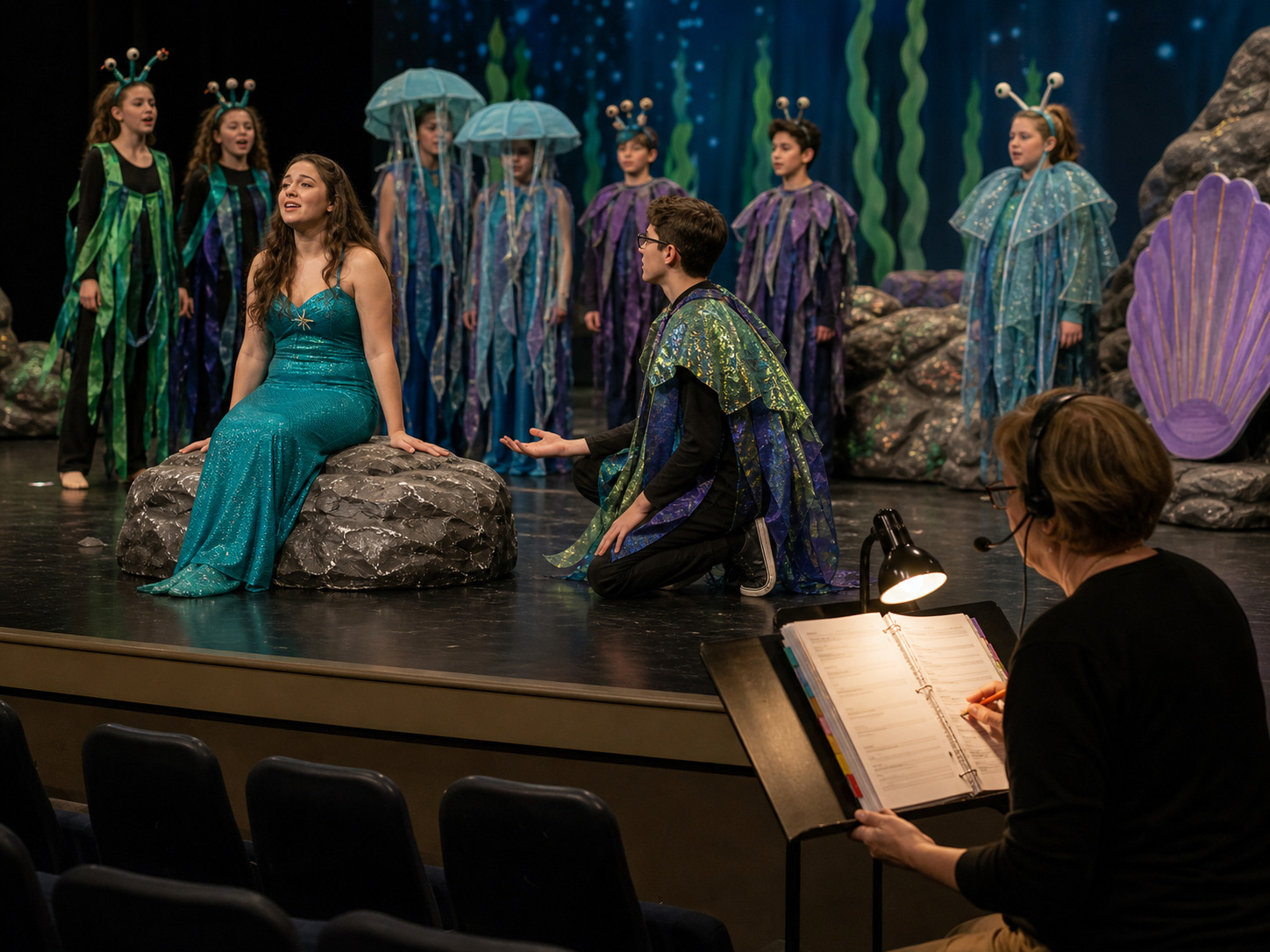
- Music starts after the rock unit is clear.
- Hold the cue until the ensemble is in place.
- Add a short lead-in before the first sung entrance.
- Keep the original tempo, but mark a clean fade point for rehearsal.
- Confirm whether the transition needs underscoring or silence.
These notes help the sound operator support the story instead of chasing it.
Match track versions to the week of rehearsal
Early rehearsals need clarity. Tech rehearsals need consistency. Performances need reliability.
That usually means the file plan should change as the production gets closer to opening.
| Rehearsal stage | Best track use | What to confirm |
|---|---|---|
| Music learning | Guide vocals | Melody, harmony, entrances |
| Choreography | Accompaniment or rehearsal track | Tempo, dance breaks, counts |
| Run-throughs | Performance-style track | Starts, stops, transitions |
| Tech week | Final approved files | Cue names, levels, backup files |
If a track version changes, label it clearly. Do not let a sound operator choose between three similar files during tech.
Make the sound operator's list boring
A good cue list should be boring in the best way.
It should include:
- cue number,
- track title,
- file name,
- start trigger,
- first singer or stage action,
- stop or fade instruction,
- backup location,
- and any version note.
The more colorful the stage picture becomes, the more practical the cue sheet should be.
Keep rights and recordings separate
Backing tracks support rehearsal and performance audio. They do not replace the theatrical rights needed to stage a licensed musical.
Treat those as separate planning items: secure the proper show rights through the appropriate licensing source, and use the track plan to manage the sound recording and rehearsal workflow.
FAQ: Little Mermaid backing tracks
When should a cast move from guide vocals to accompaniment tracks?
Move as soon as the cast can hold melody and entrances without constant support. Keep guide vocals available for review, but rehearse performance sections with accompaniment tracks before tech week.
What should the sound operator know before tech?
The operator should know the approved file name, cue number, start trigger, stop or fade point, and whether a cue follows a line, visual signal, or stage transition.
Are rehearsal files and performance files the same thing?
Not always. A rehearsal file may include learning support or a slower tempo. A performance file should reflect the approved final version without extra learning aids.
What if the standard track almost fits but not quite?
Write down the exact issue: key, cut, tempo, lead-in, cue, or transition. Specific notes make it easier to decide whether the production needs a custom version.
The takeaway
Rehearse The Little Mermaid with Broadwaytrax guide vocal and accompaniment tracks built for practice, staging, and performance preparation.
Explore The Little Mermaid AlbumFamiliar songs still need a practical production plan.
Use guide vocals to teach, accompaniment tracks to build independence, cue sheets to protect tech week, and clear version labels so every rehearsal moves the cast closer to a dependable performance.