“It’s a Privilege to Pee” Needs a Rule Everyone Reacts To
By Broadwaytrax Content Studio · November 13, 2026
Updated November 13, 2026
The short answer: rehearse “It’s a Privilege to Pee” as a public lesson that the whole room is forced to receive. The number works when the lead performer has a precise rule to enforce, every ensemble member reacts from a specific need, and the accompaniment keeps the scene moving before anyone can escape the argument.
A comic authority number can turn into generalized shouting very quickly. If the lead begins at maximum intensity and the ensemble only looks frightened, the scene has nowhere to build. The useful rehearsal task is to make the transaction clear: who needs access, who controls it, what rule is being defended, and what changes when the group realizes the rule will not bend?
Bring "“It’s a Privilege to Pee” Needs a Rule Everyone Reacts To" to life with custom tracks
Get the exact arrangement you need—either customize an existing accompaniment or commission a bespoke build from our team.
Don't see this show in our library yet? We'll build it for you.Give the lead performer one rule to enforce
Start without music. Ask the lead performer to explain the rule in one plain sentence. Then identify the people who must accept it.
Do not begin with “be scary” or “be funny.” Choose an action:
- instruct,
- warn,
- collect,
- shame,
- challenge,
- dismiss,
- regain control.
The action should change when the room responds. If the performer uses the same pressure from beginning to end, the number becomes loud but dramatically flat.
Speak each section to one real scene partner. Notice when the lead is addressing an individual, using that person as an example, or turning back to the whole group. Those changes in target will create more variety than adding extra volume.
Make the ensemble active witnesses
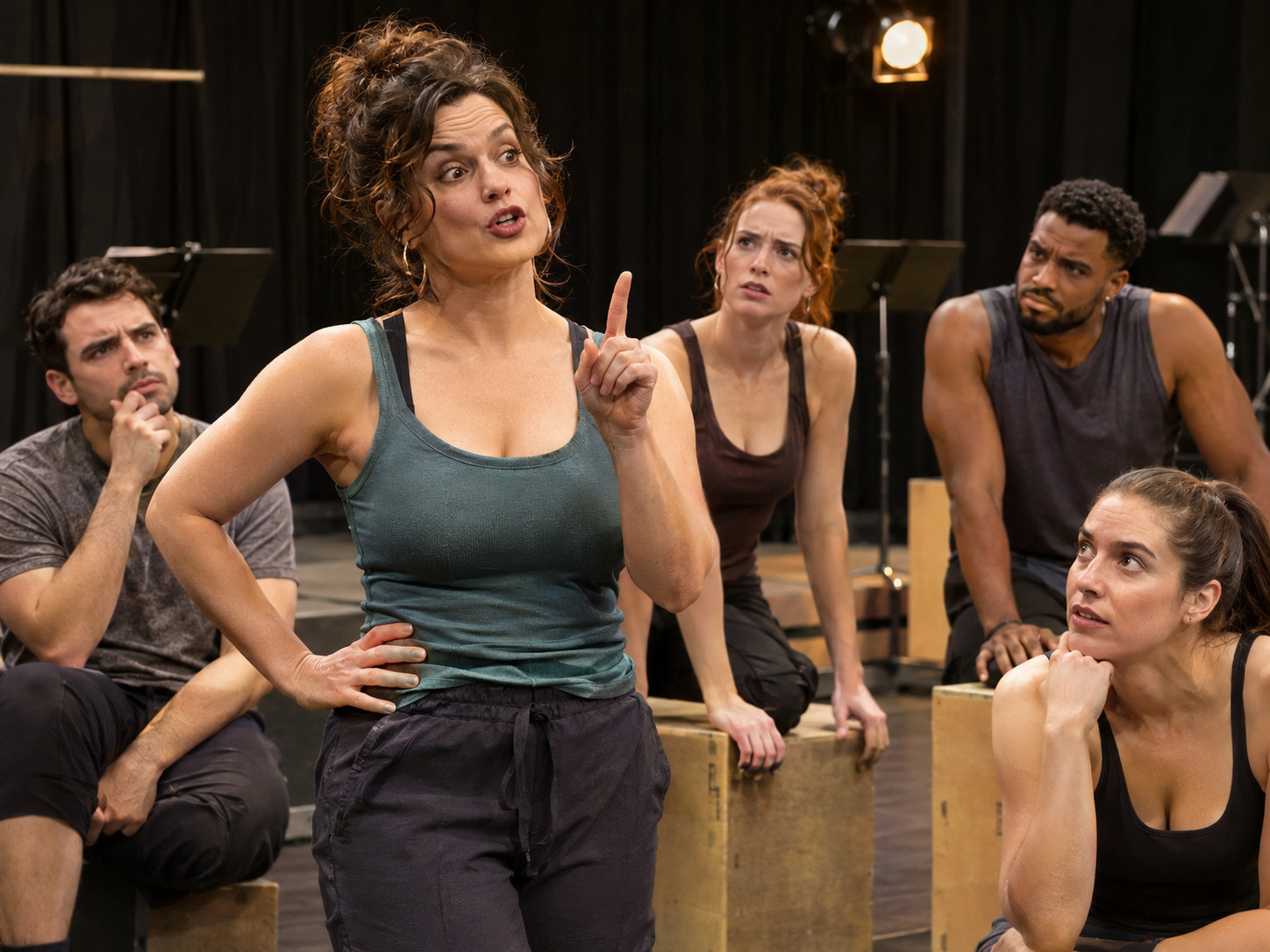
The ensemble should not function as one wall of worried faces. Give each performer a private stake in the transaction.
One person may be counting what they have. Another may be trying not to attract attention. Someone may believe compliance is safest. Someone else may be close to objecting. Those differences make the group readable without requiring extra dialogue or invented business.
Rehearse the scene once with the lead performer silent. Let the ensemble respond only to imagined turns in the argument. Can an observer follow when the rule tightens, when hope appears, and when the group accepts that there is no easy exception?
Then restore the vocal line. The ensemble reactions should support the musical thought, not compete with it.
Build the escalation in steps
Do not start at the emotional destination. Mark the number’s progression as a sequence of tactics.
A practical map might be:
- state the rule,
- make the rule sound reasonable,
- identify the consequence,
- answer resistance,
- expand the warning,
- restore order.
The exact labels can change, but each section needs a new job. Run the sequence at rehearsal volume and keep the physical choices simple. If the escalation is clear before the biggest vocal moments arrive, those moments will have somewhere to go.
Record one pass from across the room. Listen first without watching. Can you hear a change in tactic, or only a change in loudness?
Move from guide vocal to accompaniment
Broadwaytrax’s current Urinetown catalog lists both a guide-vocal version and an accompaniment-only version of “It’s a Privilege to Pee.” Use them for different stages of rehearsal.
The guide vocal can help the performer and ensemble confirm melody, entrances, rhythmic placement, and the relationship between the vocal line and the arrangement. Once those details are secure, move to the accompaniment track so the cast has to carry the words, timing, reactions, and dramatic progression independently.
Try this four-pass sequence:
- listen with the score and mark the musical sections,
- sing once with the guide vocal while checking entrances,
- speak the scene over the accompaniment,
- perform a complete accompaniment-only pass without stopping.
On playback, choose one musical correction and one scene correction. Too many simultaneous notes usually make the next run cautious.
Let diction ride the pulse
Fast comic authority becomes muddy when consonants are either too soft to understand or so heavy that they slow the line.
Speak each phrase over the track and mark:
- the word that launches the thought,
- the consonant that clarifies the rule,
- the breath that prepares the next tactic,
- the word that hands focus to the ensemble.
Then sing without giving every syllable equal weight. The audience needs the argument, not a row of individually displayed words.
Ask one person at the back of the room to raise a hand whenever the point becomes unclear. Stop only after the section. That preserves the musical flow while identifying where the text needs cleaner priority.
Map the track’s shared landmarks
A fixed accompaniment gives the cast repeatable cues. Listen without singing and name a few landmarks everyone can recognize:
- the opening cue,
- the first ensemble response,
- the first major change in texture,
- the approach to the final escalation,
- the ending and release.
Give each landmark a dramatic label as well as a musical one. “The room realizes the rule is real” is more playable than a measure number alone.
Rehearse the transitions into those landmarks separately. The most useful track work often happens at the edges: the pickup before a response, the breath before a new tactic, and the final cue before the accompaniment releases.
Keep the staging transactional
The physical life should clarify who controls the space and who needs something from it.
Choose where the transaction happens, where the ensemble waits, and what movement means “approach,” “retreat,” or “try again.” Use rehearsal blocks or floor marks rather than elaborate props. The scene should remain legible even before production design is added.
Avoid filling every musical accent with a gesture. A still response can be more useful when it shows that the group is listening, calculating, or deciding whether to risk resistance.
Run one version with no planned gestures. Add back only the movements that change the transaction or redirect focus.
Test the exact cut and ending
If the number is being prepared for an audition or showcase, rehearse the exact approved cut with the actual accompaniment file. The cut should establish the rule, contain a clear change of tactic, and arrive at an ending the room can recognize.
Check the final transition separately:
- Is the last entrance secure?
- Does the ensemble know where focus belongs?
- Does the final thought land before the sound ends?
- Is the release clean enough for the next stage or audition cue?
If the standard version is close but a key, cut, tempo, lead-in, cue, or ending does not fit the singer or staging, document the specific problem before requesting a custom edit.
FAQ: rehearsing “It’s a Privilege to Pee”
Should the cast learn from the guide vocal?
Use the guide vocal to confirm melody, entrances, and rhythmic relationships, then move to accompaniment-only rehearsal. The goal is for the cast to carry the scene without following a demonstration performance.
How can the ensemble stay active without becoming distracting?
Give each performer a specific need and a clear response to each change in the rule. Keep movement tied to decisions, and let listening do part of the work.
Can the Broadwaytrax recording be used in a public production?
The current product page distinguishes personal practice or recital use from theater use. It also states that a license for the sound recording does not replace the grand rights required to perform the musical. Confirm both the recording license and the show rights for the planned use.
What if the catalog track does not fit the production?
The current track and custom pages offer support for keys, cuts, tempos, lead-ins, cues, and other production-specific needs. Describe the exact rehearsal or staging problem so the request can be scoped around the cast and room.
Ready to turn the rule, reactions, and musical cues into one complete scene? Rehearse with the Broadwaytrax accompaniment track for “It’s a Privilege to Pee.”
Rehearse “It’s a Privilege to Pee”The takeaway
“It’s a Privilege to Pee” lands when the rule is specific and everyone onstage has to deal with it. Give the lead performer changing tactics, make the ensemble active witnesses, move from guide vocal to accompaniment, and rehearse the musical transitions that keep the transaction under pressure.