“Getting Married Today” Needs Three Rehearsal Plans
By Broadwaytrax Content Studio · October 7, 2026
Updated October 7, 2026
The short answer: rehearse the three musical jobs separately before asking the scene to move at full speed. One performer carries rapid-fire panic, one sustains a lyrical line, and one reacts inside the musical traffic. The number becomes clear and funny when all three performers share the same pulse without trying to sing, act, or move in the same way.
Broadwaytrax offers both a (“Getting Married Today” accompaniment track) and a guide-vocal version in the Company catalog. Use the guide vocal to learn entrances and relationships, then move to the accompaniment track early enough that the performers must own the words, cues, and scene themselves.
Bring "“Getting Married Today” Needs Three Rehearsal Plans" to life with custom tracks
Get the exact arrangement you need—either customize an existing accompaniment or commission a bespoke build from our team.
Don't see this show in our library yet? We'll build it for you.Give each performer one musical responsibility
This is not one difficult solo with two people standing nearby. It is a tightly interlocked trio. Before staging, name each job in plain language:
| Performer | Primary rehearsal job | What can go wrong |
|---|---|---|
| Patter performer | Keep fast text intelligible and connected to thought | Speed becomes blur or breathless showing-off |
| Lyrical performer | Sustain line, pitch, and emotional contrast | The long phrases become detached from the scene |
| Baritone partner | Listen, react, and land responses precisely | Reaction arrives late or competes with the patter |
Rehearse each part alone with the track, but do not stay isolated for long. The useful work begins when every performer can hear how another person’s phrase creates the next entrance.
Ask each actor to complete this sentence: “My character needs the other two people to understand ______.” The answers should be different. Those objectives turn tempo and timing into scene work instead of a vocal stunt.
Map the track before chasing speed
Listen to the complete approved track with the score and mark:
- the introduction and first dependable entrance;
- every handoff between patter, lyrical material, and response;
- places where two lines overlap;
- orchestral changes that signal a new section;
- one safe restart point for each major section;
- and the exact ending.
Then speak the text in rhythm without singing. Keep bodies neutral and use only the breath, consonants, and shared beat. If a spoken entrance is unreliable, singing it faster will not make it secure.
The guide vocal can help the trio hear the complete relationship among the parts. After pitches and entrances are settled, switch to accompaniment. Without reference voices, the actors must generate the musical conversation themselves.
Make the patter understandable before making it fast
Fast text needs a sequence of thoughts, not one long rush. Divide the patter into short idea units and give each one a destination: a person, a realization, an objection, or a failed attempt to regain control.
Use this progression:
- Speak one idea unit clearly at a moderate pulse.
- Add the next unit without losing the final consonant of the first.
- Put both units over the accompaniment.
- Increase to the production tempo only when the thought changes remain audible.
- Rejoin the trio and test whether the other actors can react in real time.
Do not add extra accents to every syllable. Listeners need a few important words, clean phrase direction, and enough consonant energy to follow the thought. Record one run from the center of the room. If the text is unclear in the recording, solve diction and balance before adding more volume.
Let the lyrical line create contrast
The sustained line should not feel like unrelated background music. Its calm musical shape can make the surrounding panic more vivid, but the singer still belongs inside the scene.
Rehearse the lyrical part for:
- a comfortable breath plan;
- steady pitch against the full accompaniment;
- clear vowels that do not cover consonants;
- awareness of the patter entrances underneath or around it;
- and a final release that matches the track.
Then ask the singer to direct each phrase toward a specific person or event. A beautiful sustained note is more useful when it changes the room. The performer should be able to describe what has shifted by the end of every long phrase.
Rehearse reactions as cues
The third performer’s listening is part of the score. A look, turn, interruption, or attempt to help can tell the audience which thought matters next.
Loop each handoff from two beats before the cue through the next settled phrase. The reacting performer should know:
- what word or musical event triggers the response;
- whether the response is immediate or delayed;
- where the body needs to face for the audience to read it;
- and when the next entrance makes further reaction unsafe.
Avoid constant activity. One clear reaction is stronger than five gestures that blur the cue. Stillness can be especially useful when the patter is densest.
Stage the traffic without hiding the music
Set simple physical rules before adding detailed comedy:
- Each performer has a readable home position.
- Every cross has a reason and a destination.
- A turn or move finishes before a difficult entrance.
- The audience can see the listener as well as the current singer.
- Nobody walks into a monitor, cable, music stand, or microphone path.
Run the staging once without sound. The relationship should remain legible. Then listen to a run without watching. The words, entrances, and musical structure should remain clear. Combine the two only after both tests pass.
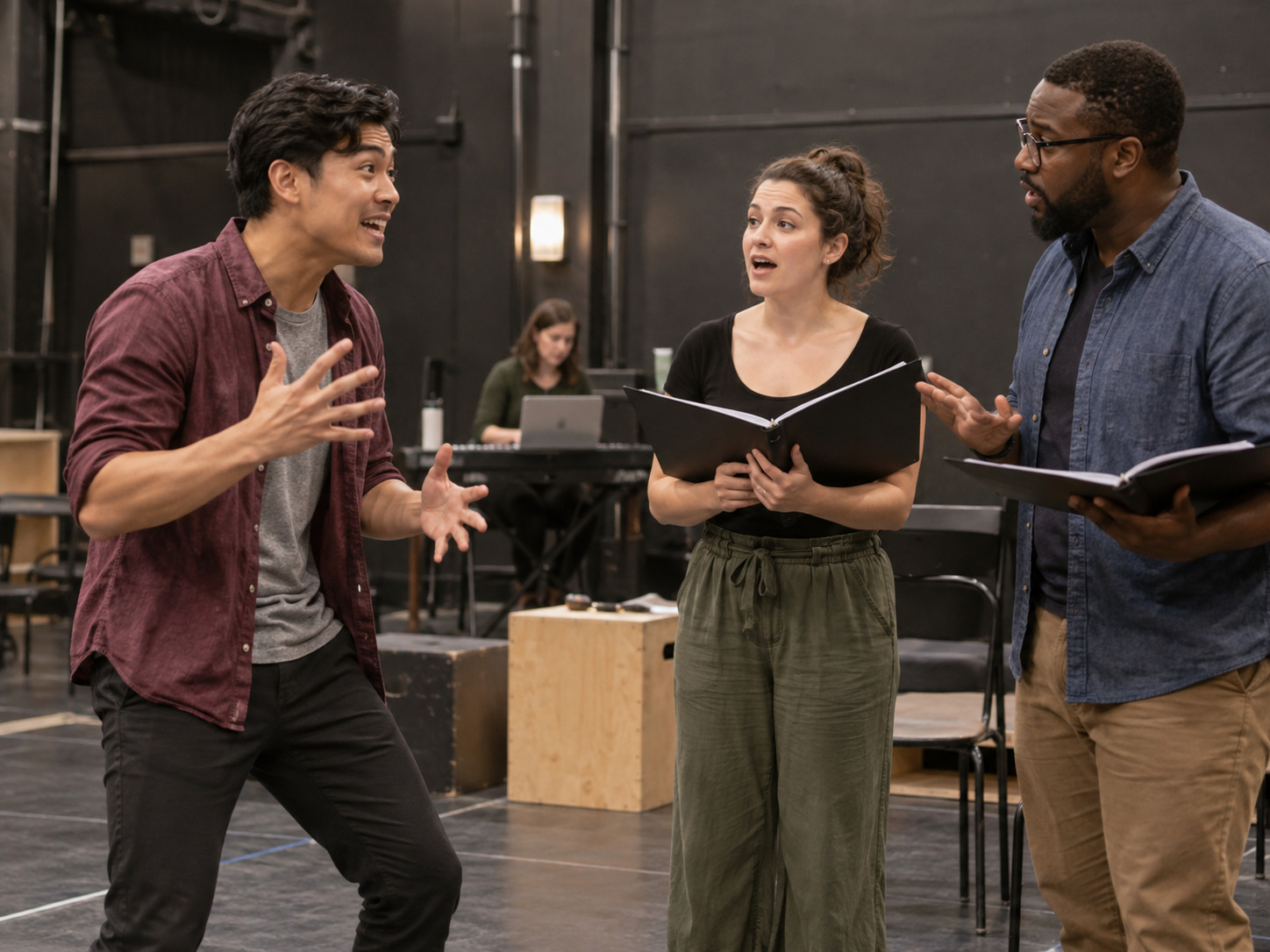
If the production needs more time for a piece of staging, first ask whether the movement can be simplified. A custom cut, tempo adjustment, or lead-in may be appropriate when the production has a genuine musical need, but the approved score, licensed materials, and applicable permissions still govern any alteration. Broadwaytrax’s (theater-use and grand-rights guide) explains why permission to use a recording and permission to present or change a musical are separate questions.
Balance three vocal textures against one track
At sound check, set speech-level clarity before raising the accompaniment. The patter performer needs consonants, the lyrical performer needs support without masking, and the baritone partner needs enough presence for reactions and replies to register.
Listen from the seating area and check:
- whether the first patter words are audible;
- whether the lyrical line remains centered and in tune;
- whether replies arrive at a comparable level;
- whether overlapping material becomes muddy;
- whether blocking changes microphone balance;
- and whether the ending lands together.
If the patter disappears, do not solve it only by making that microphone hotter. Reduce competing playback frequencies or volume, improve placement, and make the important words clearer. If the lyrical line covers everything else, check monitor and microphone balance before asking the singer to hold back unnaturally.
A 25-minute trio rehearsal
Minutes 1–5: map the musical traffic
Listen once, mark entrances, overlaps, handoffs, restart points, and the ending.
Minutes 6–10: speak the patter
Work in idea units. Keep the pulse steady and make every thought change understandable.
Minutes 11–15: connect the sustained line
Confirm breaths, pitch, and where each lyrical phrase changes the scene.
Minutes 16–20: loop the handoffs
Begin before each cue, carry through the response, and stop after the new section settles.
Minutes 21–25: prove the edges
Run from silence through the first entrance, then rehearse the final section and ending with full staging and playback balance.
Final checklist
- All three performers can state their different objective.
- The complete track has been mapped with the approved score.
- Patter is organized into clear thought units.
- Fast text remains intelligible at performance tempo.
- The lyrical line has a breath and scene-action plan.
- Every major reaction is tied to a word or musical cue.
- Overlaps were rehearsed from before the handoff, not from the collision.
- Physical choices finish before difficult entrances.
- Guide vocals were used for learning, then removed.
- Playback and all three voices were balanced from the house.
- The opening and ending were rehearsed as carefully as the middle.
- Any proposed edit or performance use was checked against the applicable permissions.
FAQ: “Getting Married Today” backing tracks
Should the patter performer practice alone?
Yes, briefly. Solo work can establish text, breath, and tempo, but the performer should rejoin the trio early because the entrances and reactions depend on the other two parts.
When should the cast stop using the guide vocal?
Use it to learn pitches, rhythms, and relationships among the parts. Move to accompaniment as soon as the trio can navigate the map, so the performers—not the reference recording—own every cue.
What should the playback operator mark?
Provide one approved filename, the start cue, section restart points, any confirmed cut or tempo note, the exact ending, and the cue that follows the number.
Can a slower practice version help?
A slower rehearsal pass can help the patter performer organize text and the trio hear overlaps. The production should still rehearse the approved final version early enough that performance tempo does not become a last-minute surprise.
How do we keep the comedy from becoming chaotic?
Preview the exact accompaniment track, then build the patter, lyrical line, reactions, handoffs, and ending from one approved rehearsal file.
Preview the Trio TrackShare one musical pulse, give every movement a cue, and let reactions grow from what another character has just done. The clearer the structure is, the more freedom the actors have to play inside it.
The final test is simple: can the audience follow three different people, three different musical textures, and one rapidly changing scene without losing the words or the relationships? When the trio shares the map, the difficulty serves the story.