“A Little Priest” Needs Two Actors on the Same Comic Pulse
By Broadwaytrax Content Studio · September 24, 2026
Updated September 24, 2026
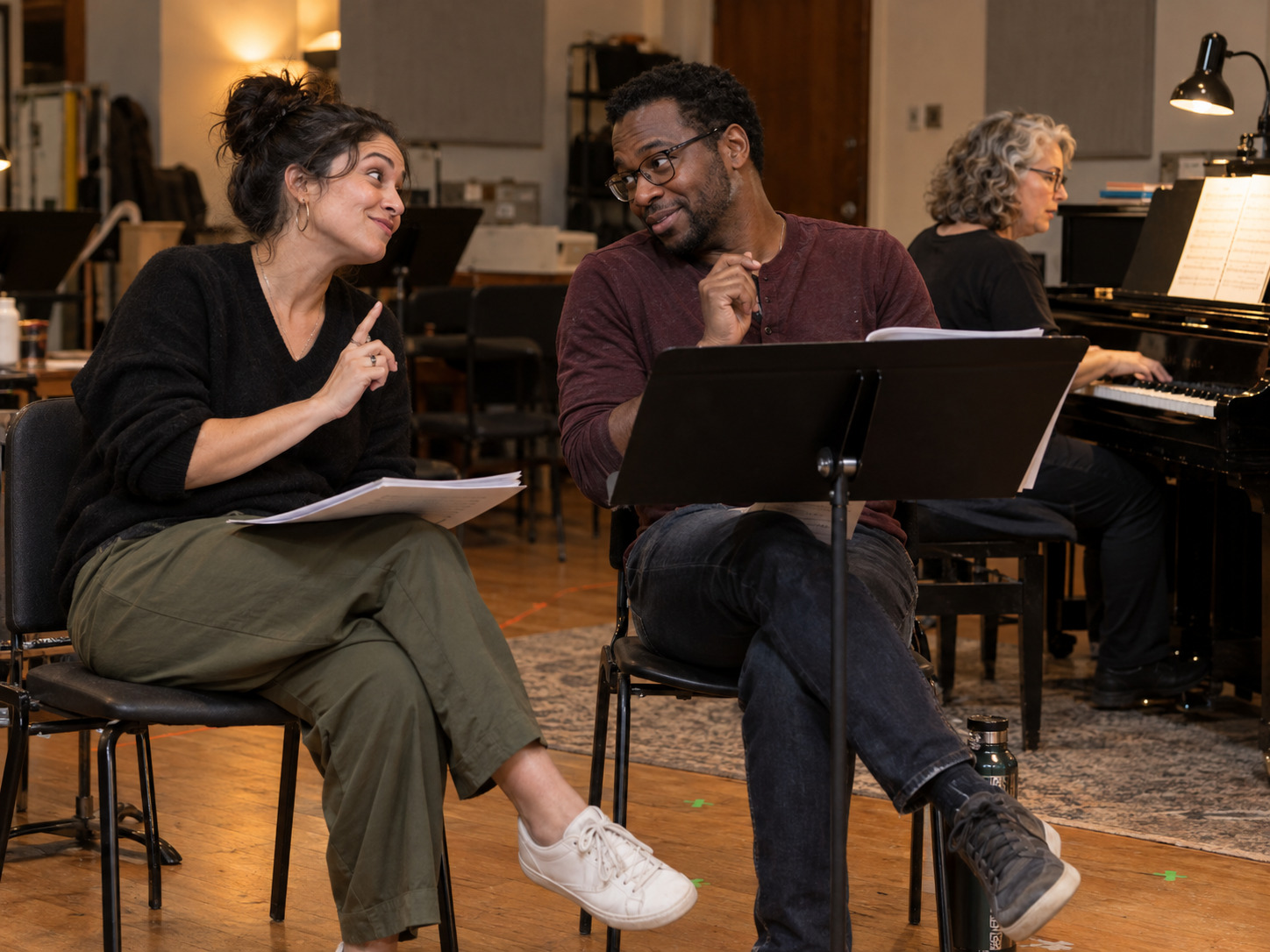
The joke in “A Little Priest” does not live in one singer’s line. It lives in the handoff between two performers: one thought lands, the other person catches it, and the accompaniment keeps the scene moving without announcing the punch line.
For a rehearsal using a backing track, the practical goal is not simply to stay with the recording. The pair needs one shared map for entrances, rests, overlapping energy, physical business, and the final button. Learn that map with the guide vocal, then prove it with the accompaniment-only track early enough that both actors are listening to each other instead of waiting for the recorded example.
Treat the number as a scene with music
“A Little Priest” is a duet, but it should not feel like two separate solos taking turns. The comedy becomes clearer when the actors know what each exchange changes.
Before running the full song, divide the scene into playable beats. For each section, identify:
- who introduces the new idea;
- who reacts before singing;
- where a pause is part of the joke rather than lost time;
- where the accompaniment moves the scene forward;
- where physical business must finish before the next entrance;
- and which musical turn begins the next comic escalation.
This keeps the rehearsal focused on action. “Come in on time” is hard to use. “React to the idea, make the choice, and enter on the next orchestral landmark” gives the performer something specific to play.
The (Broadwaytrax guide-vocal version of “A Little Priest”) can help the pair hear how the vocal exchange fits the arrangement. The matching (accompaniment track) removes the demonstration voices so the actors have to carry the timing themselves.
Rehearse the handoffs before the whole number
Long runs can hide the exact moment that keeps slipping. Work in short exchanges first.
Use this sequence:
- Play the beginning of one exchange with the guide vocal.
- Name the accompaniment sound that precedes each entrance.
- Speak the scene rhythm over the track without trying to perform at full volume.
- Sing the exchange with the guide.
- Repeat it with accompaniment only.
- Add the reaction, gesture, or piece of stage business.
- Connect that exchange to the next one without stopping.
The point is not to make the scene mechanical. It is to give both actors enough security that they can respond in the moment without losing the musical structure.
If one performer enters late, do not automatically ask the other performer to slow down. Check the whole handoff: Was the reaction clear? Could both actors hear the orchestral cue? Did a prop action take longer than it did in the rehearsal room? Did laughter or applause change the space between lines? The useful correction belongs to the layer that actually failed.
Keep the comic pulse without flattening the dialogue
A backing track fixes many parts of the musical timeline. The actors still control intention, focus, consonants, and the energy of the exchange.
That balance matters in a patter-heavy duet. If the pair chases every beat, the scene can sound rushed. If they stretch every reaction, the track can move on without them. Rehearse three kinds of timing separately:
Musical timing
Mark the first entrance, recurring accompaniment figures, transitions, held notes, and the final button. Each actor should be able to point to the sound that tells them where they are.
Verbal timing
Agree on the operative word or idea in each exchange. The responding actor should receive that idea before delivering the next one. Clear diction matters, but clarity comes from thought as well as consonants.
Physical timing
Test every look, cross, seated adjustment, prop interaction, and shared reaction against the real accompaniment. A piece of business that worked with a rehearsal pianist may need a different start point when the track continues at a fixed pace.
When these three layers agree, the number feels conversational even though the accompaniment is repeatable.
Let the guide vocal teach, then remove it
The guide vocal is useful for learning entrances, phrase length, ensemble placement, and the basic shape of the duet. It becomes less useful when performers start copying it instead of making active choices with each other.
A deliberate handoff works better than an abrupt switch:
- Listen and mark the form with the guide vocal.
- Sing while tracking the accompaniment underneath the voices.
- Mute one short section mentally by focusing only on the instruments and your partner.
- Run that section with accompaniment only.
- Return to the guide only to diagnose a specific rhythm or entrance.
- Finish rehearsal with the accompaniment-only version.
Both performers should know the same version. If one actor practices with a guide track and the other practices with a different cut, key, or tempo, the first joint rehearsal will spend its time reconciling files instead of building the scene.
Label the files by job. A Little Priest - Guide Vocal - Rehearsal and A Little Priest - Accompaniment - Performance are clearer than version 1 and new final.
Rehearse what happens around the track
The number does not begin when someone presses play and it does not end when the file stops.
Run the lead-in from the preceding dialogue or stage action. Decide:
- who gives the playback cue;
- what both actors are doing during the introduction;
- what the first singer hears before entering;
- whether the actors can see the music director, conductor, or stage manager;
- and what visual information the playback operator has.
At the other end, continue through the final reaction and the next cue. Confirm whether the button leads to dialogue, movement, applause, a blackout, or another technical event. Rehearsing only the sung material can leave the production with a strong number and a weak transition.
If the production expects audience response, practice holding the scene without guessing at an exact number of seconds. The track itself may be fixed, but the actors and stage manager need a plan for the moments around it. The Broadwaytrax guide to (planning for audience laughter and applause) gives that question a fuller production context.
Know when the track needs a real change
Many rehearsal problems can be solved through clearer cue ownership, better listening, or adjusted staging. Some problems belong to the file.
A track edit may be worth discussing when:
- the approved key does not fit both performers reliably;
- an approved cut changes the logic of the exchange;
- the introduction does not give the scene a usable start;
- physical business repeatedly cannot fit the available musical space;
- the ending needs a cleaner performance button;
- or the production needs separate rehearsal and performance versions.
Describe the problem in observable terms. Instead of “make it more flexible,” name the current version, the exact section, what happens onstage, the musical landmark, and the result the actors need.
Any change to protected show material should be confirmed with the appropriate rights holder. A custom recording or edit does not replace permission to perform or alter the musical. The Broadwaytrax guide to (theater use and grand rights) explains the distinction.
A practical duet-rehearsal checklist
Before moving the number into a full run, confirm that:
- both actors use the same key, cut, tempo, and file version;
- each entrance has an audible accompaniment landmark;
- reactions and physical business fit the musical timeline;
- the pair can perform the exchange without leaning on the guide vocal;
- the playback cue begins from the real preceding event;
- the final button connects to the next stage event;
- the operator has the approved file and a backup copy;
- and any requested edit names the exact problem it needs to solve.
Questions rehearsal rooms ask
Should both actors learn with the guide vocal?
It can help both performers hear the complete duet structure, even when one is focusing on a specific role. Move to the matching accompaniment-only track before performance so the actors own the exchange.
How do we stop the number from sounding too fast?
First check whether the actors are receiving each other’s ideas, whether diction is clear, and whether physical business begins early enough. If the agreed staging still cannot fit the approved tempo, document the exact section before requesting a change.
Can we use a shorter cut for an audition or showcase?
Use only a cut that the audition, event, and applicable permissions allow. Preserve a clear scene turn, playable entrance, and complete ending; do not cut only to meet a clock without checking what the exchange means.
What should the playback operator mark?
Mark the trigger before the track, the first audible landmark, important internal handoffs, any restart point, the final button, and the next event. Use the exact filename the production has approved.
When is the duet ready to leave the guide vocal behind?
Preview the Broadwaytrax accompaniment for “A Little Priest,” then pair it with the matching guide vocal while the two actors learn entrances, comic handoffs, and the final button.
Preview the AccompanimentWhen both actors can hear the accompaniment landmarks, enter independently, respond to each other, and finish the scene with the accompaniment-only version. If one passage still breaks, use the guide to diagnose that passage rather than returning the whole number to demonstration mode.
The best test is simple: can the actors make the scene feel newly invented while the production runs the same dependable accompaniment file? When the answer is yes, the track is supporting the comedy instead of carrying it.