“With Cat-Like Tread” Is Funnier When Everyone Sneaks Together
By Broadwaytrax Content Studio · October 26, 2026
Updated October 26, 2026
The short answer: rehearse “With Cat-Like Tread” as one ensemble making the same bad attempt at secrecy. Keep the text light and precise, let the accompaniment carry a firm pulse, and stage every glance, footfall, and reaction so the audience can follow the comic contradiction.
The number is funny because the characters believe they are being stealthy while the music keeps gathering energy. If the cast simply sings louder and moves faster, the joke becomes noise. If everyone whispers independently and waits for somebody else to lead, the track feels unforgiving. The useful middle ground is disciplined ensemble work: one pulse, shared consonants, planned movement, and a clear playback map.
Bring "“With Cat-Like Tread” Is Funnier When Everyone Sneaks Together" to life with custom tracks
Get the exact arrangement you need—either customize an existing accompaniment or commission a bespoke build from our team.
Don't see this show in our library yet? We'll build it for you.Start with the comic rule
Before singing, ask the company to state the scene in one sentence: we are trying to enter unnoticed, and we are much less subtle than we think.
That sentence gives the rehearsal a common target. The ensemble can make large theatrical choices without playing a different joke on every beat. It also keeps the performance active; “quiet” does not have to mean low energy.
Run the text once as spoken dialogue while the company moves through the entrance. Agree on:
- who first notices that the group is not actually quiet;
- where the company changes direction or formation;
- which reactions belong to the whole group and which belong to one performer;
- when the scene grows bolder;
- and what final picture the number is building toward.
Then add the accompaniment. The staging should sit inside the musical structure rather than fighting it.
Give the cast one shared pulse
The (“With Cat-Like Tread” accompaniment track) is built around crisp orchestral support, clear cueing, and steady pacing. Use that stability as the cast's common clock.
At the first music rehearsal, have everyone mark the beat with a small physical action: a fingertip pulse, a quiet step, or a shared weight shift. Keep it small enough that it does not become choreography. The goal is to prove that the company can feel the same underlying motion before adding comic business.
Next, rehearse in three passes:
- Text only. Speak the words in rhythm with exact consonants and no character voices.
- Music only. Hum or sing on a neutral syllable while keeping the shared pulse.
- Text and action. Restore the words, then add only the agreed movement landmarks.
If the third pass comes apart, remove the newest layer. Do not solve an unclear entrance by making the track louder.
Make quiet diction travel
Hushed singing still has to reach the audience. Ask for clear beginnings and shared releases rather than swallowed words.
Useful ensemble checks include:
- matching the length of final consonants;
- deciding which consonants happen on the beat and which release just after it;
- keeping vowels energized even when the dynamic is restrained;
- avoiding breathy “stage whispers” that erase pitch and tire the cast;
- and listening across the group instead of following only the nearest singer.
Place a listener at performance distance during rehearsal. The cast may feel precise from inside the formation while the text turns muddy ten rows away. The listener should report which phrase disappeared, not simply ask for more volume.
Map the accompaniment before adding business
A fixed backing track will not wait for a delayed entrance or an improvised laugh. Give the ensemble a small set of dependable landmarks.
| Landmark | What the cast should know |
|---|---|
| Opening cue | Who gives the ready signal and what everyone hears before the first entrance |
| First build | Which musical change allows the staging to expand |
| Busy text passage | Where the company must prioritize diction over extra movement |
| Final drive | Where everyone commits to the shared direction and ending |
| Button | The exact release, picture, and silence afterward |
Do not write notes such as “when it gets big.” Name what the cast can actually hear: an orchestral entrance, a rhythmic change, a repeated phrase, or a clear cadence.
For the full production, keep those notes with the same approved files used in rehearsal. The (Pirates of Penzance full-show album) provides a catalog path for the rest of the score; the broader (Pirates rehearsal and performance guide) explains how to keep show-order files and cues aligned.
Build the entrance in layers
The number benefits from coordinated stage traffic, but the cast should not learn all of it at once.
First, walk the pattern without music. Every performer should know the path, spacing, and destination. Then add the track and use ordinary walking. Only after the group can arrive together should you add bent knees, exaggerated caution, synchronized looks, props, or comic near-collisions.
For a larger ensemble, divide the company into visual lanes or small units. Each unit can have one leader for spacing, but the musical cue still belongs to the entire group. This prevents the back row from becoming a delayed copy of the front row.
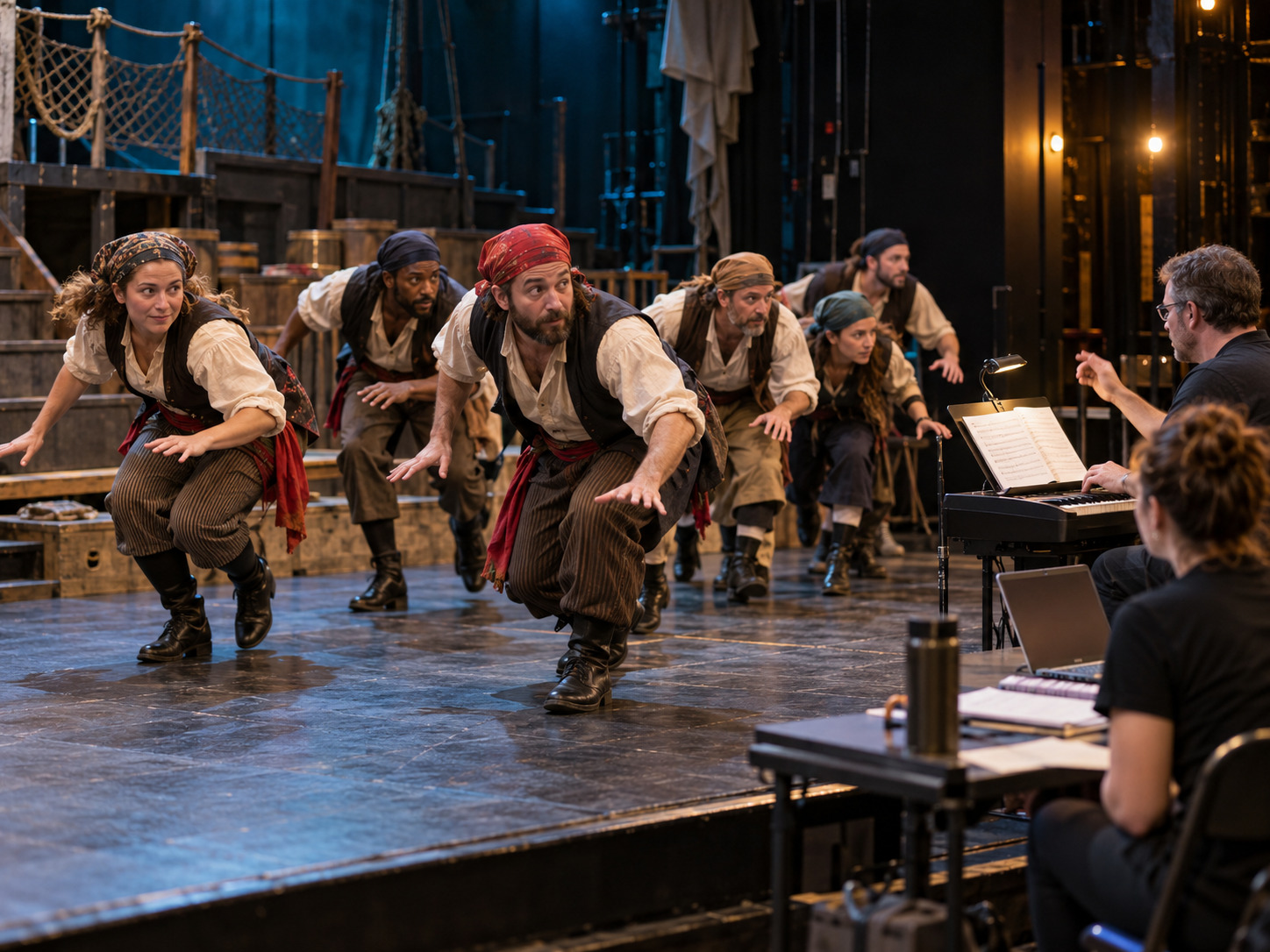
Check sightlines from both sides of the room. A funny reaction that is hidden behind another performer does not help the scene, and a formation that looks balanced from the center may stack faces from the aisle.
Decide where laughter can live
Do not assume an audience will laugh in the same place every night. Identify moments where the scene can breathe without losing the track.
If the accompaniment continues through a likely laugh, the cast should stay inside the pulse and avoid waiting for silence. If a visual joke covers important text, move the joke or simplify it. If the next entrance is exposed, give one performer responsibility for carrying it regardless of the audience response.
The best insurance is not a larger pause. It is a company that knows the next musical landmark.
Rehearse playback as part of the scene
The playback operator needs more than a filename.
Agree on:
- the exact file and version;
- who gives the start cue;
- the playback level in the room;
- whether any scene sound happens before the track;
- what the operator does if the stage is not ready;
- and the final blackout, applause hold, or transition.
Test the file through the actual sound system while the full company is moving. Costumes, scenery, and audience bodies can change what singers hear. If the cast loses the pulse in one area, adjust monitoring or formation before asking everyone to push vocally.
The product page currently separates personal use from theater use and notes that the theater license covers the Broadwaytrax recording, while show performance permission is separate. Confirm the requirements for your production before performance. The (Broadwaytrax guide to backing tracks and grand rights) explains that distinction in more detail.
A focused rehearsal sequence
Use this order when time is limited:
- Speak the scene rule and mark the ending picture.
- Run the text in rhythm with no staging.
- Sing with one shared physical pulse.
- Mark four or five accompaniment landmarks.
- Walk the traffic pattern with the track.
- Add comic business one layer at a time.
- Run from the start cue through the final silence.
- Watch once from the audience position and repair only what is unclear.
One disciplined pass of each layer is more useful than repeating the complete number while the same entrance keeps drifting.
Questions directors and music directors ask
Should the ensemble actually sing softly?
Use a controlled dynamic that preserves pitch and text. The exact balance depends on the arrangement, room, microphones, and staging. Quiet intention should not become unsupported or inaudible singing.
How do we keep synchronized movement from looking mechanical?
Synchronize the musical landmarks, not every gesture. Give performers shared starts, stops, and direction changes, then leave room for individual reactions inside that structure.
What if the company falls behind the track?
Identify the first missed landmark. Strip away movement, restore the pulse and text, then rebuild from that point. Restarting the whole number without a diagnosis usually rehearses the same drift again.
Can the track be changed for our staging?
The product page provides a customization route for key, tempo, and cut requests. Describe the exact musical change and staging reason, then confirm the available options and delivery timing for the current project.
The takeaway
Ready to rehearse the ensemble with one dependable musical foundation? Preview the Broadwaytrax accompaniment track, then confirm the version and use option that fits your production.
Preview With Cat-Like Tread“With Cat-Like Tread” does not need random sneaking. It needs a company that is musically together enough to look gloriously bad at being quiet.
Set the comic rule, protect the pulse, make the diction travel, map the accompaniment, and add business only after the ensemble can move as one. The tighter the preparation underneath the scene, the freer the comedy can feel.