“There’s a Fine, Fine Line” Lands When the Decision Comes First
By Broadwaytrax Content Studio · October 9, 2026
Updated October 12, 2026
The short answer: rehearse “There’s a Fine, Fine Line” as a decision that becomes unavoidable, not as a belt number that begins sad and ends louder. The accompaniment gives the singer a fixed musical path. The performance becomes specific when every phrase changes what the character understands, the silences stay active, and the final thought feels earned.
That makes the song especially useful for solo rehearsal. There is no scene partner to create the turn for the performer, but the scene still needs one. Before adding volume, blocking, or a microphone, build a clear sequence of discoveries that can live inside the track.
Bring "“There’s a Fine, Fine Line” Lands When the Decision Comes First" to life with custom tracks
Get the exact arrangement you need—either customize an existing accompaniment or commission a bespoke build from our team.
Don't see this show in our library yet? We'll build it for you.Name the decision before you sing
Start with one plain sentence: what has the character decided by the end that they could not admit at the beginning?
Keep the answer playable. “She feels sad” describes a mood. “She stops bargaining with a relationship that cannot meet her” describes an action and a change. Your production may frame the moment differently, but the singer should know what finally becomes clear.
Then divide the song into three broad jobs:
- Test the old explanation. The character is still checking whether the situation can be understood another way.
- Notice the evidence. Each musical turn makes the old explanation harder to defend.
- Choose what happens next. The ending is not only emotional release; it is the cost of clarity.
Speak the text as a short scene before singing. Do not imitate the melody. Let the thought change the pace naturally. If every sentence has the same emotional weight, the song will feel generalized when the track begins.
Let the accompaniment become the scene partner
With a backing track, the singer cannot ask the pianist to wait for an extra breath or follow a new pause on the spot. That is not a limitation when the musical map is understood. It gives the performer something dependable to listen against.
Run the accompaniment once without singing and mark:
- the first sound that establishes the emotional temperature;
- every place the harmony or texture changes the pressure;
- the point where the singer can no longer return to the opening idea;
- the final musical arrival;
- the amount of sound or silence after the last vocal phrase.
On the next run, ask the singer to listen through each instrumental moment rather than waiting to resume. A held chord may feel like resistance. A transition may feel like the thought catching up. An ending may require the actor to stay present after the voice stops.
This is how a fixed track begins to feel responsive: the performer knows what the music is doing and allows it to affect the scene.
Rehearse the quiet phrases at full intention
Soft singing can become vague when “quiet” is treated as the objective. Give each restrained phrase a strong verb instead: persuade, test, dismiss, protect, confess, or release. The sound can remain contained while the action becomes clear.
Try one pass at speaking volume with no added emotional color. Make every sentence understandable from the back of the room. Then sing at half volume while keeping the same consonants, breath direction, and target. Only after that should you add the fuller vocal moments.
Record from audience distance. Listen for whether the beginning communicates a specific problem before the larger phrases arrive. If the early section disappears, do not automatically raise the microphone. Check whether the singer has dropped the intention, shortened the breath, or turned away on an important word.
Build the turn without announcing it
The most satisfying turn often begins before the audience can label it. Instead of placing one large emotional marker on a single phrase, identify the small pieces of evidence that accumulate.
Use a three-column rehearsal note:
| Musical moment | What the character notices | What changes physically |
|---|---|---|
| Opening section | The old explanation is still available | Guarded, contained focus |
| Middle turn | The contradiction becomes harder to ignore | Breath or focus shifts |
| Final section | The decision is now necessary | Simpler, more direct presence |
Keep the physical changes modest. A different eye line, a released hand, or a step that finally commits can be more readable than continuous movement. The performer should not illustrate every phrase.
If the actor reaches the final emotional state too soon, return to the first column. Ask what evidence has not yet arrived. The song needs somewhere to go.
Treat breath as thought, not recovery
Mark breaths with the exact accompaniment. A breath can do three jobs at once: support the voice, let an idea land, and prepare the next choice.
For each marked breath, ask:
- What did the character just learn?
- Who or what are they listening to now?
- Does the next phrase continue the same tactic or begin a new one?
Avoid stealing time from the next entrance by making every breath emotionally large. Some breaths should be almost invisible. Others may be the instant when the scene changes. The track will tell you how much space is actually available.
If the singer repeatedly feels rushed, rehearse the two phrases around the breath in rhythm without pitch. Confirm the consonant releases and the exact re-entry. A custom edit may help when a production has a specific cut or cue need, but first make sure the problem is not an unclear breath plan.
Keep the room visually simple
This number does not need constant traffic to feel theatrical. Choose one primary focus and one meaningful change of focus. If the staging uses a chair, platform, or practical object, decide why the character approaches or leaves it.
Run the song once with the actor standing in one place. If the scene becomes clearer, any later movement has to earn its place. Add only what helps the audience understand the shift.
For a self-tape or audition, the same rule applies in a smaller frame. Keep the playback speaker outside the shot, test the balance through the actual recording device, and let the eyes reveal the changing thought without inventing an unseen scene partner who pulls focus from the song.
Broadwaytrax’s guide to (self-tape backing-track setup) offers a practical way to test the lead-in, vocal balance, and ending before the final take.
Use one approved rehearsal file
The (Broadwaytrax Avenue Q album) includes both guide-vocal and accompaniment versions of “There’s a Fine, Fine Line.” The catalog describes the album as a re-recording in the original show key and show tempo and notes that some selections may include background vocals.
Use the guide vocal while learning the musical shape, then move to the accompaniment version early enough that the singer owns every entrance. Do not alternate casually among several online files with different timings.
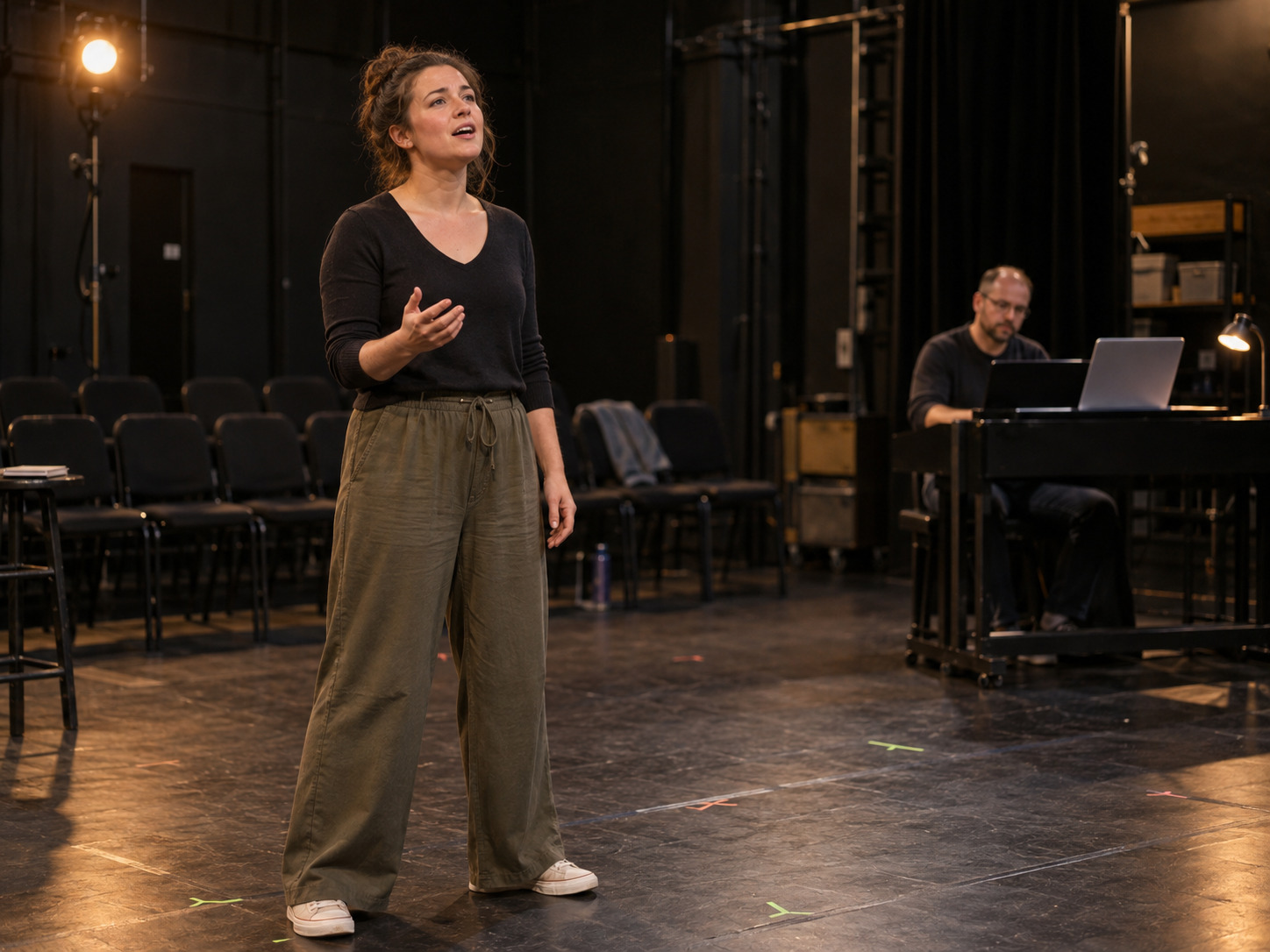
Name the approved file clearly and keep the same version in coaching, staging, sound check, and performance. If the production needs a different key, cut, tempo, lead-in, or ending, settle the change before late rehearsals. Broadwaytrax (custom track services) can shape those practical details around the singer and the room.
For a staged production, also confirm theatrical performance rights for the show with the appropriate publisher or licensing organization. A license to use a sound recording is separate from the right to present the musical. The Broadwaytrax guide to (theater use and grand rights) explains that planning distinction.
A 25-minute rehearsal plan
Minutes 0–4: state the decision
Speak the scene and name what becomes undeniable by the end.
Minutes 4–8: listen to the track
Mark the opening temperature, musical turns, point of no return, and ending.
Minutes 8–13: rehearse the quiet action
Sing at half volume with active verbs, clear consonants, and a specific target.
Minutes 13–17: build the turn
Loop the middle transition. Let several small discoveries accumulate instead of announcing one large change.
Minutes 17–21: mark breath and focus
Confirm each breath, eye line, and any physical change against the accompaniment.
Minutes 21–25: run without stopping
Record from the audience or camera position. Note only the two changes that will most clarify the next pass.
Common problems and practical fixes
The singer begins at the emotional ending
Return to the opening explanation. Make it genuinely possible before the evidence starts to change it.
The quiet phrases lose the room
Strengthen the action and breath direction before adding volume. Quiet singing still needs a clear destination.
The performance waits during instrumental moments
Write what the character hears or understands in each transition. Listening is part of the scene.
The final section becomes only a vocal event
Reconnect the sound to the decision. The largest phrase should complete the dramatic thought, not replace it.
The track and singer never seem to breathe together
Rehearse the exact file, mark the available breaths, and stop switching among versions with different timing.
FAQ: rehearsing “There’s a Fine, Fine Line” with a backing track
Should a singer learn from the guide vocal or accompaniment track?
Use the guide vocal to learn entrances, shape, and style. Move to the accompaniment track early so the singer no longer depends on another voice to lead the phrase.
Does a fixed backing track make the acting less flexible?
No. The musical timing is fixed, but the listening, target, thought, and physical response remain alive. Flexibility comes from specific choices inside the shared map.
How much movement does the song need?
Only enough to reveal the change. Start with stillness, then add one or two motivated shifts if they make the decision clearer.
What should a playback operator know?
The approved filename, exact start cue, microphone state, ending, next transition, and backup device. The operator should rehearse with the performer rather than testing the file alone.
Can the track be changed for an audition or production?
Preview the Avenue Q album’s guide-vocal and accompaniment versions, then move to one approved rehearsal file and build the dramatic turn against a dependable musical map.
Preview the Avenue Q TracksBroadwaytrax offers custom keys, cuts, tempos, lead-ins, and other production adjustments. For a staged show, confirm that any musical change also fits the permissions and approved materials from the show’s rights holder.
When the singer knows what changes, the backing track stops feeling like a timer. It becomes the reliable pressure underneath the scene. Keep the opening honest, let the evidence accumulate, and allow the final sound to complete a decision the audience has watched become necessary.