“Giants in the Sky” Needs Discovery Before Speed
By Broadwaytrax Content Studio · October 27, 2026
Updated October 28, 2026
The short answer: rehearse “Giants in the Sky” as a discovery that keeps changing the performer, not as a race through difficult notes. The accompaniment has to remain a dependable map while the singer makes each new image feel immediate, keeps the text intelligible, and arrives at the ending with a different understanding than at the start.
For an audition, voice lesson, or production rehearsal, that means separating three jobs: learn the musical map, find the story beats, and then join them without letting excitement turn into speed.
Bring "“Giants in the Sky” Needs Discovery Before Speed" to life with custom tracks
Get the exact arrangement you need—either customize an existing accompaniment or commission a bespoke build from our team.
Don't see this show in our library yet? We'll build it for you.Begin with what changed
The number works because the character is trying to make sense of an experience that was thrilling, frightening, and larger than anything familiar. A useful first rehearsal question is not “How fast can we sing it?” It is “What does the performer understand now that was impossible to understand before?”
Write a short verb beside each section of the track. The verbs might move through actions such as remembering, warning, boasting, confessing, and deciding. They do not need to be the same for every performer. They need to create a clear sequence.
That sequence keeps the song from becoming one long excited color. It also gives the singer a reason to change focus, breath, and physical energy without inventing extra movement.
Learn the accompaniment before adding speed
Fast text feels safer when the singer knows what the band is doing underneath it. Start with the (guide-vocal version of “Giants in the Sky”) to identify entrances, releases, and the shape of longer phrases. Then move to the (accompaniment track) before the sung model becomes a crutch.
Use a three-pass process:
- Map: listen without singing and mark every entrance, instrumental turn, and place where the musical energy changes.
- Speak: deliver the text in rhythm over the accompaniment, keeping consonants light enough that they do not slow the line.
- Sing: add pitch while preserving the same thought changes and rhythmic clarity.
If the singer loses the track during the speaking pass, adding vocal intensity will not solve the problem. Return to the exact transition, hear the accompaniment cue, and restart from one phrase before it.
Let the images arrive one at a time
A performer can know the full story and still act as though each remembered image is arriving for the first time. Give each section one visual target in the room. The target might be another actor, a place above the audience, or a practical piece of scenery.
Change focus only when the thought changes. Constant scanning makes the storytelling look general. A held focus lets the audience see that the performer is actually picturing something.
This is especially useful on a community-theater stage where the set may suggest a forest without literally showing every location. The performer supplies scale through attention: how far away the remembered world feels, how high it seemed, and how the familiar world looks after returning.
Keep urgency separate from rushing
Urgency is dramatic. Rushing is usually a coordination problem.
When a passage begins to run ahead of the backing track, check these points:
- Is the singer taking the planned breath, or stealing several small breaths that disturb the pulse?
- Are consonants landing before the beat rather than on top of it?
- Is a physical gesture pulling the phrase faster?
- Does the performer know which instrumental sound confirms the next entrance?
- Is the singer trying to make every word equally important?
Choose two or three important words in each section and allow the surrounding language to travel toward them. That makes the text clearer without punching every syllable.
For a difficult transition, loop the smallest useful section. Run it once at speaking volume, once while marking the melody, and once at performance energy. Then put it back into the complete musical phrase. A clean eight-bar repair is more useful than repeating the whole song with the same mistake.
Build the physical journey around the musical one
The staging should reveal change, not decorate the accompaniment. Start from a grounded position that fits the scene. Add movement when a new idea actually requires it.
A simple rehearsal plan can use three physical zones:
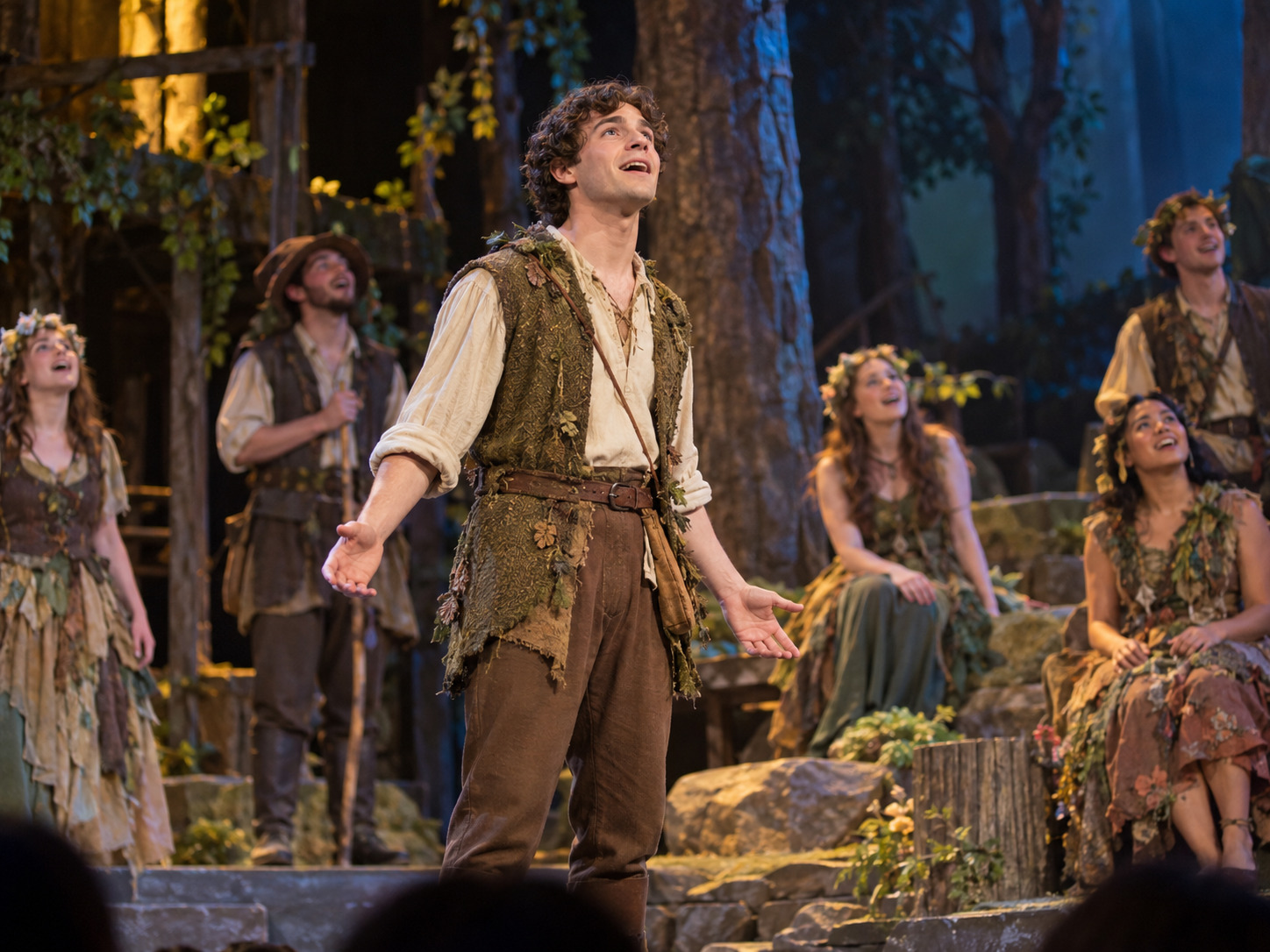
- Home: the familiar world and the person the character was before the adventure.
- Discovery: the remembered scale and danger of the new world.
- After: the place where excitement and consequence can exist at the same time.
The performer does not need to visit all three zones literally. The map gives the director and actor a shared vocabulary. If a cross, turn, climb, or level change blurs an entrance, simplify the movement until the music and story agree.
Give the playback operator a story cue
The operator needs more than the file name. Write the exact start cue, confirm whether the singer receives the complete introduction, and identify the ending behavior.
For rehearsal, note:
- the final approved file name;
- whether the run uses the guide vocal or accompaniment version;
- who signals the start;
- the first vocal entrance;
- any planned stop-and-reset point;
- and the backup file location.
The Broadwaytrax (Into the Woods full album) includes guide-vocal and accompaniment versions across the show, which makes consistent file labeling especially important. Keep rehearsal versions and performance versions in separate folders so the booth never has to guess.
A ten-minute rehearsal sequence
Use this compact sequence when the number needs clarity more than another full run:
- Speak the first section in rhythm over the accompaniment.
- Mark the melody while pointing to each written story verb.
- Sing the difficult transition at three-quarter physical energy.
- Run the same transition with the intended focus and movement.
- Start one phrase earlier and continue one phrase later.
- Finish with one uninterrupted run, then name only one adjustment for next time.
That last rule matters. A rapid song can attract a long list of corrections. One precise note gives the performer something they can actually change on the next pass.
FAQ: rehearsing “Giants in the Sky” with a backing track
Should the singer practice with the guide vocal or accompaniment track?
Use the guide vocal while learning the musical map, then move to accompaniment-only practice early enough that the singer can carry the melody, text, and entrances independently.
What usually makes the number feel rushed?
Unplanned breaths, equally stressed words, movement that pulls against the pulse, and uncertainty about accompaniment cues are common causes. Repair the smallest transition first instead of simply demanding a slower-feeling performance.
Can the track be adjusted for a different key, cut, or tempo?
Broadwaytrax lists customization options for key changes, tempo edits, and cuts on the accompaniment-track page. Any production change should also remain consistent with the show materials and permissions supplied by the appropriate rights holder.
Does the track license replace permission to perform Into the Woods?
No. Permission to use a sound recording and permission to perform a copyrighted musical are separate. Confirm show rights with the publisher or licensing house and recording-use terms for the track.
The takeaway
Preview the accompaniment track, compare the matching guide-vocal version, and confirm the key, cut, tempo, and use option your rehearsal or production needs.
Preview Giants in the SkyThe number becomes exciting when discovery stays clear. Let the performer learn the accompaniment, assign a playable change to each section, keep urgency inside the pulse, and make every physical choice serve the remembered journey.
When the musical map is dependable, the singer can stop chasing the track and let the audience experience the story in real time.