Let “Suddenly Seymour” Become a Real Conversation
By Broadwaytrax Content Studio · October 22, 2026
Updated October 22, 2026
The short answer: rehearse “Suddenly Seymour” as two people learning to trust what the other is saying, not as a duet that begins softly and waits for the big final notes. Give each singer a clear objective, map every entrance to the accompaniment, build the shared sound in stages, and keep the ending connected to the scene.
Broadwaytrax offers both a (“Suddenly Seymour” accompaniment track) and the complete (Little Shop of Horrors album). The album pairs guide-vocal demonstrations with accompaniment versions, which makes it useful for moving from note learning into scene work without changing the musical map.
Bring "Let “Suddenly Seymour” Become a Real Conversation" to life with custom tracks
Get the exact arrangement you need—either customize an existing accompaniment or commission a bespoke build from our team.
Don't see this show in our library yet? We'll build it for you.Begin with what each person needs
The scene becomes generic when both performers are asked only to “feel more” or “sing bigger.” Emotion is easier to repeat when it grows from a playable need.
Before singing, complete one sentence for each character:
- I need you to believe ______.
- I need you to let me ______.
- I need to risk saying ______ before the music ends.
The answers should create a relationship, not two private performances. Speak the scene in order without accompaniment. Let every response be changed by what the other person just offered.
If a line sounds beautiful but does not affect the partner, return to the objective. The duet works when the audience can follow trust changing in real time.
Learn the entrances as responses
An entrance is more reliable when the singer knows both the musical cue and the thought that causes it.
Listen through the accompaniment and mark:
- the first audible cue for each singer;
- the first place the second voice changes the scene;
- every handoff where one thought finishes and another begins;
- the first sustained section that needs coordinated breath and balance;
- the point where the duet becomes a shared statement;
- one safe restart point;
- and the final release.
Name cues by sound rather than approximate time. “After the piano figure” or “with the next orchestral lift” survives a rehearsal-room restart better than a timestamp.
Practice each entrance with the line or breath that precedes it. Do not begin with the singer already prepared in a neutral position. The entrance should grow from listening.
Use the guide vocal, then remove it early
A guide vocal can clarify melody, rhythm, diction, and the relationship between parts. It should not become the permanent scene partner.
Use a simple progression:
| Rehearsal pass | Primary job |
|---|---|
| Guide vocal | Confirm melody, rhythm, and entrances |
| Accompaniment while marking | Own the words and hear the partner |
| Accompaniment with staging | Connect movement to musical landmarks |
| Performance run | Use the exact approved file and cue plan |
Switch to accompaniment once the singers can enter independently. If the guide vocal stays too long, performers may copy phrasing without deciding what the words are doing in this production.
When a section breaks down, return only to the smallest useful guide-vocal passage. Then repeat it immediately with accompaniment so the repair belongs to the performers.
Build two voices before building one sound
Blend does not mean erasing the characters. The audience should still hear two people with different histories and needs.
Rehearse the early sections for individual clarity:
- consonants that keep the text understandable;
- vowels that stay comfortable rather than imitating a recording;
- phrase endings that reveal whether the thought is complete;
- breaths chosen for meaning as well as stamina;
- and dynamics that leave room for the partner’s response.
When the voices join, choose what should align and what should remain distinct. Shared rhythm, vowel shape, cutoff, and destination can create unity without forcing identical color.
Record from the audience area. A blend that feels balanced beside the piano may cover one singer in the room. Adjust playback and microphone levels before asking either performer to push.
Keep the vocal build healthy
This number invites a broad emotional and musical build, but the rehearsal plan should not depend on repeated maximum-volume runs.
Work in sections and alternate full singing with marking. Save complete high-energy passes for moments when entrances, breath choices, balance, and staging are already stable. If a phrase regularly causes pain, loss of control, or speaking discomfort, stop and involve the music director, vocal coach, or qualified voice teacher.
Useful intensity can come from:
- a more direct eyeline;
- a faster decision;
- greater stillness;
- clearer consonants;
- a fuller but unforced vowel;
- or the willingness to receive the partner’s next thought.
Volume is only one color. The strongest build often comes from the relationship becoming less guarded.
Stage the listening
Duets lose focus when both singers face front for every phrase or move continuously because the music is growing.
Give the scene a small physical map:
- where each performer begins;
- when the first direct look happens;
- which person closes or creates distance;
- where a shared focus becomes appropriate;
- and what physical event belongs to the final chord.
Movement should follow a change in the relationship. If a cross, touch, turn, or level change is planned, run the musical cue that makes the action possible. The performers should not have to choose between completing the movement and hearing the next entrance.
Check the scene from multiple audience angles. A quiet exchange that reads from the center may disappear from the side if one face is blocked or an eyeline turns away too long.
Plan the rise in three stages
Treat the duet as a progression instead of one continuous crescendo.
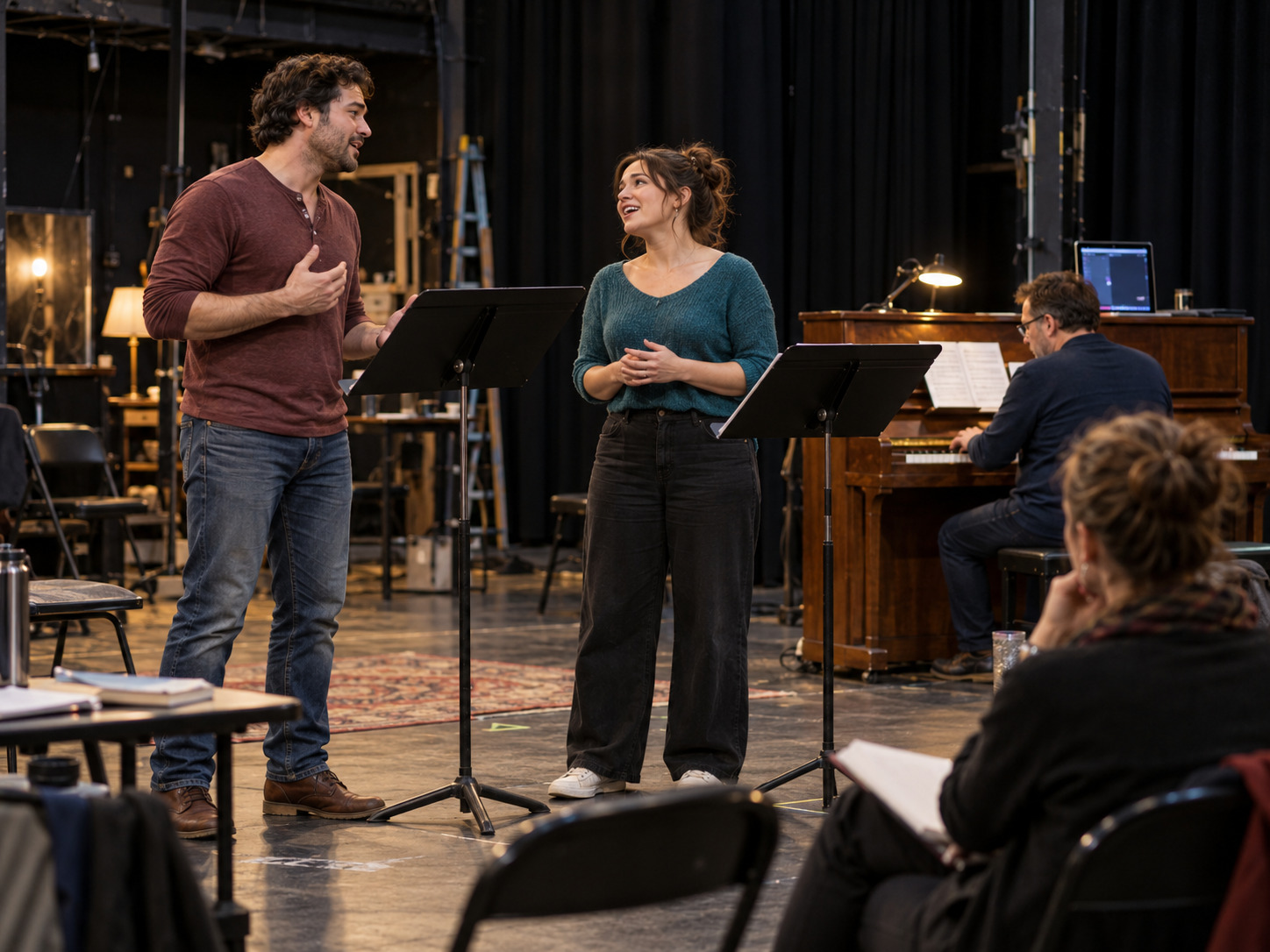
Recognition
Both people are testing whether honesty is safe. Keep the text forward and allow space for listening.
Permission
The responses become less guarded. Let the accompaniment support a wider sound while preserving the words.
Shared choice
The final section earns its scale because both people now understand what they are choosing. Coordinate breath, balance, staging, and the last release so the ending is one dramatic event.
The production may describe those stages differently. What matters is that the music grows because the scene changes—not because the cast has reached the loud part of the track.
Rehearse the handoff into and out of the song
The operator should never meet the number at the first sung word.
Run the complete lead-in:
- the preceding dialogue or stage action;
- the cue owner’s signal;
- the accompaniment start;
- each first entrance;
- and the first complete exchange.
Then rehearse the ending through the next event. Hold the final chord and release, confirm the lighting or stage action, and continue into the next line or transition. A beautiful final note still feels unfinished when no one knows what happens after it.
Give the playback operator one approved file, a plain-language GO, a tested level, a safe restart point, and a backup stored locally. Keep guide-vocal files out of the performance folder.
If the production needs a different key, cut, tempo, lead-in, or ending, test the full scene before requesting the change. Broadwaytrax can (customize an existing track) around a specific approved rehearsal need.
A focused 25-minute duet rehearsal
Minutes 1–5: speak and listen
Name each objective and speak the exchange without music. Make every response depend on the partner.
Minutes 6–10: map the entrances
Use the track to identify each cue, handoff, shared section, restart point, and ending.
Minutes 11–15: sing without staging
Confirm healthy vocal choices, text, breaths, and balance with accompaniment.
Minutes 16–20: add the physical map
Set the first direct look, distance changes, shared focus, and final picture.
Minutes 21–25: run the complete scene
Begin from the real lead-in and continue past the final chord. Choose one specific repair.
Final checklist
- Each singer has a playable objective.
- Entrances are tied to musical cues and partner responses.
- Guide vocals support learning but are not used as a performance crutch.
- Individual character remains clear when the voices join.
- The vocal build can be repeated without pain or forced sound.
- Playback and microphone levels support both singers.
- Movement follows changes in the relationship.
- The final section grows because the scene has changed.
- The real start cue, restart point, ending, and next event are rehearsed.
- One approved accompaniment file and a tested backup are ready.
- Show rights and permission to use the recording have been handled separately.
FAQ: rehearsing “Suddenly Seymour” with a backing track
Should the singers learn with the guide vocal or accompaniment track?
Use the guide vocal to establish notes, rhythm, and entrances, then move to accompaniment early enough that both performers must listen and make their own choices.
How do we keep the duet from becoming two solos?
Give each entrance a partner-based cause. Rehearse the exchange as responses, set clear eyelines, and make shared sections the result of a relationship change.
What if one singer disappears under the track?
Check the playback level and microphone balance from the audience area before asking the singer to add volume. Clarify text, vowel, breath, and placement with the music team.
Can the track be changed for our production?
Broadwaytrax offers custom keys, cuts, tempos, lead-ins, cues, and endings. Confirm that the requested change fits the production’s licensed materials before ordering it.
Does a theater-use track license replace permission to stage the show?
Preview the Broadwaytrax Suddenly Seymour accompaniment track, then use one dependable musical map to rehearse entrances, partner listening, staging, and the final shared build.
Preview the Suddenly Seymour TrackNo. Permission to use a recording and permission to present the musical are separate. The (Broadwaytrax licensing guide) explains the distinction in practical terms.
The goal is not merely a bigger finish. It is a duet in which every entrance, breath, look, and musical lift shows two people becoming brave enough to hear each other.