“Skid Row” Works When Three Worlds Share One Pulse
By Broadwaytrax Content Studio · October 23, 2026
Updated October 23, 2026
The short answer: rehearse “Skid Row (Downtown)” as several lives colliding inside one shared pulse. Keep the street trio rhythmically precise, give the principal characters distinct needs, and let the ensemble build a place around them without turning the number into one undifferentiated wall of sound.
Broadwaytrax offers both a (“Skid Row (Downtown)” accompaniment track) and the complete (Little Shop of Horrors album). The album includes guide-vocal demonstrations followed by accompaniment versions, so a cast can learn its musical map and then remove the recorded voices before staging and performance work.
Bring "“Skid Row” Works When Three Worlds Share One Pulse" to life with custom tracks
Get the exact arrangement you need—either customize an existing accompaniment or commission a bespoke build from our team.
Don't see this show in our library yet? We'll build it for you.Give each group a different job
An ensemble opening can lose detail when everyone receives the same note: “more energy.” Energy becomes repeatable when each group knows what it contributes.
Use three rehearsal lanes:
| Group | Primary rehearsal job |
|---|---|
| Street trio | Establish style, pulse, and the audience's way into the world |
| Principal characters | Pursue individual needs without stepping outside the musical clock |
| Ensemble | Make the neighborhood feel specific through shared rhythm and distinct reactions |
Speak through the scene before singing. Ask every performer to complete two sentences: “I need ______ today” and “This place keeps me from ______.” The answers should be playable and visible, not a general mood.
When the music starts, those needs remain active. The track supplies a fixed shape; the cast supplies the people who live inside it.
Build one pulse before adding layers
The number needs drive, but drive is not the same as speed. A cast that rushes will usually lose consonants, entrances, and the contrast between groups.
Begin with the accompaniment at a moderate rehearsal volume. Have the cast step or mark the underlying pulse without singing. Then add short passages in layers:
- street trio alone;
- principal entrances alone;
- ensemble rhythm and text;
- two groups together;
- the complete company.
If the full sound pulls ahead, remove voices until the pulse settles. Then rebuild. Do not ask the operator to chase the cast by changing playback speed in the room.
Name useful musical landmarks by sound rather than approximate timestamps. A cue such as “after the guitar figure” or “with the next orchestral lift” is easier to recover after a restart than “around thirty seconds in.”
Let the street trio lead without covering the story
The street trio often gives the audience style, focus, and forward motion. That leadership works best when it remains connected to the people and events around it.
Rehearse the trio for:
- consonants that arrive together;
- shared releases that do not clip the phrase;
- a consistent rhythmic placement;
- eye focus that directs attention rather than competing for it;
- and enough dynamic space for principal text to remain understandable.
Then add the principals while the trio marks. Ask whether the trio's sound still frames the action or has become the action. Restore full singing only when both layers remain clear.
From the audience area, listen for the words that carry story information. If they disappear, check ensemble balance and diction before adding microphone gain.
Keep every ensemble member specific
“Crowd” is not a playable character. Give ensemble performers concrete relationships and daily circumstances.
One person may be late for work. Another may be protecting a small space. Someone else may know every piece of neighborhood news. Those choices do not need elaborate backstory; they need to affect timing, eyelines, spacing, and reactions.
Use a reaction map for major musical changes:
- Who notices the change first?
- Who refuses to notice?
- Which relationships pull people together or apart?
- Where does the room become more crowded?
- Which image should the audience understand before the next entrance?
Run the map once without singing. Then add accompaniment and let reactions land on musical events. The goal is not synchronized pantomime. It is a neighborhood that changes together while remaining populated by individuals.
Protect the principal stories inside the company sound
Principal performers can disappear when they try to out-sing the ensemble instead of pursuing a clear objective.
Give each principal a simple arc through the number:
- what the person wants at the start;
- what the surrounding world makes difficult;
- the moment the want becomes more urgent;
- and the choice carried into the next scene.
Rehearse principal passages first with accompaniment and only the nearest scene partners. Add the ensemble in sections while protecting text, breath, and eyelines.
If the singer becomes vocally tense as the room fills, lower playback and ensemble volume before asking for a larger principal sound. Dramatic importance can come from stillness, focus, or a faster decision—not only loudness.
Move from guide vocal to accompaniment on purpose
The guide-vocal version can clarify entrances, melody, harmony, and style. It should be a teaching step, not the permanent leader of the room.
Use this progression:
| Pass | What to prove |
|---|---|
| Guide vocal | Everyone can locate the form and personal entrances |
| Guide vocal in short sections | Difficult text and layered entrances become accurate |
| Accompaniment while marking | Performers can carry their lines without the demonstration voices |
| Accompaniment with staging | Movement, reactions, and spacing stay inside the musical map |
| Performance file | Cast and operator can run the complete cue reliably |
When a passage breaks, return to the smallest useful guide-vocal section. Repeat it immediately with accompaniment so the repair belongs to the cast.
Keep guide tracks outside the performance folder. The sound operator should see only the approved files that may be played for the audience.
Stage traffic without losing entrances
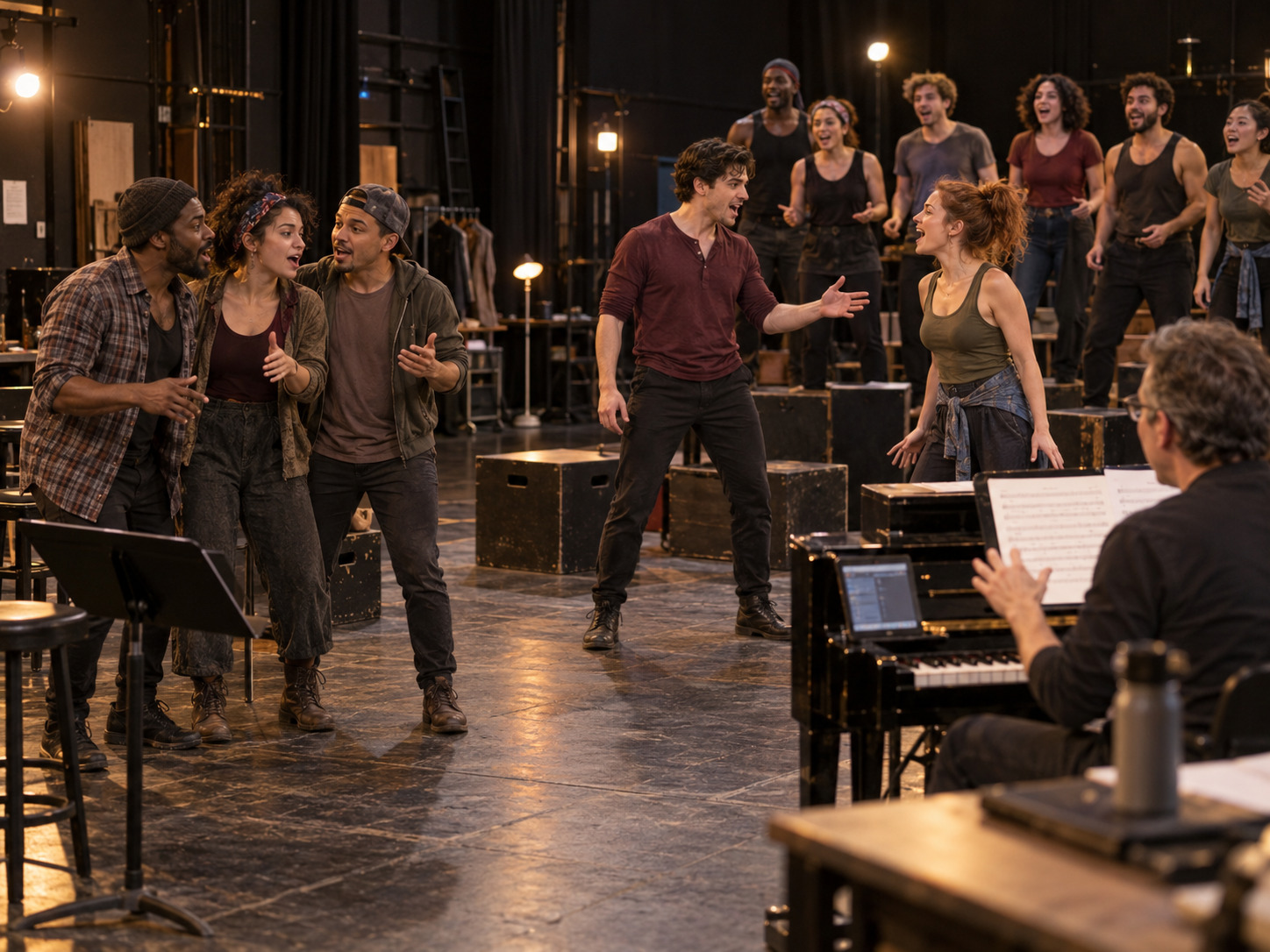
Large ensemble numbers often fail at the intersection of movement and music. A performer crosses behind scenery, changes levels, or turns away just before a pickup.
For every important entrance, verify:
- where the performer is standing;
- what the performer can hear;
- whether the music director is visible;
- what physical action happens immediately before the breath;
- and which musical sound confirms the entrance.
Run the most difficult eight or sixteen bars from every actual position. Do not test entrances only from a neutral line at the front of the room.
Keep traffic readable. If two crossing patterns obscure the principal story, simplify one. The audience should understand the place and the people without needing to decode every movement.
Give the playback operator a scene, not just a file
The operator's cue begins before the first note.
Rehearse the complete handoff:
- preceding dialogue or stage action;
- the exact cue owner's
GO; - track start and first audible sound;
- first vocal entrance;
- any planned level change;
- final button or release;
- the next line, light cue, or transition.
Give the operator one approved filename, a tested house level, one safe restart point, and a local backup on a second tested device. If scenery or audience noise could mask the intro, test that condition during a run rather than assuming the cast will hear it.
If the production needs a different key, cut, tempo, lead-in, vamp, or ending, document the exact staging problem before requesting the change. Broadwaytrax can (customize an existing track) around a confirmed production need.
A focused 30-minute ensemble rehearsal
Minutes 1–5: name the worlds
Define the trio, principal, and ensemble jobs. Speak the scene with specific objectives.
Minutes 6–10: establish the pulse
Mark the accompaniment, identify landmarks, and stop any tendency to rush.
Minutes 11–16: layer the voices
Build from trio to principals to ensemble. Protect text and releases.
Minutes 17–22: add reactions and traffic
Run the reaction map, crossings, levels, and real entrance positions.
Minutes 23–27: balance the room
Listen from several audience locations and adjust playback, ensemble, and microphone levels.
Minutes 28–30: run the handoff
Begin before the cue and continue into the next scene. Choose one repair for the next rehearsal.
Final checklist
- Street trio, principals, and ensemble have distinct jobs.
- The company shares one pulse without rushing.
- Story text remains understandable inside the full sound.
- Guide vocals have been removed from staging and performance runs.
- Reactions and traffic land on musical events without looking mechanical.
- Principal objectives remain active inside the ensemble.
- Every important entrance works from its actual stage position.
- Playback supports the cast without covering the words.
- One approved performance file and a tested backup are ready.
- The opening cue, ending, and next scene have been rehearsed together.
- Show rights and recording-use permissions have been confirmed separately.
FAQ: rehearsing “Skid Row” with backing tracks
Should the cast begin with the guide-vocal version?
Use it early to learn form, entrances, melody, harmony, and style. Move to the accompaniment track as soon as performers can carry their own lines.
How do we stop the ensemble from rushing?
Mark the underlying pulse, rehearse groups separately, and rebuild the texture in layers. Ask performers to hear a specific instrumental landmark rather than pushing toward the next lyric.
How loud should the backing track be?
Loud enough for the cast to hear pulse and entrances, but low enough that the audience understands the words. Check from several seats, not only beside the mixer.
Should every ensemble member have detailed backstory?
No. A specific need, relationship, and reaction path are enough. The choice should change timing, focus, or movement in a visible way.
Can the track be adjusted for our staging?
Preview the Broadwaytrax Skid Row accompaniment track, then give the trio, principals, ensemble, and playback operator one dependable musical map for rehearsal.
Preview the Skid Row TrackBroadwaytrax supports custom keys, cuts, tempos, lead-ins, cues, vamps, and endings. Identify the exact rehearsal or staging need before requesting the change.
The number works when the audience can hear one neighborhood without losing the people inside it. Build the pulse first, layer the voices carefully, and rehearse the track as part of the scene.